
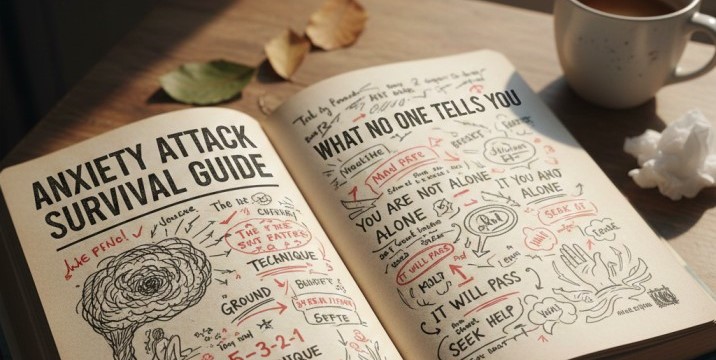
When an anxiety attack hits, logic often flies out the window. Your heart races, your breath shortens, your mind spins with catastrophic thoughts — and no amount of “calm down” seems to help. Yet, what’s most surprising is how much of the real experience and management of panic remains unspoken. Beyond deep breathing and mindfulness apps lies a messy, deeply human side to anxiety attacks that many never discuss.
This guide peels back that silence and explains what no one tells you about surviving anxiety attacks — the physiological truth, what helps in the moment, how to recover afterward, and how to make peace with your anxious mind.
Anxiety attacks, also called panic attacks, occur when your brain interprets normal sensations as threats. The body’s fight-or-flight system goes into overdrive — releasing a surge of adrenaline that triggers rapid heartbeat, chest tightness, sweating, dizziness, and a terrifying sense of losing control.
In this state, your sympathetic nervous system takes charge. Blood is redirected from your digestive tract to your muscles; your breathing quickens to supply oxygen in case you need to “flee.” The body is trying to protect you, not punish you. But the modern mind, confronted with a racing heart rather than a tiger, interprets it as disaster.
Here’s what no one tells you:
Panic is your body misfiring a survival system that was designed for physical danger — not emotional or psychological stress. Once you understand this, you stop fighting the sensations and start riding the wave until it passes.
People often focus only on big stressors like public speaking or relationship conflict. But subtle triggers can quietly prime your brain for panic, including:
Caffeine and sugar spikes: Both can mimic the physiological sensations of anxiety.
Lack of deep sleep: Chronic sleep deprivation heightens cortisol levels and decreases emotional resilience.
Body posture: Slouching compresses the diaphragm, limiting oxygen exchange — this can create breathlessness that the brain misreads as threat.
Inner criticism: Negative self-talk keeps the brain’s anxiety circuits activated even when external stress is low.
Hidden physical issues: Thyroid imbalances, anemia, or perimenopause can amplify anxious responses.
Tracking these subtle factors often reveals patterns you didn’t expect. Many people later realize their “random” panic attacks weren’t random at all — they were brewing quietly for days.
During an anxiety attack, the biggest mistake is trying to stop or suppress it. This inadvertently signals to your brain that something truly dangerous is happening — which intensifies the cycle.
Instead, contain it. Imagine putting a storm in a glass dome — it’s still there, but it can’t spread.
Try this:
Allow the sensations. Think, “This is just a surge of adrenaline; it will peak and pass.”
Label the process: “My body is anxious right now” rather than “I’m dying.”
Anchor your body: Plant your feet, uncross your limbs, and press your palms together. Physical grounding signals safety to the nervous system.
Soften the breath: Instead of deep breathing, which can feel forced, try long, slow exhales — this activates the parasympathetic system that calms the body.
When you stop fighting the storm, you shorten its lifespan.
Textbook advice often stops at “breathe deeply.” But breath alone rarely works in full-blown panic. Here are grounding tools that blend psychology with neuroscience:
Temperature shift: Splash cold water on your face or hold a chilled object. Sudden temperature change slows your heart rate via the vagus nerve.
Micro naming: Silently name five colors, four shapes, three textures, two sounds, one scent. This interrupts the catastrophic spiral and reorients your brain to the present moment.
Pressure reset: Hug a weighted pillow or wrap yourself in a blanket. Deep pressure provides proprioceptive feedback that helps regulate sensory overload.
Verbal anchor: Repeat a calming phrase like “I am safe right now” — not as affirmation, but as orientation. It tells your brain what time and place you’re in.
You’re training your nervous system to re-recognize safety, which panic temporarily deletes.
After the worst passes, you may feel drained, foggy, or emotionally fragile for hours — sometimes even days. That’s because your body just went through an intense adrenaline cycle and now needs to rebalance its chemical messengers (especially serotonin and GABA).
Most people make the mistake of pushing on as if nothing happened. But the aftershock phase is critical for recovery.
What helps:
Rest and hydration: The body has lost fluids through sweating and shallow breathing. Water and a small snack with protein and complex carbs help stabilize blood sugar and serotonin levels.
Gentle movement: A slow walk rebalances cortisol and helps your muscles discharge residual tension.
Quiet time: Avoid overstimulation — no screens, caffeine, or crowded spaces. Your nervous system needs stillness to recalibrate.
Self-soothing, not self-criticism: Understand that anxiety doesn’t mean weakness; it means your threat system is oversensitive from chronic alertness.
Most anxiety attacks don’t last more than 10–15 minutes physiologically. But they feel endless because of mental loops — anxious spirals that re-ignite the body’s fear response.
These include thoughts like:
“What if this never stops?”
“I’ll pass out or go crazy.”
“Everyone will notice.”
“This means I’m unstable.”
Each thought adds fresh fuel to the panic. The key is to spot them as loops, not as reality.
A mental shift helps: observe the thought instead of engaging with it.
For example, instead of “I might faint,” say, “My brain just offered that thought — thank you, brain.” This subtle humor distances your sense of identity from the anxiety itself.
Anxiety resilience builds through small, consistent behaviors rather than major overhauls. Neuroscience shows that daily regulation teaches your amygdala that life is safe more effectively than any single “panic hack.”
Here are practical foundations:
Regulate your sleep-wake cycle. Keep consistent timings even on weekends.
Limit caffeine and nicotine. Both are anxiety accelerators disguised as coping tools.
Exercise moderately. Cardio helps burn off excess adrenaline, while yoga or stretching activates the parasympathetic system.
Eat brain-stabilizing foods. Omega-3s, magnesium, and complex carbs help maintain neurotransmitter balance.
Body-mind scanning. Spend two minutes daily noticing where tension lives in your body. Awareness precedes regulation.
Reduce mental clutter. Digital noise, overcommitment, and multitasking all keep your nervous system in “mild panic” mode.
Over time, these habits reduce not just panic frequency but your baseline anxiety level — you live calmer by default.
If panic episodes start recurring, it may mean your brain’s alarm system has become sensitized through chronic stress, hormonal changes, or trauma. In this case, therapy or medical support can help reset the system.
Cognitive Behavioral Therapy (CBT) teaches you to reinterpret body signals and break the “fear of fear” cycle.
Mindfulness-based approaches such as Acceptance and Commitment Therapy (ACT) train you to accept transient sensations without panic.
Medication, when appropriate, helps calm hyperactive circuits and gives your brain space to relearn safety.
Seeing a professional doesn’t mean you’re “too weak” to self-manage; it means you’re taking an evidence-based route to reset your biology.
Perhaps the most unspoken truth is this: recovery from anxiety attacks is rarely linear. You’ll have good days, setbacks, and moments where you question all progress. But panic recovery is about learning trust — in your body, in your breath, and in your capacity to survive discomfort.
Here’s what rarely gets said but always matters:
You can live fully with anxiety. It doesn’t define or limit you.
Healing is not the absence of fear but the presence of courage.
Each attack you survive re-teaches your brain safety. You’re literally rewiring pathways with every calm recovery.
The goal is regulation, not perfection. Even seasoned therapists have anxious moments — the difference is how quickly they re-anchor.
The day you stop fearing panic, it stops having power.
Many readers find comfort in creating a small, tangible panic survival kit. It’s a reminder that you have tools ready whenever anxiety flares.
Here’s what to include:
A grounding object: A smooth stone, keychain, or any tactile object that anchors touch.
A calming scent: Lavender oil or a familiar perfume that evokes safety.
Water or electrolyte drink: For hydration and grounding through sensory input.
A comfort phrase or mantra: Write it on a small card — something like “This will pass like it always does.”
A breathing guide: A short step-by-step visual (like the 4-7-8 breathing pattern) to cue parasympathetic activation.
Headphones or music playlist: Soothing sounds or nature tracks help reorient attention.
The act of reaching for your kit itself triggers an internal message: I’ve been through this before and I have tools. That confidence interrupts fear at its root.
No one tells you how much shame and isolation come with anxiety attacks — the quiet embarrassment after a public episode, the guilt of “losing control,” the fear it will return. Yet, countless people experience this daily and lead strong, successful lives.
Your anxiety attack is not a personal failure; it’s a survival mechanism that’s gone too far in protecting you. When you start understanding it rather than fighting it, you reclaim control — gently, steadily, one breath at a time.
The truth is, you don’t have to “defeat” anxiety. You only need to befriend your nervous system and guide it home to calm again and again. The more you do, the shorter each storm becomes — until they stop feeling like storms at all.