
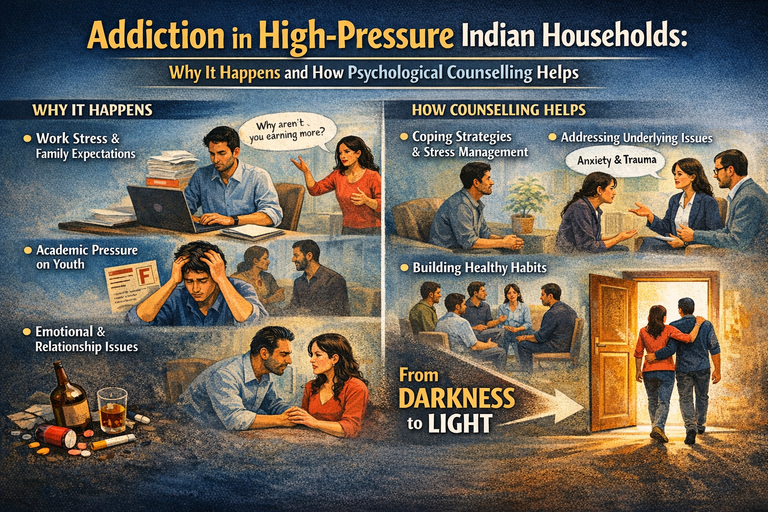
In many Indian households, success is not just encouraged—it is expected. Academic excellence, stable careers, social reputation, and family honour often become non-negotiable goals. While ambition can be healthy, constant pressure without emotional support can silently push individuals toward unhealthy coping mechanisms, including addiction.
Addiction in high-pressure Indian families is more common than openly acknowledged. From alcohol and nicotine to prescription drugs, gaming, and digital addiction, many individuals struggle behind closed doors—often misunderstood as “weak” or “undisciplined.” In reality, addiction is a psychological response to chronic stress, emotional suppression, and unmet needs.
This blog explores why addiction develops in high-pressure Indian households and how psychological counselling plays a crucial role in recovery and long-term healing.
High-pressure environments in Indian families often stem from deeply ingrained cultural and social expectations such as:
Strong emphasis on academic ranks and competitive exams
Pressure to choose “respectable” careers (doctor, engineer, IAS, etc.)
Constant comparison with relatives, neighbours, or siblings
Fear of social judgment (“log kya kahenge?”)
Limited emotional expression or validation
Expectation of obedience rather than individuality
While these pressures may be intended to secure a “better future,” they can unintentionally create chronic stress, anxiety, and emotional isolation, especially in children, adolescents, and young adults.
In many Indian households, emotions like sadness, fear, anger, or confusion are often dismissed:
“It’s all in your head”
“Be strong”
“Others have it worse”
When individuals don’t feel emotionally safe, they suppress feelings rather than process them. Addiction then becomes a way to numb emotional pain or escape overwhelming thoughts.
Constant pressure to perform—academically, professionally, or socially—keeps the nervous system in a state of hyper-alertness. Over time, this leads to:
Anxiety disorders
Sleep problems
Burnout
Low self-worth
Substances or addictive behaviours temporarily reduce stress, making the brain associate addiction with relief—even though it worsens the problem long term.
Many individuals grow up feeling valued only when they succeed. Love, praise, or acceptance may feel conditional on results.
This creates:
Fear of failure
Shame
Perfectionism
Internal pressure to never disappoint
When self-worth depends on achievement, addiction can become a coping strategy during moments of perceived failure or inadequacy.
Mental health struggles are still stigmatized in many Indian families. Symptoms of depression, anxiety, or trauma may go unnoticed or mislabelled as laziness, attitude problems, or lack of discipline.
Without early intervention, individuals may self-medicate through:
Alcohol or smoking
Prescription medication misuse
Internet, gaming, or social media addiction
Food or binge-eating behaviours
High-pressure households may also involve:
Frequent criticism
Harsh parenting styles
Emotional neglect
Intergenerational trauma
Addiction often becomes a maladaptive coping mechanism to deal with unresolved emotional wounds.
Addiction does not always look extreme or obvious. Common forms include:
Alcohol addiction (often normalized socially)
Nicotine and tobacco use
Prescription drug dependence
Internet and gaming addiction
Social media addiction
Food addiction or disordered eating
Behavioral addictions can be just as psychologically damaging as substance-related ones.
A common misconception is that addiction can be stopped through:
Self-control
Strict rules
Scolding or threats
Family pressure
In reality, addiction is not a moral failure—it is a mental health condition involving changes in brain chemistry, emotional regulation, and coping mechanisms.
Without addressing the underlying psychological causes, relapse is common.
Psychological counselling addresses addiction at its root, not just the symptoms.
A trained psychologist helps individuals understand:
What emotional needs are unmet
Which stressors trigger addictive behaviour
How family dynamics influence coping styles
This self-awareness is the first step toward sustainable recovery.
Counselling teaches practical skills to manage stress and emotions, such as:
Emotional regulation techniques
Mindfulness and grounding exercises
Stress management strategies
Assertive communication
These skills replace addiction-based coping with healthier alternatives.
Many individuals struggling with addiction carry deep shame, especially in family-centric cultures like India. Counselling provides a non-judgmental space to process guilt and rebuild self-esteem.
Recovery becomes about healing—not punishment.
In many cases, family counselling is equally important. Therapy can help:
Improve communication
Reduce blame and criticism
Educate families about addiction
Create a supportive home environment
When families shift from control to understanding, recovery outcomes improve significantly.
Counselling focuses on long-term recovery by:
Identifying early warning signs
Building emotional resilience
Creating relapse-prevention plans
Strengthening self-identity beyond achievements
This ensures individuals are equipped to handle future stress without falling back into addiction.
The earlier addiction and emotional distress are addressed, the easier recovery becomes. Seeking psychological help is not a sign of weakness—it is an act of responsibility and self-respect.
For parents, recognizing emotional distress early can prevent long-term mental health struggles in children and adolescents.
To truly address addiction, Indian households must:
Normalize mental health conversations
Encourage emotional expression
Reduce unrealistic expectations
Value effort over outcomes
Seek professional help without stigma
Healing happens not just at the individual level, but within families and communities.
Addiction in high-pressure Indian households is not about lack of discipline or character—it is a psychological response to chronic stress, emotional neglect, and unrelenting expectations. Understanding this truth is essential for real recovery.
Psychological counselling offers individuals and families a structured, compassionate path toward healing—helping them rebuild emotional balance, resilience, and healthier relationships.
If you or someone in your family is struggling with addiction, seeking help early can change lives. Support, understanding, and professional guidance make recovery possible.