
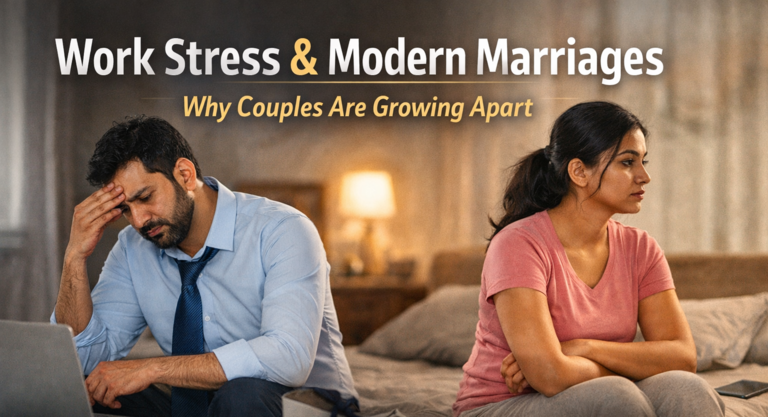
In today’s fast-paced world, work stress has quietly become one of the biggest threats to marital harmony. Long hours, performance pressure, job insecurity, financial responsibilities, and constant digital connectivity are changing how couples relate to each other. While earlier generations struggled with survival and stability, modern couples often struggle with emotional distance, communication breakdown, and burnout.
Many couples say, “We don’t fight much anymore—we just feel disconnected.” This emotional gap is not accidental. It is often the result of unresolved work stress seeping into personal relationships.
As psychologists and marital counsellors observe, modern marriages are not failing due to lack of love—but due to lack of time, emotional availability, and psychological safety.
Work stress today looks very different from what it did a few decades ago. It is no longer limited to physical exhaustion; it has become mental, emotional, and constant.
Long working hours and irregular schedules
High competition and performance pressure
Fear of job loss or unstable income
Remote work blurring boundaries between office and home
Constant emails, messages, and work calls
Lack of appreciation or control at work
In metropolitan cities and urban India, dual-income households are now the norm. While this brings financial independence, it also means both partners are exhausted, leaving little emotional energy for the relationship.
Work stress rarely stays at the workplace. It enters the marriage quietly and gradually, affecting daily interactions, emotional intimacy, and mutual understanding.
When a person is stressed at work, the brain remains in survival mode. Irritability, frustration, and emotional numbness often get redirected toward the partner.
Small issues at home—like chores, delays, or misunderstandings—suddenly trigger intense reactions. Over time, the home becomes another source of stress rather than comfort.
Couples may live under the same roof but emotionally live separate lives. Meals are rushed, conversations are functional, and weekends are spent recovering from exhaustion rather than reconnecting.
Quality time slowly gets replaced by:
Screen time
Work calls
Sleep
Social obligations
The relationship begins to feel like a routine rather than a bond.
Conversations shift from emotional sharing to logistics:
“Did you pay the bill?”
“What time are you coming?”
“What’s for dinner?”
Deep conversations about feelings, fears, or dreams slowly disappear. Partners stop checking in emotionally, assuming the other is “too tired” or “not interested.”
Every individual needs:
Validation
Empathy
Appreciation
Emotional safety
When work consumes emotional energy, partners unintentionally stop meeting these needs. Over time, one or both partners begin to feel:
Unseen
Unimportant
Taken for granted
This unmet emotional need often leads to resentment.
Intimacy—both emotional and physical—is one of the first casualties of chronic stress.
Fatigue reduces physical closeness
Anxiety lowers desire and connection
Emotional distance reduces attraction
Unresolved conflicts kill intimacy
Many couples mistakenly assume intimacy problems are personal or biological, while in reality, they are stress-related and psychological.
In many Indian households, traditional expectations still exist despite modern work demands.
Women managing work + household responsibilities
Men feeling pressure to be primary providers
Lack of emotional expression due to societal conditioning
Guilt associated with choosing career over family time
These unspoken pressures create imbalance, leading to exhaustion, frustration, and emotional withdrawal.
Work stress doesn’t always lead to loud fights. In many marriages, it leads to silence.
Avoiding conversations
Reduced affection
Increased irritability
Feeling lonely within the marriage
Spending more time on phone or work
Fantasizing about escape or emotional relief
Silence often feels safer than conflict—but over time, it deepens emotional distance.
Chronic work stress combined with marital dissatisfaction can lead to:
Anxiety
Depression
Burnout
Emotional numbness
Sleep disturbances
When one partner is struggling mentally, the relationship suffers—and when the relationship suffers, mental health worsens. This creates a vicious cycle.
Many couples believe:
“This is normal after a few years of marriage.”
“Things will improve once work pressure reduces.”
“Counselling is only for extreme problems.”
However, emotional distance grows silently. By the time couples seek help, resentment has often accumulated for years.
Early intervention through marital counselling can prevent long-term damage.
Marital counselling provides a safe, non-judgmental space for couples to understand each other beyond daily stressors.
Improves communication skills
Helps partners express unmet emotional needs
Teaches stress management within relationships
Restores emotional connection
Addresses intimacy issues
Reduces blame and defensiveness
A trained psychologist helps couples shift from “you vs me” to “us vs the problem.”
While professional help is important, small daily changes can make a big difference.
Set work-free time daily (even 20 minutes)
Practice active listening without problem-solving
Express appreciation regularly
Avoid discussing work stress during intimate moments
Plan regular emotional check-ins
Respect each other’s exhaustion without emotional withdrawal
Consistency matters more than perfection.
Consider marital counselling if:
Conversations end in arguments or silence
Emotional connection feels lost
Intimacy has significantly reduced
One or both partners feel lonely in the relationship
Work stress dominates your marriage
Seeking help is not a sign of failure—it is a sign of commitment.
Work stress is an unavoidable reality of modern life, but emotional disconnection doesn’t have to be. Marriages don’t break due to stress alone—they break due to unspoken pain, unmet needs, and lack of emotional repair.
With awareness, communication, and professional support, couples can rebuild connection even in the most demanding phases of life.
A strong marriage is not one without stress—but one where stress is faced together.