
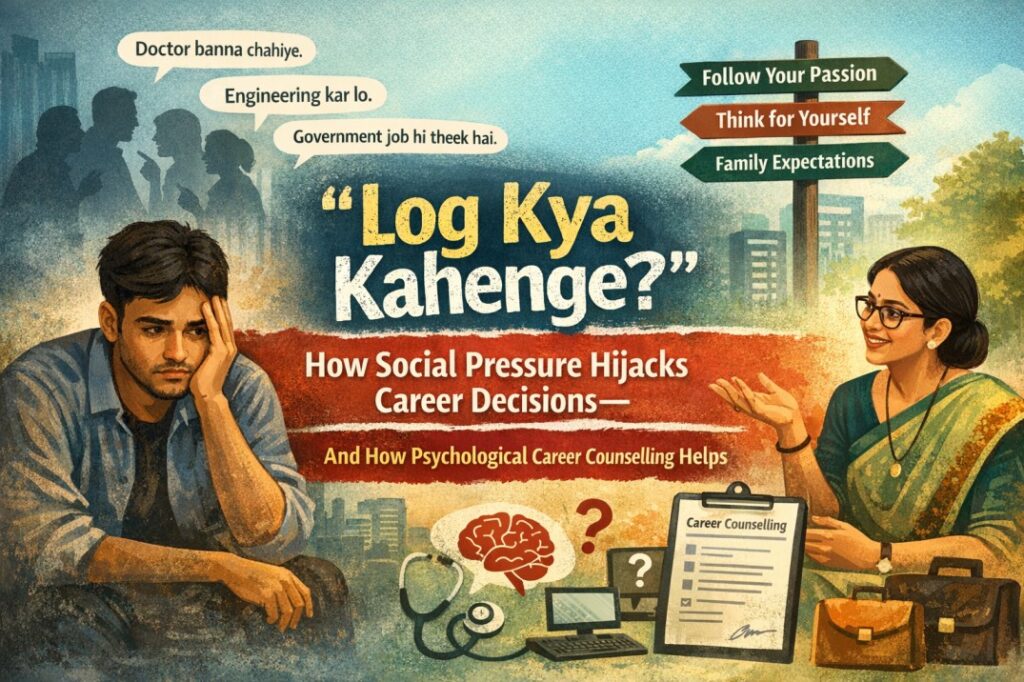
In many Indian households, career decisions are rarely made in isolation. They are shaped—sometimes dominated—by a powerful, unspoken question:
“Log kya kahenge?”
(What will people say?)
This phrase may sound harmless, even practical. But psychologically, it holds immense power. It can override personal interests, suppress emotional needs, and push individuals into careers that look respectable on the outside but feel suffocating on the inside.
As psychologists, we see the long-term emotional cost of this social pressure every day—anxiety, burnout, low self-worth, and a persistent sense of being “stuck.” This blog explores how social pressure hijacks career decisions, why it feels so difficult to resist, and how psychological career counselling helps individuals reclaim clarity, confidence, and choice.
“Log kya kahenge?” is not just a sentence—it is a cultural conditioning.
From a young age, children learn that approval, praise, and acceptance are tied to performance and conformity. Marks, ranks, degrees, and job titles become social currency. Over time, this creates an internal belief:
“My worth depends on how others perceive my success.”
In such an environment:
Careers are chosen for status, not suitability
Stability is valued over psychological well-being
Deviating from the norm feels like a personal failure
Medicine, engineering, government jobs, or corporate roles often become “safe” choices—not because the individual is interested, but because they protect the family from social judgment.
Social pressure doesn’t force decisions overnight. It works subtly, through emotional and psychological mechanisms:
Humans are wired for belonging. In collectivistic cultures, the fear of disappointing parents or relatives can feel more threatening than personal dissatisfaction. Choosing differently can trigger guilt, anxiety, and fear of being labelled irresponsible or ungrateful.
Many students and professionals know what they should do, but not who they are. Over time, external opinions drown out internal signals—interests, strengths, temperament, and emotional needs.
Socially approved careers are seen as emotionally safe. But psychologically, a mismatch between personality and profession often leads to:
Chronic stress
Emotional numbness
Burnout
Loss of motivation
Safety becomes an illusion when mental health deteriorates.
When personal preferences are consistently overridden, individuals disconnect from their authentic self. This suppression doesn’t disappear—it resurfaces later as confusion, anger, regret, or depression.
Teenagers and young adults often lack the emotional vocabulary to articulate discomfort. They comply outwardly but struggle internally, experiencing anxiety, low confidence, or academic burnout.
Parents often act from fear—fear of uncertainty, financial instability, or social judgment. While intentions are protective, the emotional impact on the child is often overlooked.
Many adults seek career counselling years later, saying:
“I did everything right… but I still feel unhappy.”
Mid-career dissatisfaction, burnout, or the urge to quit often stem from unresolved early career compromises.
Choosing a career primarily to satisfy social expectations can lead to:
Persistent anxiety about performance
Feeling trapped or stuck despite success
Low self-esteem (“Something must be wrong with me”)
Difficulty making decisions independently
Depression or emotional exhaustion
These are not signs of weakness. They are psychological responses to prolonged misalignment between self and role.
Many people assume career counselling means aptitude tests and lists of “suitable careers.” While assessments can be helpful, they are insufficient on their own.
They do not address:
Emotional conflict with parents
Fear of judgment or failure
Guilt associated with choosing differently
Identity confusion
Anxiety-driven decision-making
This is where psychological career counselling differs.
Psychological career counselling goes beyond “What career should I choose?”
It explores why decision-making feels so difficult in the first place.
A psychologist helps identify hidden fears—fear of disappointing parents, fear of instability, fear of being judged—that silently influence choices.
Through therapeutic conversations, individuals reconnect with:
Personal values
Natural temperament
Emotional needs
Strengths and limitations
This clarity forms the foundation of confident decision-making.
Counselling helps differentiate realistic concerns from inherited anxieties. Not every unconventional choice is risky—and not every “safe” career is sustainable.
Career decisions in India are deeply relational. Therapy provides tools to navigate difficult conversations with family—without aggression, avoidance, or emotional shutdown.
Clients learn how to tolerate uncertainty, trust their judgment, and take responsibility for choices—essential skills for long-term career satisfaction.
When career confusion is left unaddressed, it often manifests as:
Anxiety disorders
Depression
Chronic stress
Psychosomatic symptoms
Psychological career counselling treats career confusion not as indecisiveness, but as an emotional and cognitive struggle that deserves care.
One of the most powerful shifts clients experience is realizing that:
Choosing yourself does not mean abandoning your family
Prioritizing mental health is not failure
A fulfilling career benefits not just the individual, but the entire family system
When individuals are emotionally healthy, they function better—in relationships, work, and life.
You may benefit if:
You feel anxious or guilty about your career choice
You are successful but unhappy
You feel stuck between personal interest and family expectations
You overthink career decisions constantly
You fear making the “wrong” choice
Career counselling is not only for students—it is for anyone feeling disconnected from their work identity.
“Log kya kahenge?” will always exist. Society will always have opinions.
The real question is:
Can you build a life based solely on others’ expectations—and stay mentally well?
Psychological career counselling helps individuals shift from social approval to self-alignment. It doesn’t promise easy answers, but it offers something far more valuable: clarity, confidence, and emotional freedom.
Your career is not just a source of income—it is a space where you spend most of your waking life. Choosing it consciously is not rebellion.
It is self-respect.