
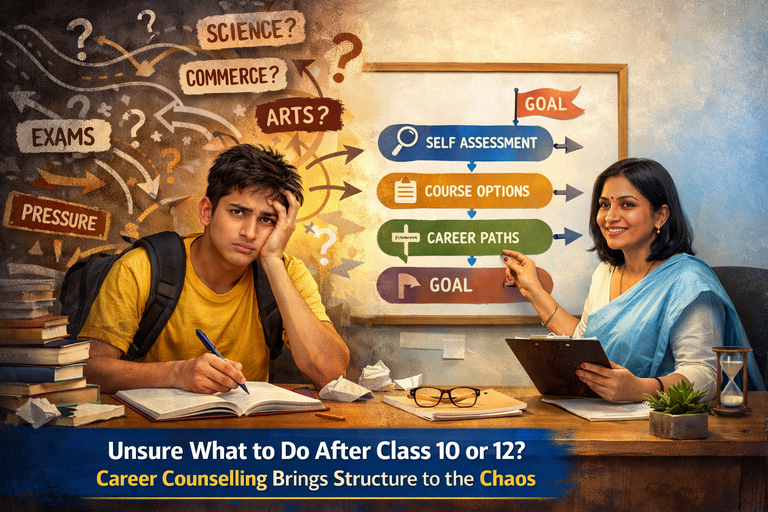
If you’ve just completed Class 10 or 12 and find yourself caught between confusion, pressure, and endless advice — you’re not alone. Every year, lakhs of students in India face the same question: “What next?” For many, this question comes loaded with anxiety, expectations, and fear of making the wrong choice. The good news is that it doesn’t have to be this way.
Career counselling, when done well, transforms this period of chaos into a phase of clarity. It helps you understand who you are, what you value, and how to align your strengths with meaningful career options. Let’s unpack how professional career guidance can make all the difference — not just in choosing a stream or college, but in shaping the foundation of your future.
After Class 10, you’re asked to pick your “stream” — science, commerce, or humanities — a decision that seems to determine the rest of your life. After Class 12, the stakes get even higher: choosing courses, entrance exams, and colleges.
Most students make these choices based on:
Family expectations or traditions (like “Everyone in our family is an engineer!”)
Peer influence (“All my friends chose science, so I will too.”)
Perceived prestige or salary potential of certain fields
Random guesses about what might be interesting
Unfortunately, very few decisions come from self-awareness — a clear understanding of one’s interests, aptitude, personality, and values. That’s where professional career counselling steps in.
There are three main reasons students find career decisions overwhelming today:
Explosion of Options:
Decades ago, the mainstream choices were medicine, engineering, or government jobs. Today, there are hundreds of viable careers — data analytics, nanotechnology, design thinking, psychology, digital journalism, ethical hacking, clinical research, sustainable architecture, and more.
Mismatch Between Skills and Goals:
Many students choose subjects that don’t match their natural abilities or interests. This can lead to disengagement, low performance, and even burnout later in life.
Information Overload Without Direction:
The internet provides infinite data but zero clarity. You can Google every course in the world, but you still need someone to help you interpret how you fit into those possibilities.
Social Pressure and Fear of Judgment:
Students often feel cornered into making choices that please others rather than reflect their personal goals. This emotional stress often leads to self-doubt and decision paralysis.
Career counselling is a structured, evidence-based process that helps students (and parents) make informed educational and career decisions. It’s not about merely selecting a profession — it’s about discovering the best path for your unique personality, abilities, and circumstances.
A trained career counsellor often follows these key steps:
Self-Assessment:
This is the foundation stage. Students undergo psychometric tests to measure:
Aptitude (for logical, numerical, spatial, or verbal reasoning)
Personality traits (introversion, openness, persistence, etc.)
Interests (creative, investigative, social, enterprising, practical)
Emotional and social intelligence
Career Exploration:
Based on results, the counsellor introduces students to career clusters that align with their strengths and preferences. For example, a student with high verbal reasoning, empathy, and creativity might explore psychology, communication, or counselling careers.
Guidance and Goal Setting:
The next step involves developing an actionable plan — choosing subjects, identifying entrance exams, shortlisting top colleges, and mapping short-term and long-term goals.
Decision-Making Support:
Counsellors provide clarity but don’t impose decisions. They guide families to make informed, practical, and emotionally sound choices that balance passion with stability.
Modern career counselling isn’t guesswork — it’s grounded in psychology. Several theories guide counsellors in understanding personality-career fit. For instance:
Holland’s Career Theory (RIASEC):
Proposes that people thrive in environments matching their personality type — Realistic, Investigative, Artistic, Social, Enterprising, or Conventional.
Example: An “Artistic” type finds satisfaction in design or writing, while an “Investigative” one may prefer research or analytics.
Gardner’s Theory of Multiple Intelligences:
Highlights that intelligence is not one-dimensional. A student may excel in musical, interpersonal, or kinesthetic intelligence rather than purely academic intelligence — vital insight for non-traditional career paths.
Super’s Life-Span Theory:
Emphasizes that career development continues through different life stages. The choices made after Class 10 or 12 are important — but they’re also adaptable as one grows.
These frameworks help counsellors make objective recommendations instead of opinion-based suggestions.
Choosing a career is not just an academic decision — it’s deeply emotional. Uncertainty during formative years can trigger anxiety, comparison, and even identity conflict. Career counselling acts as an anchor in this storm.
Reduces Stress: Students gain structure, so the “unknown” feels manageable.
Builds Confidence: Clarity about personal strengths boosts self-esteem.
Improves Family Communication: Counsellors bridge gaps between parental expectations and a child’s individuality.
Encourages Lifelong Decision Skills: Learning how to evaluate options logically prepares students for future transitions as well.
All career counselling services are not created equal. When choosing whom to consult, look for these indicators:
Qualified professionals (preferably psychologists, counsellors, or educators with certification in career guidance).
Use of validated psychometric tools rather than generic quizzes.
A personalized session — not an automated report.
Practical knowledge of evolving industry trends and education systems.
Willingness to involve both student and parents in discussions.
You can find such counsellors through reputed online platforms, educational institutions, or independent career psychology clinics.
Parents play one of the most crucial roles in shaping a child’s career path — but it’s easy to confuse support with control. Here’s how parents can truly empower their children during this phase:
Listen Before Advising:
Allow children to express what they enjoy doing. Begin with why they like it, not how they will earn from it.
Stay Updated on Emerging Fields:
Careers in artificial intelligence, digital health, sustainability, and creative technology didn’t exist a decade ago. Be open to the idea that your child might excel in a field unfamiliar to you.
Value Aptitude Over Myths:
A student not excelling in physics or math isn’t “less capable.” They may have exceptional emotional or creative intelligence — aptitudes equally vital in today’s world.
Promote Mental Health and Balance:
Encourage breaks, reflection, and stress management during academic decisions. Remember: a confident, happy student performs better.
In India, academic choices often get tied to societal status — science equals success, while arts or vocational fields are seen as “backup plans.” Thankfully, this mindset is shifting fast.
Government initiatives like the National Education Policy (NEP 2020) emphasize flexibility, allowing students to blend disciplines — for example, combining music with physics or business studies. Additionally, many CBSE and state boards are now integrating career guidance modules into the curriculum.
Urban centers such as Delhi, Mumbai, and Bangalore already see rising demand for psychometric assessments and strategic counselling before board exams. With technology, even rural students now have access to virtual career mentoring and aptitude tests in regional languages.
Let’s look at two short examples:
Case 1: Riya, Class 10 Student
Riya loved art but was pushed toward science because of family pressure. A career assessment showed her strong preference for visual-spatial reasoning and creativity, suggesting design and architecture as natural fits. She eventually pursued design studies at NID and thrived — both academically and emotionally.
Case 2: Aarav, Class 12 Student
Aarav scored well in commerce but wasn’t sure whether to do CA, BBA, or data analytics. Career counselling revealed his interest in tech and high logical reasoning. He opted for a B.Sc. in Data Science and now loves what he’s studying.
These stories show how structured counselling replaces guesswork with purpose.
Career indecision is normal at 16 or 18. You’re not expected to have your life’s roadmap ready. Counselling simply helps you navigate possibilities methodically rather than letting confusion make decisions for you.
Remember:
Your marks don’t define your potential.
A wrong stream choice doesn’t end your career prospects.
You can always realign your path — the earlier you start reflecting, the easier it becomes.
What truly matters is self-awareness, curiosity, and the courage to explore.
Career counselling is more than guidance — it’s an investment in clarity. It helps you align passion with practicality, convert anxiety into action, and bring structure to what feels like chaos. Whether you’re a Class 10 student choosing your stream or a Class 12 student preparing for the next big step, the process helps you see the bigger picture of your potential.
After all, success doesn’t come from choosing the “most popular” course. It comes from choosing the right fit — the one that makes you look forward to your Mondays.
So before you rush into a decision based on what others think you should do, take a step back. Seek guidance. Understand yourself. Because when you know why you’re choosing a path, how to walk it becomes much easier.