
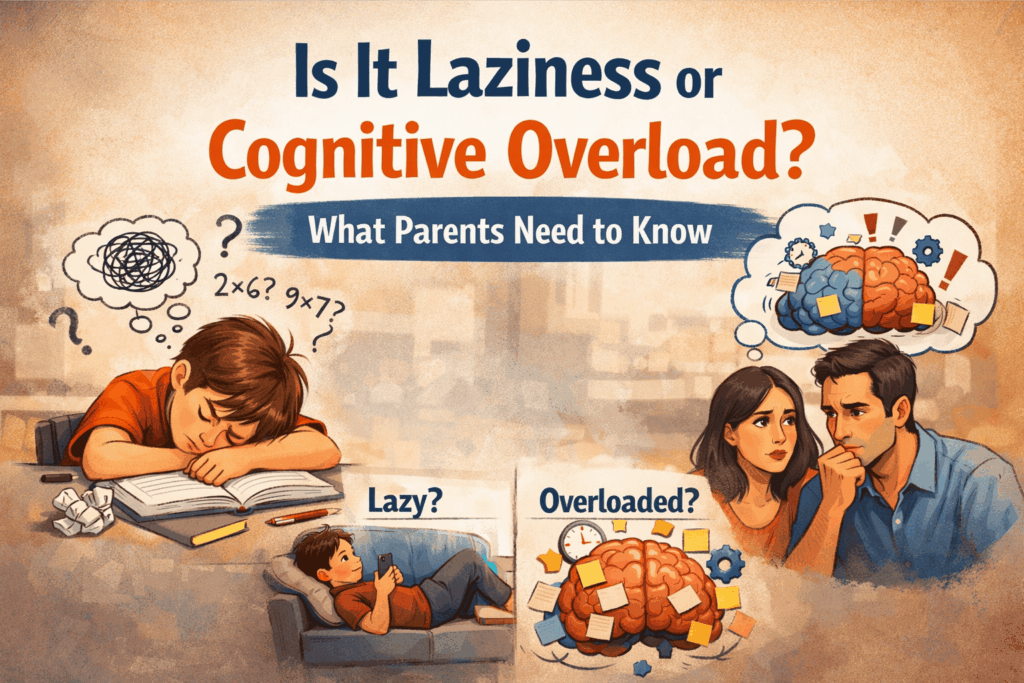
As parents, we’ve all been there. We ask our child to do a simple task – “Please put your shoes away” or “It’s time to start your homework” – and are met with a blank stare, a slow-motion response, or even an outright “I don’t feel like it.” In those moments, it’s easy for the thought to creep in: “Are they just being lazy?”
It’s a common and understandable reaction. We live in a world that often values speed, efficiency, and self-starters. When our children don’t seem to embody these traits, we might jump to conclusions. However, what if what appears to be laziness is actually something far more complex? What if it’s a sign of cognitive overload?
Understanding the difference between genuine laziness and cognitive overload is crucial for effective parenting, fostering a child’s development, and maintaining a healthy parent-child relationship. This blog post will delve into what cognitive overload is, how it manifests in children, and practical strategies parents can use to help their children thrive.
Imagine trying to juggle too many balls at once. You might drop a few, or all of them. That’s a good analogy for cognitive overload. In simple terms, cognitive overload occurs when the brain is asked to process too much information, too many tasks, or too many demands simultaneously, exceeding its processing capacity.
Our brains have a finite amount of working memory and attentional resources. Working memory is like a mental scratchpad where we temporarily hold and manipulate information. When this scratchpad gets too full, or when there are too many demands on our attention, our ability to think clearly, make decisions, initiate tasks, and even regulate emotions can significantly diminish.
For adults, cognitive overload might manifest as feeling overwhelmed at work, struggling to make a decision after a long day, or forgetting appointments. For children, especially those whose brains are still developing, the signs can be even more subtle and often misinterpreted.
Children’s brains are not miniature adult brains. They are undergoing rapid development, particularly in the prefrontal cortex – the area responsible for executive functions like planning, organization, impulse control, and working memory. This means children are inherently more susceptible to cognitive overload than adults.
Consider the sheer volume of information a child processes daily:
Sensory input: Sights, sounds, smells, textures – a constant stream of information about their environment.
Social cues: Interpreting facial expressions, body language, and tone of voice in interactions with peers and adults.
Academic demands: Learning new concepts, remembering facts, completing assignments, following instructions.
Emotional regulation: Understanding and managing their own feelings, as well as reacting to the emotions of others.
Physical demands: Coordinating movements, participating in sports, navigating their physical space.
Future planning (even small scale): Thinking about what to do next, remembering routines, anticipating consequences.
Each of these categories represents multiple “balls” that a child’s brain is constantly juggling. When the number of balls exceeds their current capacity, the system can crash, leading to what looks like “laziness.”
Let’s explore some common scenarios where cognitive overload can be mistaken for a lack of effort or motivation:
Difficulty Initiating Tasks: You ask your child to clean their room, and they just stare blankly or start fiddling with something else. It’s not necessarily defiance; they might not know where to start, or the task feels too big given the mental load they’re already carrying.
Example: “Clean your room” can mean: decide what goes where, pick up clothes, put away toys, make the bed, deal with dirty laundry. Each step is a micro-decision.
Slow Processing and Delayed Responses: You ask a question, and it takes an unusually long time for your child to answer, or they give a vague response. Their brain might be struggling to access the information or formulate a coherent reply amidst the internal noise.
Appearing Disinterested or Unmotivated: They might seem checked out during a conversation, not engage in an activity, or show a general lack of enthusiasm. This could be a protective mechanism – their brain is trying to shut down input to prevent further overload.
Forgetfulness and Difficulty Following Instructions: Despite hearing you, they might forget what you said or struggle to follow multi-step instructions. Their working memory is full, and new information isn’t sticking.
Example: “Go upstairs, put your dirty clothes in the hamper, brush your teeth, and pick out your pajamas for tomorrow.” That’s a lot for a child.
Increased Irritability, Frustration, or Emotional Outbursts: When the brain is overloaded, the ability to regulate emotions diminishes. Small frustrations can feel enormous, leading to meltdowns or acting out.
Avoidance or Procrastination: Rather than facing a demanding task, a child might find distractions or simply put it off. This isn’t necessarily a desire to shirk responsibility but an attempt to avoid the discomfort of feeling overwhelmed.
Physical Manifestations: Some children might complain of headaches, stomachaches, or seem excessively tired. These can be genuine physical symptoms of mental exhaustion.
Several factors in a child’s environment and internal world can contribute to cognitive overload:
Excessive Screen Time: Constant notifications, rapid visual changes, and interactive demands of screens can be highly stimulating and taxing on the brain.
Overscheduling: Too many extracurricular activities, back-to-back lessons, and a lack of downtime can leave children with little room to simply “be.”
Academic Pressure: High expectations, a rigorous curriculum, test anxiety, and heavy homework loads.
Lack of Sleep: Sleep is vital for brain consolidation and recovery. Insufficient sleep dramatically reduces a child’s ability to cope with cognitive demands.
Environmental Stimuli: Noisy environments, cluttered spaces, or chaotic routines can create constant sensory input that strains attention.
Underlying Learning Differences or Neurodevelopmental Conditions: Children with ADHD, autism spectrum disorder, anxiety, or specific learning disabilities often have brains that process information differently, making them inherently more prone to overload.
Emotional Stressors: Family changes, peer issues, conflicts, or worries can consume significant mental energy, leaving less for other tasks.
Lack of Structure or Too Much Structure: Both extremes can be problematic. A lack of predictable routine can create uncertainty and anxiety, while overly rigid structure can stifle autonomy and create pressure.
Parental Over-Direction/Micromanagement: Constantly telling a child what to do, how to do it, and when to do it can prevent them from developing their own executive functions and make every decision feel like a parental command rather than an internal choice.
Once we recognize that our child might be experiencing cognitive overload rather than intentional laziness, our approach as parents can shift dramatically. Instead of frustration and disciplinary measures, we can offer empathy, understanding, and practical support.
Pay attention to patterns: When does the “laziness” appear? Is it at certain times of day (after school, before bed)? In certain situations (homework, chores, social gatherings)?
Look for triggers: Are they tired? Hungry? Have they just had a lot of screen time? Is there an upcoming event causing anxiety?
Ask open-ended questions: Instead of “Why aren’t you doing it?”, try “What feels hard about this right now?” or “How can I help you get started?” Validate their feelings (“It sounds like you’re feeling a bit overwhelmed.”)
Break down big tasks: “Clean your room” becomes “First, put all the dirty clothes in the hamper.