
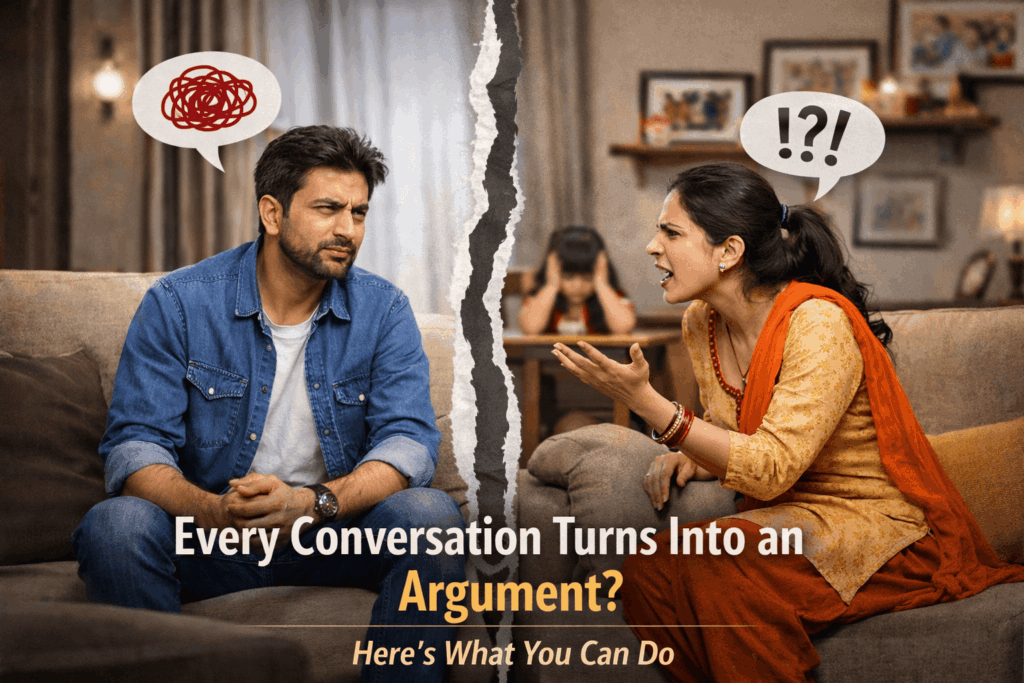
Do you feel like every simple discussion with your partner turns into a fight? You start talking about something small — bills, kids, in-laws, schedules — and suddenly voices are raised, doors are shut, and both of you feel unheard.
If this sounds familiar, you’re not alone.
Many couples seek marital counselling because they feel stuck in a constant cycle of arguments. The good news? This pattern can be changed. Relationships don’t break because couples fight — they break when couples don’t know how to fight in a healthy way.
In this blog, we’ll explore:
Why every conversation turns into an argument
The psychology behind repeated conflicts
Common triggers in Indian marriages
Practical steps you can start today
When to seek professional marital counselling
When couples say, “We can’t talk without fighting,” it usually isn’t about the topic itself. It’s about emotional triggers, unmet needs, and communication styles.
Here are some common underlying reasons:
Often, the fight about “who forgot to pay the electricity bill” is not really about the bill. It may actually be about:
Feeling unsupported
Feeling unimportant
Feeling disrespected
Feeling unheard
When deeper emotions are not expressed directly, they come out as irritation or anger.
In heated conversations, many partners:
Interrupt each other
Prepare their defense instead of listening
Focus on proving who is right
When both people try to win, the relationship loses.
Do old fights resurface again and again?
Unresolved conflicts create emotional “baggage.” Even a small disagreement can trigger memories of:
Past betrayals
Previous insults
Earlier disappointments
Without resolution, arguments become repetitive.
In Indian households, couples often juggle:
Work pressure
Parenting stress
Financial responsibilities
Joint family dynamics
When stress builds up, patience decreases. Your partner becomes the easiest outlet for frustration.
Many couples unknowingly fall into a predictable pattern:
One partner criticizes
The other becomes defensive
Voices rise
One partner withdraws
Both feel hurt and disconnected
Over time, this cycle damages emotional intimacy.
Without intervention, couples may:
Stop communicating completely
Become emotionally distant
Consider separation
But it doesn’t have to reach that point.
If every conversation feels like a battle, here are practical steps you can begin immediately.
When you feel triggered:
Take a deep breath
Count to 10
Ask yourself: “What am I really feeling?”
Often, beneath anger is hurt or fear.
Instead of saying:
“You never care about this family!”
Try:
“I feel overwhelmed handling this alone.”
This shifts the tone from blame to vulnerability.
“You always…”
“You never…”
“You don’t care…”
These phrases trigger defensiveness instantly.
Instead say:
“I feel hurt when…”
“I need more support with…”
“I feel anxious about…”
This invites conversation instead of conflict.
Timing matters.
Avoid serious discussions when:
One of you is exhausted
Children are around
Either partner is already stressed
Schedule calm conversations instead of reacting in the heat of the moment.
Healthy couples fight too — but with boundaries.
Examples:
No name-calling
No bringing up past resolved issues
No shouting
Take a 20-minute break if emotions escalate
This protects emotional safety.
When your partner speaks:
Don’t interrupt
Maintain eye contact
Repeat what you heard
Example:
“So what you’re saying is you feel ignored when I’m on my phone?”
This small step reduces misunderstandings dramatically.
Some people:
Avoid confrontation
Become aggressive
Shut down emotionally
Understanding your own pattern is powerful. A trained psychologist can help you identify and change unhealthy conflict styles.
In our cultural context, arguments often arise due to:
Family involvement can create loyalty conflicts and misunderstandings.
Expenses, savings, and lifestyle expectations can cause stress.
Traditional beliefs about household roles may create resentment.
Many individuals grow up without learning healthy communication skills.
Recognizing these triggers is the first step toward breaking the cycle.
If you notice:
Every conversation ends in shouting
Silent treatment lasting days
Emotional distance increasing
Thoughts of separation
Communication feeling impossible
It may be time to seek professional help.
Marital counselling is not a sign of failure. It is a proactive step toward healing.
A trained psychologist provides:
Both partners get equal time to speak without interruption.
You learn the root cause of repeated fights.
Couples learn healthier ways to express needs.
Therapy helps rebuild trust and intimacy.
Many couples report that after counselling:
Arguments reduce significantly
Emotional connection improves
Mutual respect returns
Many couples wait years before seeking help. They assume:
“This is just how marriage is.”
“We are not compatible.”
“It’s too late now.”
But research and clinical experience show that with willingness and guidance, relationships can transform — even after years of conflict.
The key factor is not the number of fights.
It’s the willingness to change the pattern.
Here are simple daily practices that strengthen connection:
Appreciate one thing about your partner daily
Spend 15 minutes distraction-free talking
Hug for at least 20 seconds (physical connection reduces stress hormones)
Say “thank you” for small efforts
Apologize quickly when wrong
Healthy marriages are built on consistent small efforts.
In arguments, couples often turn against each other.
Shift the mindset to:
“We are a team solving this issue together.”
The goal is not to win.
The goal is to understand and grow.
If every conversation turns into an argument, it doesn’t mean your marriage is broken. It means your communication pattern needs attention.
Conflicts are normal.
Constant hurt is not.
With self-awareness, effort, and professional support when needed, couples can transform their relationship from tension-filled to emotionally secure.
If you and your partner are struggling to communicate without fighting, consider reaching out to a qualified psychologist for marital counselling. Seeking help is not weakness — it’s a commitment to your relationship.
Q1. Is it normal to argue daily in marriage?
Frequent arguments may signal unresolved communication issues. Occasional disagreements are normal; daily fights need attention.
Q2. Can counselling really reduce constant arguments?
Yes. Therapy teaches structured communication tools and helps identify deeper emotional triggers.
Q3. How many sessions does marital counselling take?
It depends on the couple’s concerns, but many see improvement within 6–10 sessions.
Q4. Is online marital counselling effective in India?
Yes, online sessions are effective when both partners are committed and engaged.