
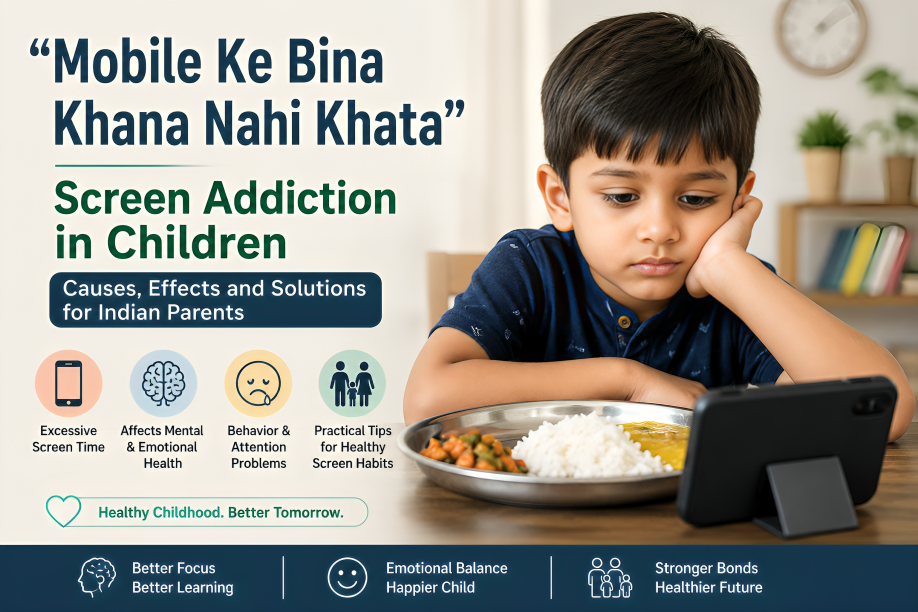
In many Indian homes today, a common scene unfolds at mealtime: a child refusing to eat unless a mobile phone is placed in front of them. Whether it’s cartoons on YouTube, games, or short videos, screens have become an easy solution for parents trying to feed their children. While it may seem harmless at first, this habit can slowly develop into screen addiction in children, affecting their mental, emotional, and physical health.
If you often say, “Mera baccha mobile ke bina khana nahi khata”, you are not alone. Many parents face this challenge. The good news is that with awareness and the right strategies, screen dependency can be managed effectively.
In this article, we’ll explore why children become dependent on screens, the warning signs of screen addiction, its impact on child psychology, and practical ways parents can help.
Technology is everywhere. Smartphones and tablets have become a regular part of daily life, and children are exposed to them from a very young age. For busy parents, handing over a phone often feels like the easiest way to calm a child or complete everyday tasks.
Common reasons children become attached to screens include:
Bright colors, music, fast-moving animations, and interactive games keep children highly engaged. Their brains quickly begin to crave this level of stimulation.
Many parents use screens during meals, travel, or tantrums because it helps avoid conflict and saves time.
In urban Indian households, limited outdoor play, academic pressure, and smaller family sizes can make screens the default source of entertainment.
Children learn by observing. If parents are frequently on their phones, children naturally want to imitate that behavior.
Not every child who enjoys mobile phones is addicted. However, certain behaviors can indicate problematic screen use:
If your child says “Bas ek aur video” repeatedly and struggles to stop, it may be time to intervene.
Many parents believe screen time during meals is harmless because the child is at least eating. However, this habit can create several hidden problems.
When children are distracted by screens, they do not pay attention to hunger and fullness cues. This can lead to overeating or unhealthy eating patterns later in life.
Meal times are valuable opportunities for conversation and bonding. Screens replace communication with passive entertainment.
Children need face-to-face interaction to learn emotional regulation, language skills, and social understanding.
Soon, eating becomes psychologically linked to screen exposure. Without the mobile, the child may refuse food altogether.
Excessive screen exposure can affect multiple aspects of child development.
Fast-paced digital content can make it harder for children to focus on slower, real-world activities like reading, studying, or conversations.
Children may become impatient, easily frustrated, or emotionally reactive when they are used to constant digital stimulation.
Many children experience mood swings when screen time is restricted, similar to withdrawal symptoms.
Unstructured play helps children imagine, problem-solve, and develop social skills. Too much screen time can limit these opportunities.
Blue light exposure and stimulating content can disrupt melatonin production, affecting sleep quality.
According to pediatric mental health recommendations:
The issue is not just how much, but also when and how screens are used.
Breaking screen habits can feel difficult, especially when children resist. Gradual and consistent changes work best.
Start by reducing dependency step by step.
Try:
Expect resistance initially. Stay calm and consistent.
Make certain spaces and times non-negotiable:
Children respond well to clear boundaries.
Replace screens with enjoyable activities:
Children need alternatives, not just restrictions.
If parents are always on their phones, children notice.
Try:
Behavior speaks louder than rules.
Praise and reward screen-free behavior.
For example:
Avoid punishment whenever possible.
Sometimes the screen is not just entertainment—it may be helping the child cope with boredom, loneliness, anxiety, or overstimulation.
Ask yourself:
Understanding the cause helps solve the problem.
Consult a child psychologist or child psychiatrist if:
Professional support can help identify underlying emotional or behavioral concerns.
If your child says “Mobile ke bina khana nahi khata,” it may be a sign that screen habits need attention—but it’s not a reason for guilt or panic.
Modern parenting comes with unique challenges, and many Indian families are navigating the same struggle. With patience, consistency, and healthy routines, children can learn to enjoy meals, play, and family time without depending on a screen.
Small changes today can protect your child’s mental health, emotional growth, and family relationships in the future.