
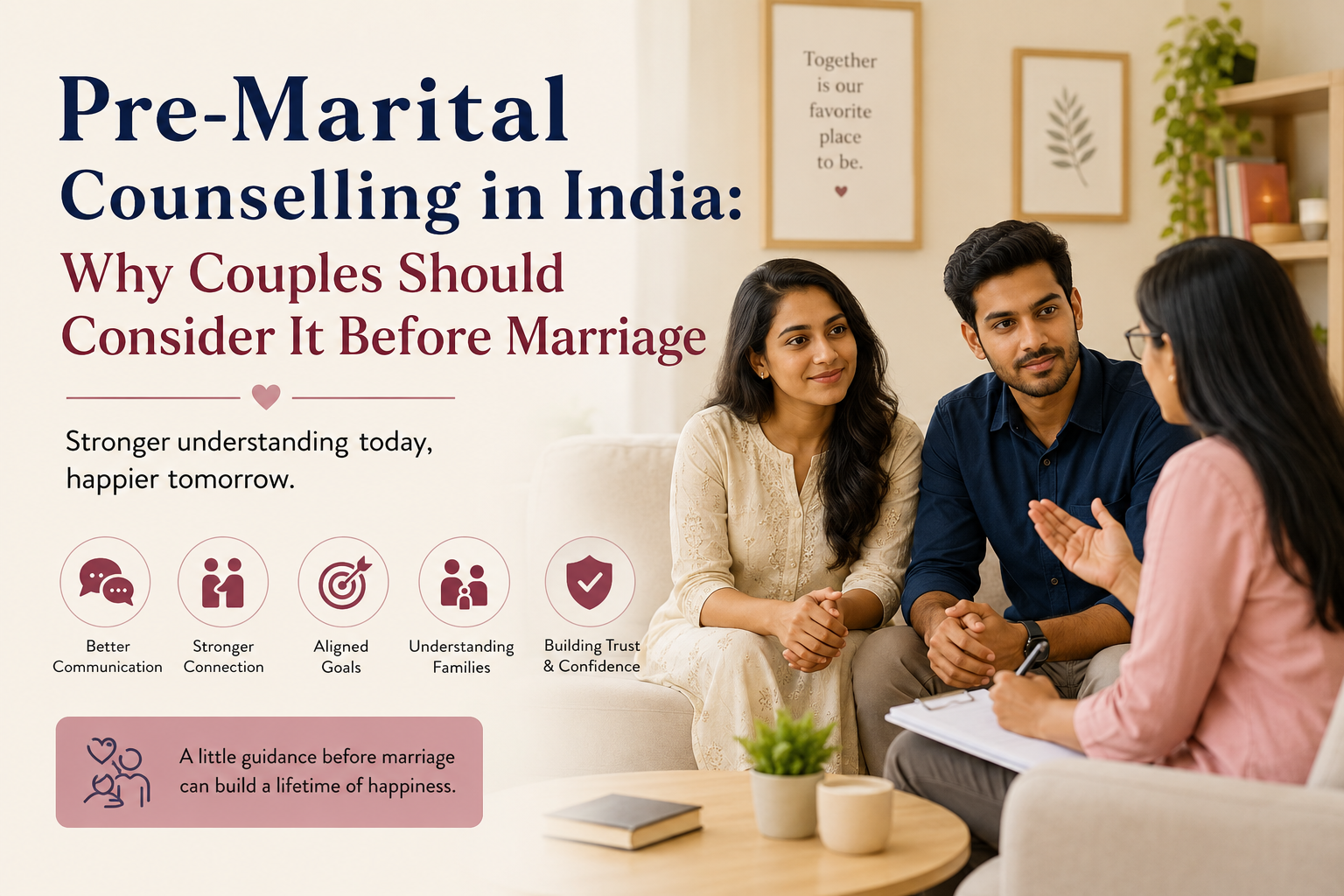
Marriage is one of the biggest emotional, social, and personal commitments in life. In India, marriage is often seen not just as a union between two individuals, but also between two families, lifestyles, values, and expectations. While weddings are planned for months with great attention to clothes, venues, and rituals, very few couples prepare themselves emotionally and psychologically for married life.
This is where pre-marital counselling becomes important.
Pre-marital counselling helps couples understand each other better before marriage. It provides a safe and professional space to discuss communication, expectations, finances, family dynamics, intimacy, emotional compatibility, career goals, and future planning. In recent years, more Indian couples are choosing counselling before marriage to build healthier and stronger relationships.
Pre-marital counselling is a form of therapy designed for couples who are planning to get married. It helps partners identify strengths, understand potential challenges, and improve communication before entering married life.
The goal is not to find faults or create doubts about marriage. Instead, it helps couples develop clarity, emotional maturity, and realistic expectations.
A psychologist or relationship counsellor guides couples through meaningful conversations that many people otherwise avoid before marriage.
Indian society is changing rapidly. Today’s couples face very different challenges compared to previous generations.
Some common reasons include:
Many couples realize that love alone is not enough to sustain a healthy marriage. Understanding, communication, emotional safety, and compatibility also play a major role.
As awareness around mental health grows in India, couples are becoming more open to seeking professional guidance before marriage rather than waiting for serious conflicts to arise later.
One of the biggest causes of relationship conflict is poor communication.
Some people express emotions openly, while others avoid difficult conversations. Counselling helps couples learn how to communicate respectfully, handle disagreements, and listen without judgment.
Healthy communication reduces misunderstandings and emotional distance after marriage.
Many couples enter marriage with unspoken expectations.
These may relate to:
When expectations remain unclear, disappointment and frustration often follow.
Pre-marital counselling encourages honest discussions so both partners understand each other’s perspectives before marriage.
In India, family involvement in marriage is often significant.
Conflicts may arise regarding:
Counselling helps couples prepare for these situations and develop healthy boundaries while maintaining respect for family relationships.
Money-related stress is one of the most common reasons for marital conflict.
Couples may have different attitudes toward:
Discussing finances before marriage helps avoid future misunderstandings and creates transparency between partners.
Mental health plays an important role in marriage.
Stress, anxiety, depression, anger issues, past trauma, or emotional insecurity can affect relationships deeply if left unaddressed.
Pre-marital counselling helps couples understand emotional triggers, coping styles, and emotional support needs.
It also encourages partners to create a relationship environment based on empathy and emotional safety.
Modern Indian couples often balance demanding careers along with family responsibilities.
Questions like these are important:
Counselling helps align expectations and encourages teamwork in future planning.
In Indian culture, discussions around intimacy are often uncomfortable or avoided completely.
However, emotional and physical closeness are important aspects of marriage.
Pre-marital counselling allows couples to discuss:
Open conversations help build trust and reduce confusion after marriage.
No. This is one of the biggest misconceptions.
Pre-marital counselling is not only for couples facing serious issues. In fact, emotionally healthy couples often benefit the most because they are willing to invest in their relationship early.
Just as people go for health check-ups before a problem develops, relationship counselling helps strengthen the emotional foundation before marriage.
It is a preventive and growth-oriented approach.
Couples learn healthier ways to express feelings, solve problems, and manage disagreements calmly.
Counselling promotes emotional understanding and helps couples feel more connected and secure.
Many relationship problems arise because expectations remain unspoken. Counselling helps create clarity and balance.
Every marriage has disagreements. Counselling teaches couples how to resolve conflicts respectfully without damaging the relationship.
Honest discussions before marriage improve trust and reduce fear or uncertainty.
While no counselling can guarantee a perfect marriage, emotional preparation often reduces misunderstandings and unhealthy patterns later.
Many couples struggle to balance personal choices with family expectations.
In many Indian households, emotional communication is not openly encouraged. This can create emotional distance in marriage.
Social media often portrays ideal relationships that are far from reality. Couples may compare their marriage with unrealistic standards.
Urban life, long commutes, financial pressure, and career competition can affect emotional availability between partners.
Even today, many people hesitate to seek counselling because they fear judgment or misunderstanding.
However, seeking professional support is a sign of emotional awareness and maturity, not weakness.
Yes.
Whether it is a love marriage or arranged marriage, counselling can be beneficial.
Couples may already know each other emotionally but still avoid practical conversations about finances, family roles, or future planning.
Partners may need more emotional understanding, communication support, and compatibility discussions before marriage.
In both situations, counselling helps build emotional clarity and confidence.
Sessions are usually conducted by a psychologist, therapist, or relationship counsellor.
The counsellor may discuss:
Some sessions are conducted jointly, while others may involve individual conversations as well.
The process is confidential, non-judgmental, and focused on helping couples build healthier relationships.
There is no fixed number.
Some couples may benefit from 2–3 sessions, while others may prefer more detailed discussions over several weeks.
The number of sessions depends on:
Couples may benefit from counselling if they:
Even couples without major concerns can benefit from emotional preparation and guidance.
One of the biggest barriers to counselling in India is stigma.
Some people believe counselling means the relationship is weak or failing. In reality, counselling reflects emotional responsibility and willingness to grow together.
Today, many educated and emotionally aware couples are choosing therapy proactively to build stronger marriages.
Mental and emotional compatibility matter just as much as financial stability or family background.
Marriage is not only about ceremonies, traditions, or social expectations. It is also about emotional partnership, communication, trust, and mutual respect.
Pre-marital counselling helps couples prepare for real married life beyond the wedding celebrations. It encourages honest conversations, emotional understanding, and healthier relationship habits before problems become serious.
In modern India, where relationships face increasing emotional and lifestyle pressures, seeking professional guidance before marriage can be one of the healthiest decisions a couple makes.
A strong marriage is not built overnight. It is built through understanding, communication, empathy, and continuous effort.
Pre-marital counselling gives couples the opportunity to begin that journey with greater awareness, confidence, and emotional readiness.