
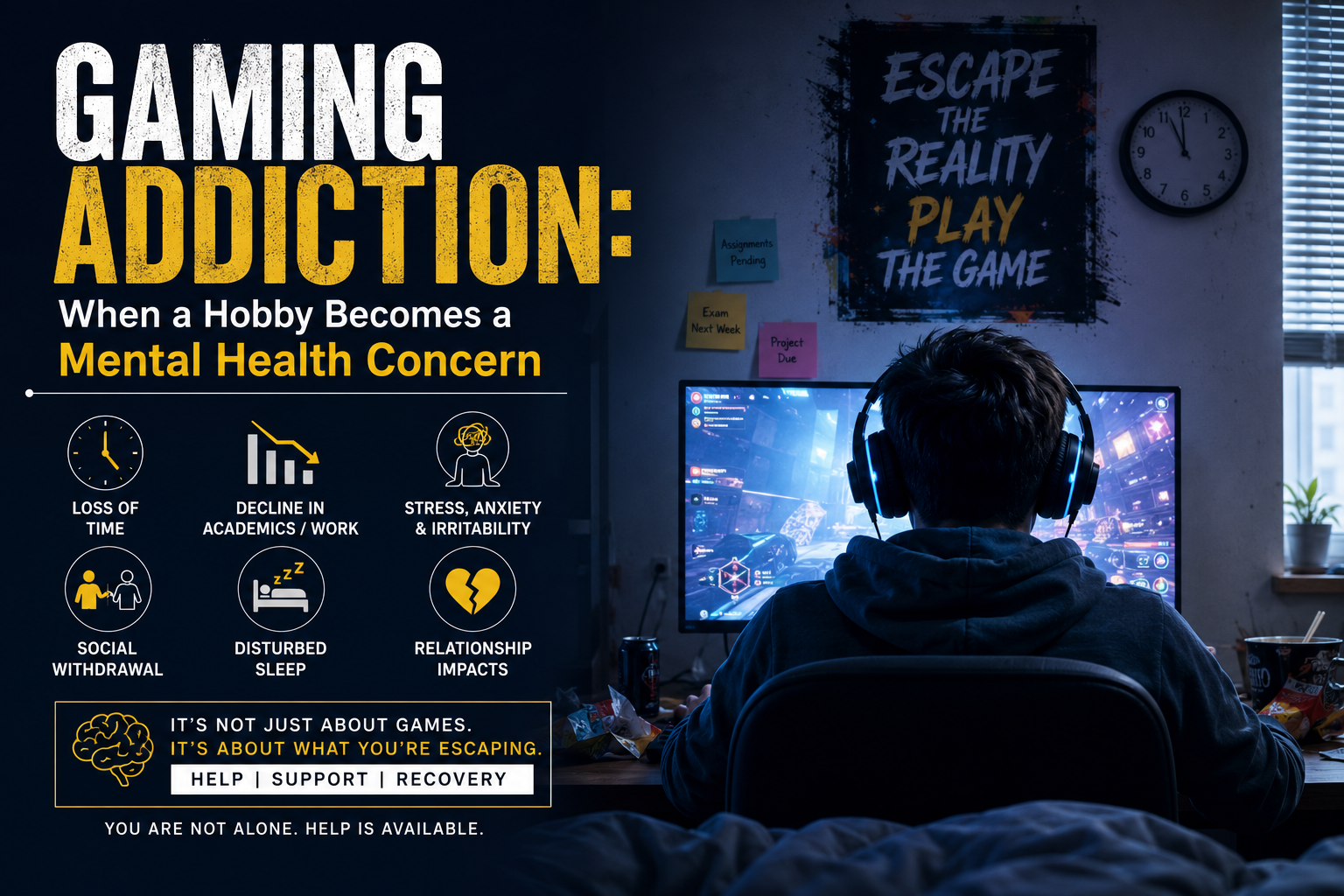
For millions of people, gaming is a fun way to relax, socialize, and challenge themselves. Whether it’s a quick match after work, a weekend session with friends, or an immersive story-driven adventure, gaming has become a mainstream form of entertainment.
But what happens when gaming stops being a hobby and starts taking control of your life?
Perhaps you’ve noticed that you can’t stop playing even when you want to. You stay awake until 3 a.m. saying “just one more game,” only to wake up exhausted for work or college. Your parents, spouse, or friends complain that you’re emotionally unavailable. Your grades begin to fall, deadlines are missed, and real-life responsibilities start feeling less rewarding than virtual achievements.
These aren’t just signs of “loving games.” For some individuals, they may indicate gaming addiction, a behavioral addiction that can significantly affect mental health, relationships, academic performance, and overall well-being.
The good news is that gaming addiction is treatable. With the right psychological support, individuals can regain control without necessarily giving up gaming forever.
Gaming itself is not harmful. Research has shown that video games can improve problem-solving skills, reaction time, strategic thinking, teamwork, and even stress relief.
The concern begins when gaming becomes the primary way of coping with emotions or escaping life’s challenges.
Healthy gaming typically looks like this:
Gaming addiction looks very different.
The individual feels compelled to play, even when they know it is causing harm. Attempts to reduce gaming often fail, leading to frustration, irritability, or anxiety. Over time, gaming starts replacing real-life activities, hobbies, and social interactions.
The hobby gradually becomes the centre of life.
Gaming addiction, also known as Gaming Disorder, refers to a pattern of persistent or recurrent gaming behavior characterized by:
It is important to understand that gaming addiction is not defined simply by the number of hours spent playing.
Someone may game for several hours every weekend without any negative consequences.
Another person may play fewer hours but experience severe academic decline, emotional distress, family conflict, and loss of control.
The key issue is how gaming affects daily functioning.
Modern games are intentionally designed to keep players engaged.
Many games use psychological principles such as:
Each achievement releases dopamine—the brain’s reward chemical.
Over time, the brain begins associating gaming with relief, excitement, achievement, and emotional comfort.
Real-life activities such as studying, working, exercising, or household responsibilities may begin to feel less stimulating by comparison.
This doesn’t mean games are “bad.” It means the brain naturally responds to repeated reward systems.
Contrary to popular belief, gaming addiction isn’t usually about the games themselves.
It is often about what gaming provides emotionally.
For many people, gaming becomes a way to:
Academic pressure, demanding jobs, or financial worries can make virtual worlds feel much safer than reality.
Gaming temporarily distracts the mind from anxious thoughts.
Online multiplayer games provide constant interaction, teamwork, and belonging.
Someone struggling with self-esteem may feel more successful inside a game than in everyday life.
Gaming becomes an emotional escape from sadness, conflict, disappointment, or trauma.
In these situations, gaming functions less as entertainment and more as emotional self-medication.
Gaming addiction often develops gradually.
Warning signs include:
Many individuals recognize the problem but feel unable to stop.
This feeling of losing control is one of the strongest indicators that professional support may be needed.
Gaming addiction affects much more than screen time.
It can contribute to several psychological difficulties.
Many individuals experience anxiety when unable to access games or when separated from online communities.
Excessive gaming can reduce real-world achievements, social interaction, and physical activity—all protective factors against depression.
Gaming becomes the primary coping mechanism.
Without it, even minor stress may feel overwhelming.
Late-night gaming disrupts natural sleep cycles, leading to fatigue, poor concentration, irritability, and mood changes.
Constant stimulation may make routine tasks such as studying or office work feel less engaging.
Parents often describe gaming addiction as a daily battle.
Arguments become frequent.
Trust decreases.
Communication breaks down.
Many parents try:
While understandable, these strategies alone often create more resistance.
This is because the gaming behavior is usually a symptom of a deeper emotional issue rather than simply poor discipline.
Similarly, partners of adults with gaming addiction may feel neglected, emotionally disconnected, or frustrated when gaming consistently takes priority over relationships.
One of the biggest misconceptions is that removing games automatically solves the problem.
In reality, sudden restrictions often lead to:
Unless the underlying emotional needs are addressed, the individual may simply replace gaming with another unhealthy coping behavior.
Recovery focuses on understanding why gaming became so important.
Treatment does not usually involve forcing someone to quit gaming forever.
Instead, therapy helps individuals build a healthier relationship with gaming.
A psychologist may help the individual:
Understanding what situations increase the urge to game.
Learning better ways to manage stress, anxiety, loneliness, and boredom.
Building resilience instead of escaping difficult emotions.
Creating routines that include work, study, exercise, relationships, hobbies, and responsible gaming.
Helping individuals reconnect with personal goals outside gaming.
Family counselling may also be recommended when communication has become strained.
Consider consulting a psychologist if gaming:
Early intervention is often much easier than waiting until the problem becomes severe.
Absolutely.
Recovery from gaming addiction does not mean giving up technology or abandoning every game forever.
Instead, it means regaining control.
Many individuals learn to enjoy gaming as one part of a balanced life rather than allowing it to dominate their emotional well-being.
With professional guidance, healthier coping strategies, improved emotional awareness, and family support, lasting recovery is possible.
Progress is rarely about perfection—it is about gradually making choices that align with your values, relationships, health, and future goals.
Gaming has become an integral part of modern life, offering entertainment, creativity, and meaningful social connections. For most people, it remains a healthy pastime.
However, when gaming begins to replace real-life relationships, responsibilities, sleep, education, or emotional well-being, it deserves attention—not judgment.
Recognizing gaming addiction as a mental health concern is not about blaming individuals or demonizing technology. It is about understanding the emotional and psychological factors that keep the cycle going.
If you or someone you care about feels trapped in a pattern of excessive gaming, remember that help is available. Seeking support from a qualified psychologist can help uncover the underlying causes, restore balance, and develop healthier ways to cope with life’s challenges.
Because the goal isn’t to stop living in a virtual world—it’s to build a real life that’s just as rewarding.
1. How many hours of gaming is considered an addiction?
There is no fixed number of hours. Gaming becomes a concern when it causes significant problems in daily life, relationships, studies, work, or mental health.
2. Is gaming addiction common among teenagers?
Teenagers are particularly vulnerable due to ongoing brain development, peer influence, and increased exposure to online games. However, adults can also develop gaming addiction.
3. Can gaming addiction be treated without medication?
Yes. In many cases, psychological therapies such as Cognitive Behavioural Therapy (CBT), motivational interviewing, and family counselling are effective. Medication may only be recommended if there are co-occurring conditions like anxiety, depression, or ADHD.
4. Should parents completely ban video games?
A complete ban is rarely effective on its own. A balanced approach that combines clear boundaries, open communication, and professional guidance when needed is generally more successful.
5. When should I consult a psychologist for gaming addiction?
If gaming is consistently interfering with your daily responsibilities, relationships, emotional well-being, or your ability to control your gaming habits despite repeated efforts to cut back, it is a good time to seek professional help.