
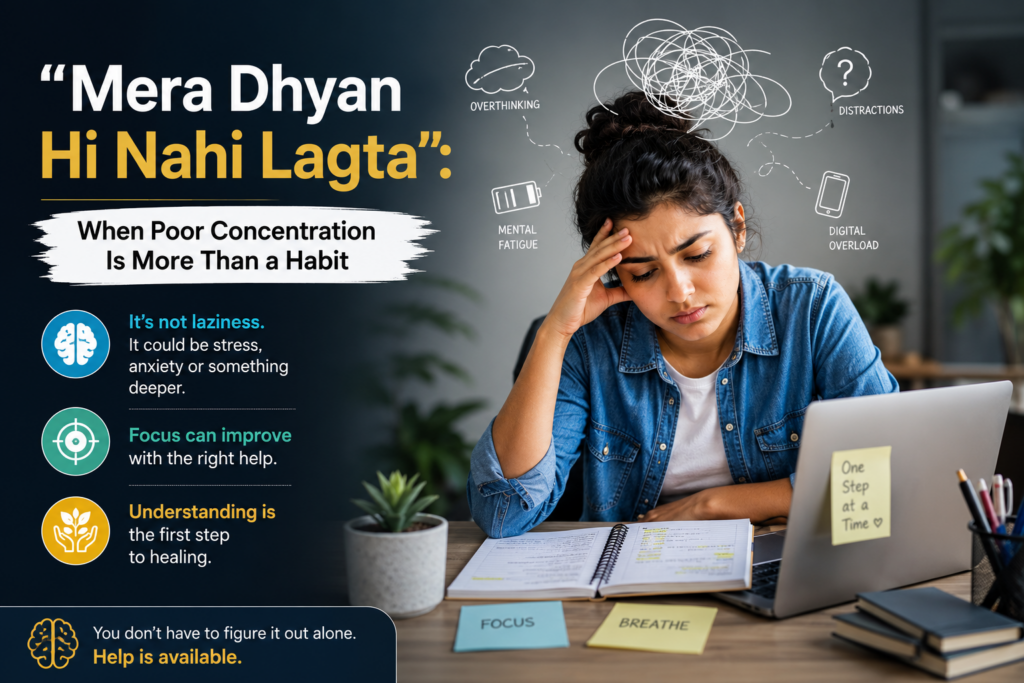
“Main kitni bhi koshish kar loon, mera dhyan hi nahi lagta.”
“I read the same page over and over, but I don’t remember a thing.”
“I can’t focus at work anymore.”
If you’ve ever said these words to yourself or someone else, you’re far from alone. In today’s fast-paced world, many people struggle to concentrate and often blame themselves for being “lazy,” “careless,” or “unmotivated.” In India, it is common to hear students, working professionals, and even older adults say, “Mera dhyan hi nahi lagta.”
While occasional distractions are a normal part of life, persistent difficulty concentrating is not always a bad habit. It can be a symptom of an underlying psychological or neurological issue that deserves attention.
Poor concentration can affect every aspect of life—from academic performance and workplace productivity to relationships and self-confidence. Fortunately, understanding the root cause is the first step toward improvement, and with the right psychological support, concentration can often be significantly improved.
Concentration is your brain’s ability to focus on one task while ignoring unnecessary distractions. It is an essential cognitive skill that helps us:
Learn new information
Solve problems
Complete tasks efficiently
Remember important details
Make decisions
Stay organized
Communicate effectively
Everyone loses focus occasionally. However, when concentration problems become frequent and start affecting your daily life, they should not be dismissed as “just a habit.”
Ask yourself the following questions:
Do you often forget what someone just told you?
Do you read the same paragraph several times without understanding it?
Are you unable to complete tasks even when you genuinely want to?
Do you keep losing track during meetings or classes?
Do you struggle to watch a movie or read a book without checking your phone repeatedly?
Do you feel mentally exhausted after doing simple work?
If your answer is “yes” to several of these questions and these problems have persisted for weeks or months, it may be time to seek professional help.
Concentration difficulties rarely have a single cause. Often, multiple physical, emotional, and psychological factors work together.
Stress is one of the biggest reasons people lose focus.
When your brain is constantly worried about deadlines, finances, relationships, or family responsibilities, it remains in a state of alertness. Instead of concentrating on the present task, your mind keeps thinking about potential problems.
You may notice:
Racing thoughts
Constant worrying
Difficulty staying present
Reduced productivity
People with anxiety often believe they have a memory problem, but in reality, their brain is overloaded with anxious thoughts.
Instead of paying attention to what is happening around them, their mind remains occupied with “what if” scenarios.
For example:
“What if I fail?”
“What if something goes wrong?”
“What if people judge me?”
This mental noise leaves very little room for concentration.
Many people associate depression only with sadness, but cognitive symptoms are equally important.
Depression commonly affects:
Attention
Memory
Decision-making
Processing speed
Mental energy
Many patients describe it as having “brain fog.”
Even after mood improves, concentration may take time to recover.
ADHD is not limited to children.
Many adults struggle for years without realizing they have ADHD.
Common signs include:
Easily distracted
Frequently forgetting things
Difficulty organizing work
Poor time management
Starting many tasks but finishing few
Losing important items
With proper assessment and treatment, individuals with ADHD can learn effective strategies to manage these challenges.
Your brain performs essential repair and memory consolidation during sleep.
Poor sleep due to:
Insomnia
Late-night screen use
Sleep apnea
Irregular schedules
can significantly reduce concentration, memory, and learning ability.
Adults generally need 7–9 hours of quality sleep each night for optimal cognitive functioning.
Modern life is filled with constant notifications, short videos, and endless scrolling.
Over time, frequent task-switching trains the brain to seek constant stimulation, making it harder to focus on activities that require sustained attention, such as studying, reading, or working.
Digital distractions are common—but they are not always the only reason for poor concentration.
Certain physical health conditions can also contribute to poor concentration, including:
Thyroid disorders
Vitamin B12 deficiency
Iron deficiency
Diabetes
Chronic pain
Migraine
Hormonal changes
A comprehensive evaluation helps determine whether medical factors are playing a role.
Concentration problems often have a ripple effect.
Students may:
Take longer to complete assignments
Forget what they studied
Make careless mistakes in exams
Feel frustrated despite working hard
Many are wrongly labelled as “lazy” when they are actually struggling with an underlying cognitive or psychological issue.
Employees may experience:
Reduced productivity
Difficulty meeting deadlines
Poor decision-making
Frequent errors
Trouble following discussions
Increased workplace stress
Over time, this may affect career growth and confidence.
Managing a household requires planning, organization, and multitasking.
Poor concentration can lead to:
Forgetting appointments
Missing household tasks
Feeling overwhelmed
Increased emotional stress
Although mild forgetfulness may occur with aging, significant concentration problems should never be ignored.
A professional evaluation helps distinguish normal aging from conditions that require treatment.
Not necessarily.
While excessive screen time certainly contributes to distraction, many people reduce phone use but continue to struggle.
This is because concentration problems often arise from deeper causes such as:
Anxiety
Depression
ADHD
Chronic stress
Sleep deprivation
Cognitive difficulties
Blaming yourself or your phone alone may delay proper treatment.
A psychologist does much more than simply ask whether you can focus.
Assessment typically includes:
Detailed clinical interview
Emotional well-being assessment
Stress and lifestyle evaluation
Attention and memory testing
Cognitive functioning assessment
Screening for anxiety, depression, ADHD, and learning difficulties
Understanding why concentration is affected allows treatment to be tailored to your specific needs.
One of the most effective evidence-based approaches for improving attention, memory, and thinking skills is Cognitive Remediation Therapy (CRT).
Cognitive Remediation is a structured psychological intervention that helps strengthen cognitive abilities through targeted exercises and practical strategies.
It focuses on improving:
Attention
Concentration
Memory
Problem-solving
Planning
Executive functioning
Mental flexibility
Processing speed
Unlike simple brain games, CRT is guided by trained mental health professionals and is designed to help people apply these improved skills in real-life situations such as work, school, and daily living.
Depending on the underlying cause, treatment may include:
Helps identify and change unhelpful thinking patterns that interfere with focus.
Teaches relaxation techniques, healthy coping strategies, and problem-solving skills.
Improves the ability to stay present rather than getting caught up in distracting thoughts.
Strengthens attention, memory, and executive functioning through structured exercises.
Psychologists may recommend:
Better sleep hygiene
Physical activity
Reduced screen time
Healthy nutrition
Time management techniques
Scheduled breaks during work or study
While professional support is important when concentration problems persist, these habits can also help:
Break large tasks into smaller, manageable steps.
Follow a daily routine.
Keep your workspace free from distractions.
Use the Pomodoro technique (25 minutes of focused work followed by a 5-minute break).
Limit unnecessary notifications on your phone.
Exercise regularly.
Stay hydrated and eat balanced meals.
Practice mindfulness or deep breathing for a few minutes each day.
Get consistent, quality sleep.
Small, consistent changes often lead to meaningful improvements over time.
Consider consulting a psychologist if:
Your concentration problems have lasted several weeks or longer.
They are affecting your work, studies, or relationships.
You frequently forget important information.
You experience persistent anxiety, low mood, or overwhelming stress.
Family members have noticed changes in your attention or memory.
Self-help strategies have not improved your focus.
Early intervention can prevent these challenges from becoming more severe and improve overall quality of life.
Saying “Mera dhyan hi nahi lagta” may seem like a casual complaint, but for many people, it reflects a genuine struggle. Poor concentration is not always a sign of laziness, lack of intelligence, or weak willpower. It can be an important signal that your mind and brain need support.
Whether the cause is stress, anxiety, depression, ADHD, poor sleep, or another cognitive concern, effective treatments are available. With the right assessment, psychological therapy, lifestyle changes, and evidence-based approaches such as Cognitive Remediation Therapy, it is possible to rebuild attention, improve memory, and regain confidence in your daily life.
If you or someone you care about has been struggling with concentration for an extended period, don’t ignore the signs. Seeking help from a qualified psychologist is not a sign of weakness—it is a positive step toward better mental well-being and a healthier, more focused life.