
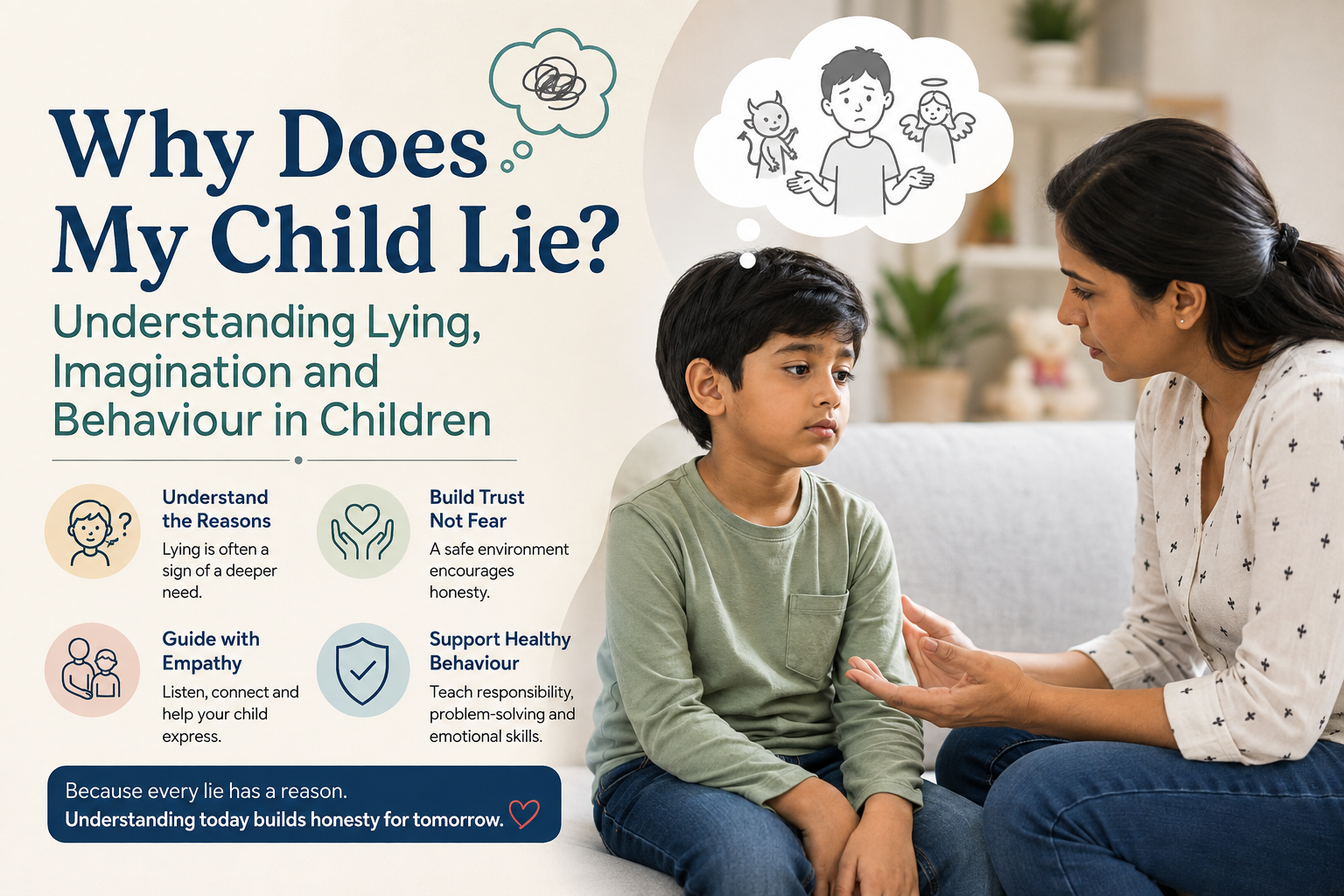
“Mera bachcha jhooth bolta hai, pata nahi kis se seekha hai!”
This is a common concern among Indian parents. A child denies breaking a toy, says they finished their homework when they did not, blames a sibling for something they did, or tells an elaborate story that clearly did not happen. For many parents, lying immediately feels like a sign of poor values, bad parenting, or a developing behavioural problem.
But children’s lies are not always as simple as they appear.
From a child psychology perspective, lying can have several meanings depending on the child’s age, emotional development, environment, and reason for telling the untruth. Sometimes a child is deliberately hiding something. At other times, what looks like a lie may actually be imagination, wishful thinking, fear, confusion, or an immature understanding of reality.
Understanding why a child lies is therefore more important than simply asking, “How do I stop my child from lying?”
In many cases, occasional lying can be a part of normal childhood development.
As children grow, they gradually develop the ability to understand that other people have different thoughts, knowledge, feelings, and perspectives. This developing social and cognitive ability also means that children eventually learn that they can influence what another person believes by changing or hiding information.
Younger children may not always have a clear understanding of the difference between imagination and reality. A preschooler might describe an imaginary event with complete confidence. This does not necessarily mean the child is intentionally trying to deceive anyone.
Older children, however, generally become more aware of the difference between truth and falsehood. At this stage, lying may be connected to fear of punishment, avoiding embarrassment, gaining attention, getting something they want, or protecting themselves emotionally.
Therefore, parents should consider the child’s developmental stage before interpreting the behaviour.
There is rarely one single reason behind lying. Understanding the motivation can help parents respond more effectively.
One of the most common reasons children lie is fear.
Imagine a child accidentally breaks an expensive object. If they expect shouting, hitting, humiliation, or severe punishment, they may immediately say:
“Maine nahi kiya.”
The lie may not necessarily indicate that the child does not understand right and wrong. Instead, it may reflect an attempt to avoid an immediate threat or unpleasant consequence.
If children repeatedly experience harsh reactions to mistakes, they may learn that hiding the truth feels safer than telling it.
Children may also lie to obtain something they want.
For example:
“Mummy ne mujhe chocolate khane di thi.”
“Teacher ne homework nahi diya.”
“Papa ne bola tha main game khel sakta hoon.”
This type of lying may be an attempt to manipulate a situation to achieve a desired outcome.
It is an opportunity for parents to teach children about honesty, responsibility and consequences without turning every incident into a moral crisis.
Sometimes children create stories because they want attention.
A child might say:
“Mere school mein sab mere best friends hain.”
Or:
“Maine aaj class mein sabse difficult question solve kiya.”
If a child notices that dramatic stories consistently receive attention, they may repeat the behaviour.
In such situations, parents can help by giving children positive attention for genuine achievements, effort and honest communication, rather than only responding strongly to exaggerated stories.
This is particularly important in younger children.
A child may tell you:
“Aaj ek dinosaur mere school ke bahar aaya tha.”
For an adult, this is obviously untrue. But the child may be engaging in imaginative play rather than consciously deceiving you.
Children have rich imaginations. They may create stories involving superheroes, imaginary friends, magical events, animals or impossible adventures.
Instead of immediately saying, “Stop lying,” parents can explore the story:
“Wow, that sounds like an amazing story. Was it something you imagined or something that really happened?”
This helps the child gradually understand the distinction between pretend and reality.
Sometimes children say what they wish were true.
For example:
“Mujhe kal school nahi jaana hai, teacher ne holiday announce kar diya.”
Or:
“Mera birthday gift already aa gaya hai.”
The child may be expressing a desire rather than intentionally planning a deception.
Parents can acknowledge the feeling while correcting the fact.
“I know you wish tomorrow was a holiday, but tomorrow is a school day.”
As children grow older, social acceptance becomes increasingly important.
A child who received poor marks might hide the result because they are embarrassed. Another child may lie about not being invited to a birthday party because admitting it could make them feel rejected.
In these situations, the lie may be connected to self-esteem and emotional vulnerability.
The underlying issue may not simply be dishonesty. It may be:
“I am afraid you will think I am not good enough.”
Parents need to address that emotional message as well.
Not every lie requires professional intervention.
Occasional lying is different from a persistent pattern of deception, manipulation, aggression, rule-breaking or other behavioural difficulties.
Parents may want to seek professional guidance if:
The child lies very frequently across different situations.
The child appears unable to acknowledge obvious facts.
Lying is accompanied by stealing or serious rule-breaking.
The child consistently blames others and refuses responsibility.
The behaviour is creating significant problems at home or school.
The child appears extremely fearful of telling the truth.
There are major changes in behaviour, mood, sleep, school performance or social functioning.
The child frequently creates elaborate stories that cause significant distress or impairment.
Parents and teachers are increasingly concerned about the child’s behaviour.
A child psychologist or child psychiatrist can assess the overall emotional, developmental and behavioural picture rather than focusing on lying in isolation.
One of the most common questions parents ask is:
“How do I know whether my child is lying or simply imagining things?”
Consider the child’s age and developmental level.
You can ask gentle questions such as:
“Did this really happen or was it part of your game?”
“Is this a story you made up?”
“What actually happened?”
“What do you wish had happened?”
Avoid immediately accusing the child.
For example, instead of:
“You are lying again!”
try:
“That sounds different from what I heard. Let’s figure out what really happened.”
This approach encourages truth-seeking without immediately placing the child in a defensive position.
Harsh punishment may stop a child from admitting the truth in that particular moment, but it does not necessarily teach honesty.
If a child learns:
Truth = severe punishment
they may become better at hiding mistakes rather than becoming more honest.
Physical punishment, humiliation, threats and repeated labeling such as “liar” can also damage the parent-child relationship.
Instead, parents can use calm consequences and accountability.
For example:
“If you spilled the juice, it is okay to tell me. We will clean it together. But if you hide it and blame someone else, we need to talk about taking responsibility.”
The message becomes:
Mistakes are manageable. Dishonesty has consequences. Telling the truth is safe.
Children should know that telling the truth does not automatically result in humiliation or extreme punishment.
This does not mean there should be no consequences. It means consequences should be predictable, proportionate and focused on learning.
When your child admits a mistake, acknowledge the honesty.
You can say:
“Thank you for telling me what actually happened. I am upset about what happened, but I am glad you told me the truth.”
This separates the behaviour from the child’s identity.
Labels can become part of a child’s self-image.
Instead of:
“You are such a liar.”
say:
“What you told me wasn’t true. Let’s talk about what really happened.”
Correct the behaviour without defining the child by it.
Children learn a great deal by observing adults.
If parents regularly ask children to hide information, make excuses, or give misleading explanations, children may receive confusing messages about honesty.
Parents can demonstrate:
“I made a mistake. I should have told you earlier.”
This teaches that honesty includes acknowledging our own mistakes.
Sometimes children lie because they don’t know how to handle difficult situations.
Teach them alternatives:
Ask for help.
Admit a mistake.
Say “I don’t know.”
Say “I forgot.”
Ask for another chance.
Explain what happened honestly.
These skills make honesty easier.
Academic pressure deserves special attention in the Indian context.
Children may hide poor marks, incomplete homework or disciplinary issues because they fear disappointing their parents.
If every academic mistake results in comparison with another child, children may begin hiding information.
Instead of immediately asking:
“How did Sharma ji ka beta score?”
focus on:
“What was difficult for you?”
This changes the conversation from comparison to problem-solving.
A child’s academic performance should be understood alongside their learning abilities, attention, emotional state, sleep, motivation and overall development.
A lie is sometimes a behaviour that points toward a deeper need.
The child may be saying:
“I am scared.”
“I don’t want to disappoint you.”
“I want your attention.”
“I wish this were true.”
“I don’t know how to handle this situation.”
“I made a mistake and don’t know what to do.”
“I am embarrassed.”
“I want more independence.”
This is why simply demanding:
“Tell me the truth!”
may not solve the underlying problem.
Parents need to understand the function of the behaviour.
If lying is persistent, escalating, causing significant family conflict, or occurring alongside emotional or behavioural concerns, a professional assessment may be helpful.
A child psychologist can explore the child’s emotional development, family environment, social relationships, behaviour and coping mechanisms. In some situations, a psychiatrist may also be involved when broader developmental, emotional or behavioural concerns require psychiatric assessment.
Professional support is not about labeling a child as “bad.” It is about understanding why the behaviour is happening and what support the child needs.
Children do not always lie because they are dishonest or “bad.” Sometimes they lie because they are afraid. Sometimes they are seeking attention. Sometimes they are testing boundaries. And sometimes they are simply using their imagination.
The most useful question is therefore not:
“How do I punish my child for lying?”
but:
“Why did my child feel the need to say this?”
When parents respond with curiosity, clear boundaries, emotional safety and age-appropriate consequences, children can gradually learn that telling the truth is safer, healthier and more effective than hiding mistakes.
If you are concerned about your child’s lying, behaviour, emotional regulation, attention, school performance or social development, speaking with a qualified child mental-health professional can help you understand the situation from a developmental and psychological perspective.
At The Lifestyle Clinic, professional psychological and psychiatric support can help parents better understand their child’s emotional and behavioural needs and identify appropriate next steps.