
Change sounds simple when we talk about it from the outside.
“Just stop drinking.”
“Quit smoking.”
“Start exercising.”
“Take your treatment seriously.”
“Think positively.”
For someone struggling with an addictive behaviour, an unhealthy habit, or a life pattern they know is hurting them, these statements can feel frustrating rather than helpful. The person may already know that something needs to change. They may have promised themselves—and their family—many times that they would do things differently.
Yet, knowing that change is needed and feeling ready to make that change are not always the same thing.
This is where Motivational Enhancement Therapy (MET) takes a different approach.
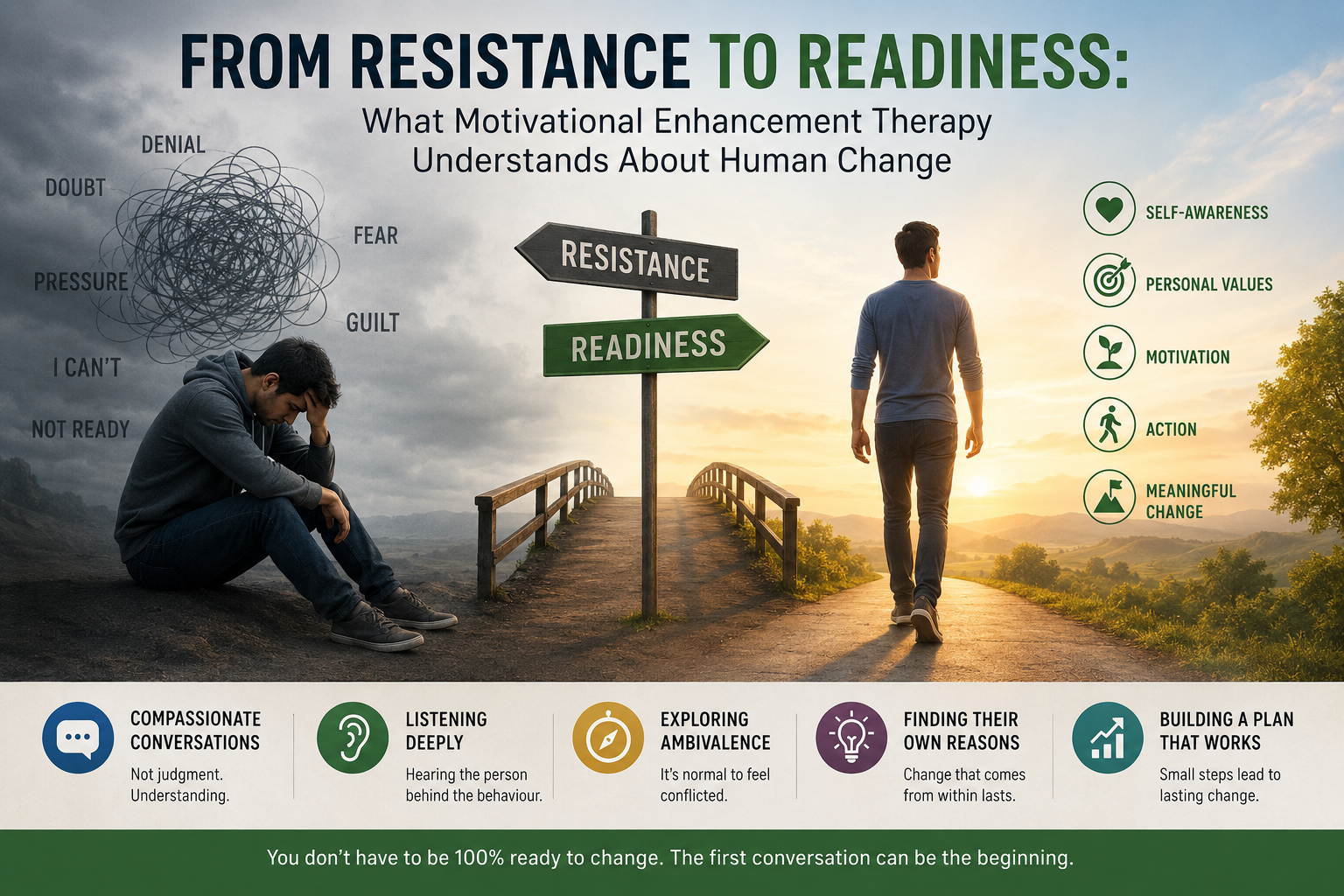
Instead of seeing resistance as stubbornness, lack of character, or unwillingness to cooperate, MET views it as something that can occur naturally when a person feels uncertain, pressured, afraid, or conflicted about change.
The goal is not to force someone into changing.
It is to help them discover their own reasons for change.
Most people have experienced this conflict in some form.
You may know that staying up late is affecting your health, yet continue doing it.
You may want to exercise but repeatedly postpone starting.
You may recognise that alcohol is affecting your relationships but still find yourself drinking.
You may want to reduce smoking but feel that cigarettes are one of the few things that help you manage stress.
This does not necessarily mean that you don’t care about your health.
Human behaviour is rarely driven by logic alone.
Our habits can provide immediate comfort, relief, pleasure, confidence, social connection, or escape—even when they create problems in the long term.
This creates an internal conflict:
“Part of me wants to change, but another part of me doesn’t.”
In psychology, this is known as ambivalence.
And ambivalence is often a normal part of the change process.
Imagine a person whose family brings them to a psychiatrist because of problematic drinking.
The family may say:
“He doesn’t accept that he has a problem.”
But the person may be thinking:
From the outside, these statements can sound like denial or resistance.
But underneath them may be fear, uncertainty, loss, shame, or lack of confidence.
MET tries to understand that underlying conflict rather than simply confronting it.
This distinction matters because repeatedly telling someone that they are wrong can sometimes make them defend their behaviour even more strongly.
Motivational Enhancement Therapy is a structured therapeutic approach that helps people strengthen their motivation and commitment toward positive behavioural change.
It is particularly associated with the treatment of substance-use problems, including alcohol and other addictive behaviours.
MET draws heavily from principles of motivational interviewing. Instead of the therapist simply telling the patient what they should do, the conversation explores the patient’s own thoughts, values, concerns, goals, and reasons for changing.
The central question becomes:
“What matters to you, and does your current behaviour take you closer to—or further away from—it?”
That question can be much more powerful than:
“Why don’t you just stop?”
Pressure can produce short-term compliance.
For example, someone may stop drinking because their spouse threatens to leave, their parents become angry, or their doctor warns them about the consequences.
Sometimes external pressure can be an important reason someone seeks help.
But sustainable change often becomes stronger when the person develops internal motivation.
There is a significant psychological difference between:
“I have to stop because everyone is forcing me.”
and
“I want to change because I don’t like what this is doing to my life.”
MET aims to help people move toward the second position.
This doesn’t mean family members have no role. In fact, family support can be extremely valuable. But the person’s own motivation remains an important part of lasting behavioural change.
One of the most important shifts in motivational therapy is moving from external expectations to personal reasons.
Consider two statements:
“I should stop drinking because my family keeps telling me to.”
versus
“I want to reduce my drinking because I don’t want my children to remember me this way.”
The second statement contains something personal.
It connects behaviour with values.
Perhaps the person’s values include being a good parent, maintaining their career, protecting their marriage, improving their health, or becoming financially stable.
When behaviour is examined against these values, motivation can become more meaningful.
The therapist’s role is not to manufacture motivation.
It is to help the person find it.
A common instinct when someone refuses to acknowledge a problem is to provide more evidence.
“Look at how much you’ve been drinking.”
“Your reports are abnormal.”
“Everyone in the family is suffering.”
“Don’t you realise what you’re doing?”
The intention may be good, but confrontation can sometimes create defensiveness.
The person may respond:
“You’re exaggerating.”
“It’s not that serious.”
“Other people drink more than me.”
The conversation becomes an argument about whether a problem exists rather than an exploration of whether the person wants something different from their life.
MET takes a less confrontational route.
Instead of trying to win an argument, the therapist may explore the person’s perspective and gently help them examine contradictions between their current behaviour and their personal goals.
One of the important concepts in motivational approaches is change talk—statements that express a person’s own desire, ability, reasons, or need for change.
For example:
These statements may appear small.
But psychologically, they are important because the person is beginning to articulate their own reasons for change.
Rather than the therapist repeatedly saying, “You need to change,” the patient begins saying it themselves.
That shift can be meaningful.
Another important idea is that people are rarely simply either “ready” or “not ready.”
Someone may be:
Readiness can fluctuate.
A person might say:
“I want to quit smoking, but I don’t know if I can.”
That statement contains both motivation and uncertainty.
Instead of treating uncertainty as failure, MET explores it.
What makes quitting important?
What makes it difficult?
What has worked before?
What are the consequences of continuing?
What would life look like if things improved?
These conversations can gradually help a person move from resistance toward readiness.
In India, conversations around addiction and behavioural change often involve the entire family.
Parents, spouses, siblings, and children may become deeply affected by one person’s behaviour.
Family members may respond with concern, anger, repeated reminders, monitoring, threats, or emotional appeals.
Often, these reactions come from genuine care.
But when every conversation becomes:
“You need to change.”
the person may start hearing only criticism.
A more productive conversation can sometimes begin with curiosity:
“What do you think is happening?”
“What concerns you about your drinking?”
“What would you like your life to look like six months from now?”
“If you decided to make one change, what would feel realistic?”
The aim is not to remove accountability.
It is to create a conversation in which the person can participate in their own change.
A common misunderstanding is that a non-confrontational approach means being permissive.
It doesn’t.
Motivational Enhancement Therapy does not mean telling someone that their behaviour is harmless.
It does not mean ignoring consequences.
And it does not mean avoiding difficult conversations.
Instead, it approaches those conversations differently.
The person can be encouraged to look honestly at the consequences of their behaviour while also being treated with respect and autonomy.
The message becomes:
“You are responsible for your choices, and you are also capable of making different choices.”
That combination of accountability and empathy is important.
Once someone develops a clearer personal reason for change, the next question becomes:
“What can I actually do about it?”
This is where motivation can translate into action.
Depending on the individual situation, treatment may involve setting realistic goals, identifying triggers, developing coping strategies, addressing underlying psychological concerns, building support systems, and creating a plan for maintaining change.
The exact treatment approach depends on the person’s needs and the nature and severity of the problem.
For some individuals, MET may be used as a focused intervention. For others, it may form part of a broader treatment plan.
Perhaps the most important message of Motivational Enhancement Therapy is that uncertainty does not mean treatment cannot begin.
You don’t necessarily have to walk into a clinic saying:
“I am completely ready to change.”
You can arrive saying:
“I don’t know if I have a problem.”
Or:
“I know I need to change, but I’m scared.”
Or:
“My family wants me to stop, but I’m not sure I do.”
These conversations can still be the beginning of meaningful change.
Sometimes readiness develops through the process of talking, reflecting, and understanding yourself better.
Human change is rarely a straight line.
There may be motivation, doubt, progress, setbacks, and renewed motivation.
What matters is not simply whether someone says, “I want to change.”
What matters is helping them understand why change matters to them, what is getting in the way, and what steps they are willing to take.
Motivational Enhancement Therapy recognises that people are more likely to engage in meaningful change when they are not simply told what to do, but are helped to discover their own reasons for doing it.
If you or someone in your family is struggling with addiction or another behaviour that has become difficult to control, speaking with a mental-health professional can be an important first step.
You don’t have to be completely ready for change before asking for help. Sometimes, the conversation is where readiness begins.