
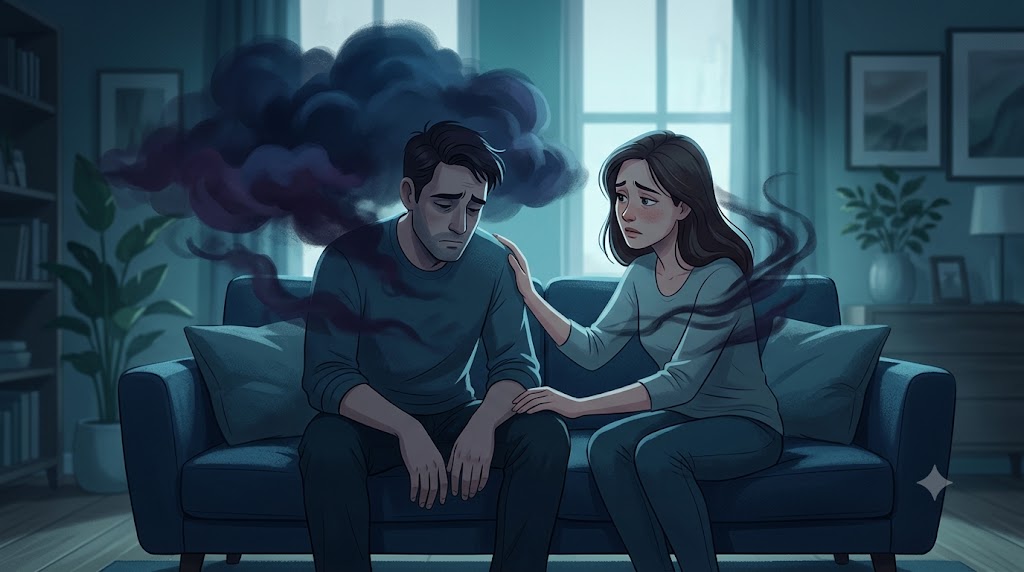
Marriage is often imagined as a partnership in which two people support each other through life’s uncertainties. But what happens when one partner begins experiencing depression? Gradually, the emotional landscape of the relationship may change. Conversations become shorter, affection may feel less spontaneous, everyday responsibilities become harder to manage, and the partner who once seemed emotionally available may begin to withdraw.
For the person experiencing depression, even simple tasks can require enormous effort. For their spouse, understanding this change can be equally difficult. They may feel worried, helpless, rejected, frustrated, or guilty for wanting things to return to how they used to be.
Over time, depression can become more than an individual mental health concern. It can influence communication, intimacy, parenting, household responsibilities, and the emotional connection between partners.
Understanding depression within a marriage requires recognising two realities: one partner is experiencing genuine psychological distress, and the relationship itself may also be struggling under its effects. Neither reality cancels out the other.
Depression is not simply sadness or a temporary loss of motivation. It can involve persistent low mood, diminished interest or pleasure, fatigue, sleep disturbances, changes in appetite, difficulty concentrating, feelings of worthlessness, and hopelessness. Its presentation varies from person to person.
Within a marriage, these symptoms may be interpreted as changes in the relationship rather than signs of psychological distress.
A partner who becomes emotionally withdrawn may appear uninterested in the marriage. Someone who struggles to complete routine tasks may seem irresponsible. Reduced sexual interest may be experienced as rejection, while irritability may make ordinary conversations feel unexpectedly hostile.
Consider a couple who previously enjoyed spending evenings together. One partner begins experiencing depression and increasingly spends time alone, finding even casual conversation exhausting. The other partner initially responds with concern, then begins to feel unwanted. They make repeated attempts to reconnect, but each unsuccessful attempt increases their frustration.
Neither partner necessarily wants to create distance. Yet depression can make connection difficult precisely when emotional support becomes especially important.
Recognising this distinction can change how couples understand what is happening. Instead of asking only, “Why has my partner changed towards me?” they can also begin asking, “Could my partner be struggling in ways I do not fully understand?”
Much of the conversation about depression understandably focuses on the person experiencing it. However, their spouse may also be dealing with considerable emotional strain.
They may become responsible for more household tasks, childcare, financial decisions, or family obligations. They may repeatedly encourage their partner to seek treatment, manage practical arrangements, or attempt to maintain a sense of normality for the family.
Alongside these responsibilities, they may experience uncertainty about how to respond.
Should they encourage their partner to participate in activities or allow them to rest? Should they discuss their own unhappiness or avoid adding to their partner’s distress? How can they offer reassurance without becoming responsible for their spouse’s entire emotional well-being?
These questions can create a persistent sense of walking on eggshells.
The non-depressed partner may suppress their own needs because expressing frustration feels selfish. Over time, however, unspoken exhaustion can become resentment. They may feel guilty about their resentment, especially when they recognise that their partner is unwell.
It is important to acknowledge that supporting someone with depression can be emotionally demanding. A spouse can love their partner deeply and still feel exhausted by the circumstances.
Recognising caregiver strain is not an act of disloyalty. It is part of understanding the full impact of depression on a relationship.
One of the most difficult aspects of depression within a marriage is that its symptoms can resemble relationship rejection.
A lack of affection may be interpreted as a loss of love. Reduced communication may feel like emotional abandonment. Irritability may be experienced as criticism, while low motivation may appear to reflect indifference towards shared responsibilities.
The partner experiencing depression may, in turn, feel misunderstood or pressured. They might hear suggestions to exercise, socialise, or think positively as evidence that their spouse does not understand how difficult daily life has become.
This creates a painful interpretative gap: one partner feels rejected, while the other feels unable to meet expectations.
The distinction between depressive symptoms and genuine relationship problems is not always straightforward. Depression can influence how people relate to each other, but it does not explain every disagreement or excuse hurtful behaviour. Marital difficulties may also precede depression, contribute to it, or develop alongside it.
A more constructive approach involves remaining curious about the meaning of each partner’s experience.
Instead of assuming that withdrawal means rejection, couples can discuss what is happening. The depressed partner might explain that conversation feels exhausting rather than unwanted. Their spouse can acknowledge this while expressing that prolonged silence leaves them feeling disconnected.
The aim is not to decide whose interpretation is correct. It is to develop a shared understanding that makes room for both experiences.
Healthy communication requires emotional energy, attention, and the ability to respond to another person’s perspective. Depression can interfere with all three.
A person experiencing depression may struggle to identify their feelings, articulate their needs, or imagine that circumstances can improve. Conversations about ordinary problems may therefore feel overwhelming.
Meanwhile, their spouse may become increasingly anxious about saying the wrong thing. Discussions that once felt routine can turn into emotionally charged exchanges.
Intimacy may also change. Sexual desire can decrease because of low mood, fatigue, medication effects, or reduced self-esteem. Non-sexual affection may become less frequent, and couples may stop discussing their intimate lives because the subject feels uncomfortable.
These changes can lead to misunderstandings on both sides.
The partner experiencing depression may feel inadequate or ashamed of being unable to participate in the relationship as before. Their spouse may interpret the lack of intimacy as evidence that they are no longer desirable.
Open communication can help couples separate physical and emotional changes from assumptions about love or attraction. This does not mean every concern should be attributed to depression. It means discussing changes without immediately assigning blame.
Small, manageable forms of connection can be helpful: sitting together without pressure to talk, sharing a meal, taking a short walk, or setting aside a few minutes to check in with each other.
The goal is not to recreate the relationship overnight. It is to maintain opportunities for connection while recognising the limits imposed by the current situation.
Some couples gradually develop a repetitive pattern in which one partner withdraws while the other pursues greater engagement.
The more one partner withdraws, the more the other seeks reassurance or demands change. The more pressure the withdrawn partner experiences, the further they retreat. Both partners may then feel increasingly alone.
For example, a spouse might repeatedly ask, “Why don’t you ever spend time with me anymore?” The person experiencing depression may hear this as criticism and respond defensively or withdraw further. Their spouse interprets that reaction as another sign of rejection and intensifies their efforts to obtain a response.
Over time, the argument becomes less about the original concern and more about the pattern itself.
Recognising this cycle can help couples move away from personal accusations.
The pursuing partner may need to express their need for connection without framing it as a character judgement. The withdrawing partner may need support in communicating their limits rather than disappearing from the conversation entirely.
This does not mean both partners are equally responsible for the depressive illness. Rather, it acknowledges that the way a couple responds to distress can either intensify or reduce the relational strain surrounding it.
Depression is a treatable mental health condition, and professional assessment can help determine the appropriate course of care.
Depending on the individual’s symptoms, history, severity, and preferences, treatment may involve psychotherapy, medication, or a combination of approaches. A qualified mental health professional can also assess other possible contributing factors and help establish an appropriate treatment plan.
A spouse can encourage treatment, offer practical assistance, and provide emotional support. However, they cannot be expected to function as their partner’s therapist.
This distinction is important because couples sometimes fall into roles that are difficult to sustain. One partner becomes responsible for monitoring symptoms, motivating the other, managing appointments, and assessing progress. The other may begin to experience every conversation as an evaluation of their recovery.
Professional treatment helps establish a space where the person experiencing depression can receive appropriate care without placing the entire responsibility for improvement on their marriage.
It is equally important not to assume that treating depression will automatically resolve every relationship difficulty. Some concerns may have developed independently of the illness and may require direct attention.
Marital counselling can help couples understand how depression affects their interactions and identify ways to respond more constructively.
The purpose is not to blame either partner or suggest that relationship problems caused the depression. Instead, counselling provides a structured setting in which both people can discuss their experiences and understand the patterns that have developed around the illness.
Several areas may be addressed during counselling.
1. Improving communication
Couples can learn to express needs without criticism and listen without immediately becoming defensive. They may practise distinguishing between a partner’s symptoms, their own emotional reactions, and assumptions about what those symptoms mean.
2. Rebuilding emotional connection
Counselling can help couples identify realistic ways to maintain closeness, even when energy, motivation, or sexual interest is reduced. This may involve establishing manageable routines for connection without creating unrealistic expectations.
3. Addressing resentment and unequal responsibilities
When one partner has been carrying most household or family responsibilities, counselling can help the couple discuss the imbalance openly. Practical adjustments may be necessary while symptoms are severe, with expectations reviewed as circumstances change.
4. Establishing healthy boundaries
Supporting a spouse does not mean abandoning personal needs. Couples can explore how to provide support while preserving individual time, social connections, and emotional well-being.
5. Developing a shared understanding of recovery
Recovery is rarely a perfectly linear process. Counselling can help couples recognise gradual changes, prepare for difficult periods, and avoid interpreting every setback as evidence that treatment has failed.
Where appropriate, marital counselling can complement individual depression treatment. It does not replace individual assessment or treatment when these are needed.
If there is coercion, intimidation, or abuse within the relationship, safety must take priority. Joint counselling may not be appropriate in every such situation, and individual support may be necessary.
There is no single correct way to support a spouse experiencing depression. Nevertheless, a few principles can make the process more sustainable.
Acknowledge the illness without reducing your partner to it. Depression may explain some changes in behaviour, but your spouse remains a person with preferences, strengths, and responsibilities.
Offer specific, practical support. Instead of saying, “Tell me if you need anything,” consider asking whether help with an appointment, a meal, or a household task would be useful.
Avoid turning encouragement into pressure. Gentle invitations may be more manageable than repeated demands to become active, social, or cheerful.
Communicate your own needs honestly. It is possible to say, “I know things are difficult for you, and I also miss spending time together.”
Maintain support outside the marriage. Trusted friends, family members, or a mental health professional can provide space to process your own feelings.
Recognise when professional help is needed. Persistent symptoms, worsening functioning, or significant distress deserve clinical attention rather than reliance on willpower alone.
If your partner talks about suicide, expresses a wish to die, or appears at immediate risk of harming themselves, take it seriously and seek urgent professional assistance. In India, emergency services can be reached at 112. Do not leave an individual alone if there is immediate danger and it is safe for you to remain with them.
A common misconception is that relationship concerns should be postponed until the depressed partner has fully recovered.
In some circumstances, temporarily reducing relationship demands may be sensible. However, ignoring every marital concern can allow emotional distance and resentment to become more deeply established.
Couples do not need to resolve every disagreement while one partner is unwell. They can instead identify which issues require immediate attention and which can be revisited later.
For example, a serious safety concern or escalating hostility requires timely intervention. A disagreement about how to divide a non-urgent household task may be addressed through a temporary arrangement and revisited when the partner has more capacity.
The important distinction is between accommodating the effects of an illness and allowing the relationship to become a place where neither person’s needs can be discussed.
Both partners deserve compassion. Both deserve to be heard. And both may need support to navigate a situation neither anticipated when they entered the marriage.
Depression inside a marriage can create a painful contradiction. The partner who needs support may have less capacity to offer it, while the spouse trying to provide support may gradually become emotionally depleted.
Without understanding, these experiences can be mistaken for rejection, indifference, or a loss of love. With appropriate treatment, open communication, and realistic expectations, couples can begin to understand the distinction between the illness and the relationship patterns that develop around it.
Healing does not require one partner to sacrifice their well-being for the other. Nor does it require the person experiencing depression to recover on a timetable determined by the relationship.
It requires recognising that individual mental health and relational well-being are connected, while remaining attentive to the needs of each person.
Marital counselling can provide a space to understand these dynamics, rebuild communication, address resentment, and develop healthier ways of supporting one another.
Sometimes, the first step towards healing a marriage is not asking how to make things return to the way they were. It is learning how to understand what both partners are experiencing now—and deciding, together, what support and change are needed next.
Seeking professional support: If depression is affecting your relationship, consider consulting a qualified mental health professional for an individual assessment and, where appropriate, marital counselling. Early support can help address psychological distress and relationship difficulties before they become more entrenched.