
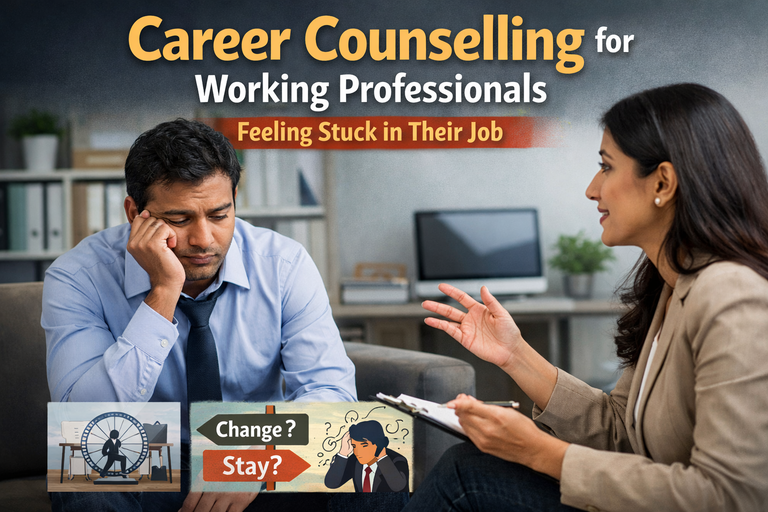
It’s a feeling many working professionals know all too well: that dull ache of dissatisfaction, the nagging sense that you’re treading water, or worse, sinking. You’ve put in the years, built experience, perhaps even achieved a degree of success, yet the spark is gone. The daily grind feels less like progress and more like quicksand. If this resonates with you, you’re not alone. The feeling of being “stuck” in your job, despite having a job, is a pervasive challenge for many mid-career and senior professionals.
This isn’t about laziness or a lack of ambition. Often, it’s a symptom of deeper misalignment – a disconnect between where you are and where you truly want to be. And that’s where career counseling for working professionals becomes not just helpful, but often essential.
Before we delve into the solution, let’s understand the problem. Why do experienced professionals, seemingly established in their fields, find themselves feeling stuck?
The Golden Handcuffs: You’re earning well, enjoying benefits, and the thought of leaving feels financially risky. The comfort of the known often outweighs the fear of the unknown, even if the known is unfulfilling.
Lack of Growth Opportunities: The ladder you were climbing suddenly has no more rungs, or the next rung isn’t appealing. Stagnation in learning and development can quickly lead to disengagement.
Misalignment of Values: The company culture, its mission, or even the core responsibilities of your role no longer align with your personal values or what you deem important.
Burnout and Exhaustion: The relentless pace, pressure, or sheer volume of work has taken its toll, leaving you depleted and unmotivated.
Loss of Purpose: You’ve achieved what you set out to do, but now wonder, “Is this all there is?” The initial drive or passion has waned, replaced by a sense of emptiness.
Skills Obsolescence (or Fear of It): The industry is evolving rapidly, and you worry your skills aren’t keeping pace, leading to insecurity about your future relevance.
Fear of Change: The idea of starting over, retraining, or even just looking for a new job can be daunting, especially after years in a comfortable routine.
External Pressures: Family expectations, financial commitments, or societal norms can make it incredibly difficult to consider a significant career shift.
These internal and external pressures can create a complex web of emotions – frustration, anxiety, demotivation, and even a quiet despair. But it’s crucial to remember that this feeling is a signal, not a sentence. It’s an invitation to explore, to reassess, and to redefine your professional path.
Forget the image of career counseling as something solely for fresh graduates. For working professionals, it’s a sophisticated, strategic partnership designed to help you navigate complex career challenges and make informed decisions about your future. It’s not about finding a job; it’s about finding the right job, or even redefining your current job, to align with your evolving self.
A professional career counselor acts as:
An Objective Mirror: They provide an unbiased perspective, helping you see patterns, strengths, and blind spots you might miss.
A Strategic Guide: They offer frameworks, tools, and methodologies to systematically explore your options, rather than relying on gut feeling alone.
A Sounding Board: A safe space to voice your fears, aspirations, and frustrations without judgment.
An Accountability Partner: They help you set realistic goals and develop actionable steps to achieve them.
An Information Hub: They can provide insights into industry trends, market demands, and various career paths you might not have considered.
The process of career counseling is highly individualized, but generally follows several key stages:
This is the foundational step. You can’t know where you’re going if you don’t know who you are and what truly motivates you now.
Values Clarification: What truly matters to you in your work and life? Is it impact, autonomy, creativity, financial security, work-life balance, collaboration, innovation? Often, feeling stuck stems from a misalignment of your current role with your deepest values.
Skills Inventory and Strengths Identification: Beyond your job description, what are you truly good at? What comes naturally to you? What skills do you enjoy using? Counselors use assessments (like VIA Character Strengths, CliftonStrengths, or others) to help you articulate your unique value proposition.
Interests and Passions Re-evaluation: What did you love doing before your career took its current shape? What intellectual curiosities do you have? Sometimes, dormant interests can be reignited and integrated into a new career path or even a side hustle.
Personality Profiling: Understanding your personality type (e.g., using MBTI, Big Five) can shed light on work environments where you thrive and roles that align with your natural preferences.
Work-Life Balance Audit: Are your professional demands encroaching too much on your personal life? Defining your ideal balance is crucial for sustainable career satisfaction.
Example: Sarah, a marketing manager, felt burnt out. Through counseling, she realized her core value of “impact” was unfulfilled in her current role, which focused heavily on internal reporting rather than external community engagement. She also rediscovered a long-lost interest in environmental causes.
Once you have a clearer picture of yourself, the counselor helps you brainstorm and explore potential paths. This is where creative thinking and challenging assumptions come into play.
Internal Mobility: Could a different role or department within your current organization be a better fit?
Career Pivoting: Exploring entirely new industries or functions that leverage your transferable skills. This could be a “soft pivot” (e.g., project manager in tech to project manager in healthcare) or a “hard pivot” (e.g., accountant to graphic designer).
Entrepreneurship/Freelancing: Is starting your own venture or offering your services independently a viable option?
Further Education/Reskilling: Identifying gaps in your knowledge or skills and exploring advanced degrees, certifications, or bootcamps.
“De-promotion” or Downshifting: For some, reducing responsibility or hours might be the key to regaining control and satisfaction.
Portfolio Career: Combining multiple part-time roles, projects, or interests to create a diverse and fulfilling professional life.
Example: Building on Sarah’s insights, the counselor helped her research roles in sustainability marketing within non-profits, exploring how her current skills in strategy and communication could be applied to a field aligned with her values.
This is where the vision becomes actionable.
Goal Setting: Defining clear, measurable, achievable, relevant, and time-bound (SMART) goals for your career transition.
Action Planning: Breaking down large goals into smaller, manageable steps. This might include networking strategies, updating your resume/LinkedIn, acquiring new skills, or conducting informational interviews.
Risk Assessment and Mitigation: Exploring the potential challenges and developing contingency plans. How will you manage financial implications, family reactions, or the learning curve of a new role?
Networking Strategies: Developing a targeted approach to connect with people in your desired fields or roles. Counselors can provide guidance on effective networking and informational interviewing.
Resume/CV and LinkedIn Optimization: Tailoring your professional presence to reflect your new direction and highlight transferable skills.
Interview Preparation: Practicing how to articulate your career story and explain your transition effectively.
Example: Sarah decided to pursue a certificate in sustainable business practices while volunteering for a local environmental group. Her counselor helped her update her LinkedIn to reflect these new interests and identify key people in the environmental sector for informational interviews.
The journey doesn’t end with a plan; it continues through its execution.
Ongoing Support: Counselors provide encouragement, feedback, and accountability as you implement your plan.
Overcoming Obstacles: Helping you navigate setbacks, rejections, or moments of doubt.
Refinement: The plan is dynamic. As you learn more, the counselor helps you adjust and refine your strategy.
Celebrating Milestones: Acknowledging progress and maintaining motivation throughout the transition.
Choosing the right counselor is paramount. Look for someone who:
Specializes in working with professionals: Their experience should align with the complexities of mid-career transitions.
Has relevant certifications/credentials: Look for qualifications from reputable bodies.
Offers a clear methodology: Understand their approach and what the process entails.
Is a good personality fit: You’ll be sharing personal information, so trust and rapport are essential.
Offers a discovery call: Many counselors provide a free initial consultation to discuss your needs and see if there’s a good match.
Don’t hesitate to ask about their experience, success stories, and how they measure progress.
Engaging in career counseling is an investment – of time, energy, and money. However, the cost of staying stuck can be far greater: diminished well-being, lost potential, reduced earning capacity in the long run, and the quiet regret of not pursuing a more fulfilling path.
Think of it as investing in your future happiness and professional longevity. It’s about taking proactive control of your narrative rather than passively letting circumstances dictate your career.
Feeling stuck is a signal that it’s time for change. It’s an opportunity to pause, reflect, and intentionally design a professional life that brings you greater satisfaction, purpose, and growth. Career counseling for working professionals is not a quick fix, but a powerful partnership that provides the clarity, strategy, and support you need to unlock your potential and confidently step into your next, more fulfilling chapter.
Don’t let the feeling of being stuck define your professional journey. Take the courageous step to explore what truly lies ahead. Your future self will thank you.