
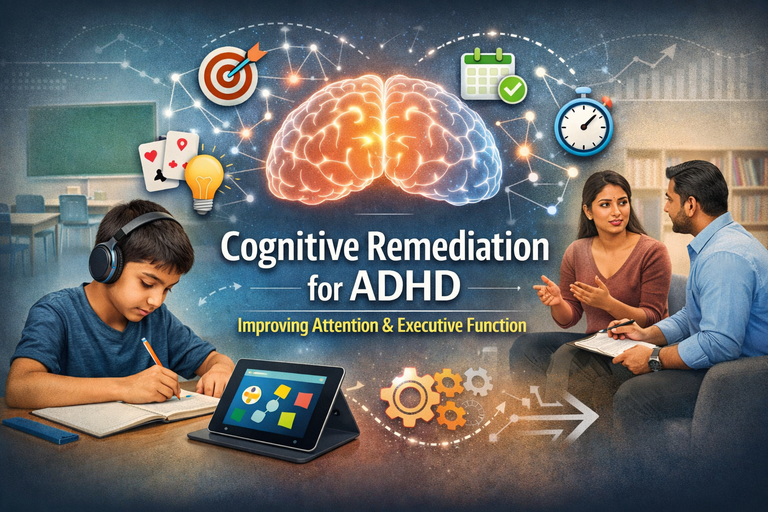
Attention-Deficit/Hyperactivity Disorder (ADHD) is often misunderstood as “just a problem of distraction or hyperactivity.” In reality, ADHD is a neurodevelopmental condition that significantly affects how the brain manages attention, memory, planning, impulse control, and emotional regulation. These abilities together are known as executive functions.
While medication and behavioural therapy remain common treatment approaches, an increasing number of psychologists are now using Cognitive Remediation Therapy (CRT) to address the core cognitive deficits seen in ADHD. Cognitive remediation focuses on training the brain itself, helping individuals build stronger attention, working memory, and executive functioning skills that translate into real-world improvements.
This blog explores how cognitive remediation works for ADHD, who can benefit, and why it is emerging as a powerful evidence-based intervention.
ADHD affects both children and adults. Common challenges include:
Difficulty sustaining attention
Poor working memory
Problems with planning and organisation
Impulsivity and poor inhibitory control
Trouble regulating emotions
Difficulty completing tasks despite effort
These difficulties are not due to lack of intelligence or motivation. Brain imaging studies show that ADHD is associated with differences in prefrontal cortex functioning, the area responsible for executive control.
Traditional interventions often focus on managing behaviour, but cognitive remediation targets the underlying cognitive processes, offering deeper and longer-lasting improvements.
Cognitive Remediation Therapy is a structured, goal-oriented psychological intervention designed to improve cognitive skills through repeated practice, strategy learning, and therapist guidance.
CRT is based on the principle of neuroplasticity—the brain’s ability to change and reorganize itself through targeted training.
Unlike general brain games, cognitive remediation is:
Individualized
Clinically guided by a psychologist
Linked to real-life functional goals
Focused on transfer of skills to daily activities
Cognitive remediation for ADHD focuses on strengthening the following areas:
Sustained attention
Selective attention
Divided attention
CRT trains individuals to maintain focus for longer periods and reduce distractibility in both academic and daily tasks.
Working memory is the ability to hold and manipulate information in the mind. In ADHD, this is often impaired, leading to:
Forgetting instructions
Losing track of tasks
Difficulty following conversations
CRT includes exercises that progressively strengthen working memory capacity.
Executive functions include:
Planning and organization
Task initiation and completion
Time management
Cognitive flexibility
Cognitive remediation helps individuals learn structured problem-solving and goal-management strategies.
Many people with ADHD struggle with impulse control. CRT works on:
Response inhibition
Delaying gratification
Thoughtful decision-making
This can significantly reduce impulsive behaviors.
Cognitive remediation is not a one-size-fits-all program. A typical process includes:
A psychologist evaluates attention, memory, processing speed, and executive function using standardized tools.
Based on assessment results, a personalized program is designed targeting specific deficits relevant to the person’s daily challenges.
Exercises may include:
Computer-based tasks
Paper-pencil activities
Strategy learning tasks
Real-life simulations
The difficulty level is adjusted continuously to challenge the brain without overwhelming it.
Clients are taught metacognitive strategies—thinking about how they think—so skills can be applied outside therapy sessions.
Therapists actively help clients apply cognitive skills to:
Schoolwork
Workplace tasks
Household responsibilities
Social situations
Medication can be effective in reducing symptoms such as hyperactivity and inattention, but it does not teach cognitive skills. Once medication is stopped, benefits may reduce.
Cognitive remediation:
Builds lasting cognitive capacity
Improves self-regulation skills
Enhances functional independence
Works alongside medication or independently
Many individuals benefit most from a combined approach, using medication for symptom control and CRT for cognitive development.
Research and clinical experience show multiple benefits:
Improved attention span
Better task completion
Enhanced academic or work performance
Increased self-confidence
Reduced frustration and emotional dysregulation
Better time management and organization
Long-term cognitive improvements
Parents often report improved classroom behaviour in children, while adults notice better productivity and reduced mental fatigue.
For children, CRT is delivered in a playful, engaging, and age-appropriate manner. Sessions focus on:
Improving classroom attention
Enhancing learning abilities
Strengthening self-control
Supporting academic skills
Parents and teachers are often involved to ensure consistency across environments.
Adult ADHD often affects:
Career growth
Time management
Relationships
Self-esteem
CRT helps adults:
Structure their thinking
Reduce procrastination
Improve decision-making
Build effective coping strategies
Many adults report feeling more “mentally organized” after consistent therapy.
Yes. Multiple studies support the effectiveness of cognitive remediation for improving:
Working memory
Attention regulation
Executive functioning
While results vary depending on individual engagement and program quality, CRT is increasingly recommended as part of comprehensive ADHD management.
Cognitive remediation may be helpful if:
ADHD symptoms interfere with daily functioning
Medication alone is insufficient or not preferred
There are learning difficulties or executive dysfunction
The individual struggles with organization and follow-through
CRT is suitable for both children and adults.
Typically:
Sessions: 1–2 times per week
Duration: 12–24 weeks depending on goals
Improvements are gradual but cumulative
Consistency is key for meaningful results.
While highly beneficial, CRT:
Requires motivation and participation
Is not a quick fix
Works best under trained psychological supervision
It is most effective when combined with psychoeducation, behavioural strategies, and lifestyle support.
Cognitive Remediation Therapy offers a powerful, science-backed approach to addressing the core cognitive challenges of ADHD. By strengthening attention, working memory, and executive function, CRT helps individuals not just manage symptoms, but build lasting cognitive skills for everyday life.
For children struggling academically or adults feeling overwhelmed by disorganization, cognitive remediation provides hope beyond symptom control—helping the brain learn, adapt, and function more effectively.