
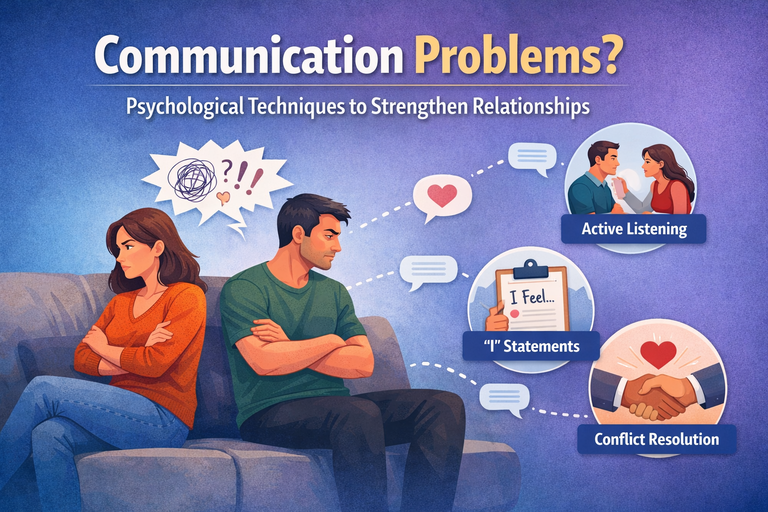
Communication problems in relationships are one of the most common reasons couples and families seek professional help. When conversations repeatedly end in conflict, silence, or misunderstanding, the relationship slowly starts to feel unsafe and disconnected. Effective communication, however, is a learnable psychological skill that can transform how partners, parents, children, friends, and even colleagues relate to each other.
This blog explains why communication breaks down and outlines evidence‑informed psychological techniques you can start using immediately to strengthen your relationships. The focus is on practical, therapist‑style tools you can apply at home or in everyday interactions.
Communication problems in relationships rarely appear overnight; they emerge from repeated patterns that slowly erode trust and emotional safety. Over time, small misunderstandings can harden into resentment, criticism, or withdrawal if they are not addressed.
Common factors that fuel poor communication include:
Assumptions and “mind‑reading,” where each person believes the other should just know what they feel or need.
Defensiveness and blame, where both focus on being right instead of understanding the other’s perspective.
Emotional flooding, where the nervous system goes into fight, flight, or freeze and rational problem‑solving shuts down.
Avoidance or passive‑aggressive communication, where needs are expressed indirectly through sarcasm, silence, or irritability.
Recognising these patterns is the first therapeutic step; the next is to intentionally practise new communication habits grounded in psychological science.
Active listening is a core relationship skill taught in most evidence‑based couples therapies. It means listening to understand, not simply waiting for your turn to respond or defend.
You can build this skill by:
Reflecting and paraphrasing: Briefly summarise what the other person has said, and check if you understood correctly.
Staying present: Put away phones and other distractions, and pay attention to tone, facial expressions, and body language.
Validating emotions: Acknowledge the feeling, even if you see the situation differently, for example, “I can see why that felt hurtful.”
When people feel genuinely heard and emotionally validated, their defensiveness decreases and they become more open to problem‑solving and compromise.
Shifting from “you” accusations to “I” statements is a simple but powerful cognitive‑behavioural communication tool. Blaming phrases such as “You never listen” or “You always ignore me” tend to trigger immediate defensiveness.
An “I” statement follows a structure like:
“I feel [emotion] when [situation] because [reason].”
For example: “I feel anxious when plans change suddenly because I find it hard to adjust at the last minute.” This format focuses on your internal experience rather than attacking the other person’s character.
Over time, using “I” statements helps both partners understand each other’s emotional world more clearly and reduces escalation during difficult conversations.
Attachment theory suggests that people develop characteristic ways of relating—secure, anxious, or avoidant—based on early experiences of safety and care. These attachment styles often shape how adults communicate in close relationships.
Secure individuals are generally comfortable with emotional closeness and open dialogue.
Anxiously attached partners may seek frequent reassurance and can become highly activated by silence or distance.
Avoidant partners may shut down or withdraw when conversations feel too emotional or overwhelming.
Recognising your own and your partner’s attachment tendencies allows you to interpret reactions more compassionately: withdrawal may reflect overwhelm rather than lack of love, while intensity may reflect fear of loss rather than control. Attachment‑focused therapies, such as Emotionally Focused Therapy (EFT), explicitly work on these patterns.
When conflict escalates, emotions often move faster than cognition. Taking a structured pause is not avoidance; it is an emotional regulation strategy that protects the relationship from impulsive, hurtful responses.
A simple technique involves:
Noticing your signs of escalation, such as raised voice, racing thoughts, or bodily tension.
Verbally requesting a pause: “I want to continue this, but I need ten minutes to calm down so I can think clearly.”
Returning to the conversation after the agreed time, with a focus on problem‑solving and curiosity rather than winning the argument.
Practised consistently, this reduces the “attack–withdraw” cycle that is commonly seen in distressed couples.
Many communication problems in relationships are not about the topic being discussed but about unspoken, poorly understood emotions underneath. Emotional literacy—the ability to identify, name, and express feelings accurately—can be developed like any other skill.
You can strengthen emotional literacy by:
Using more specific emotion words such as “disappointed,” “lonely,” or “overwhelmed” instead of only “angry” or “fine.”
Reflecting on patterns: noticing which situations repeatedly trigger irritability, shutdown, or arguments.
Practising empathy mapping: asking yourself, “What might my partner be feeling right now beneath their words or behaviour?”
As emotional vocabulary expands, conversations shift from surface‑level blame to deeper understanding of needs, fears, and longings.
A large proportion of relational communication is nonverbal—tone of voice, posture, facial expressions, and eye contact often carry more emotional weight than the words themselves. In therapy, clients are frequently guided to notice and adjust these signals.
To align verbal and nonverbal communication:
Maintain an open posture and gentle eye contact, especially during difficult topics.
Notice whether your tone matches your intention; a sharp or sarcastic tone can undo a well‑worded sentence.
Use small nonverbal gestures—like a reassuring touch or nod—to signal that you are engaged and supportive.
When nonverbal cues match the message, the other person is more likely to feel emotionally safe and less likely to misinterpret your intentions.
Relationship researchers John and Julie Gottman describe the idea of a “Love Map”—a mental map of your partner’s inner world, including their current stresses, hopes, and values. Regularly updating this map keeps couples emotionally close.
You can build this by asking open‑ended questions such as:
“What has been stressing you out lately that I may not know fully?”
“What are you most looking forward to in the next few months?”
“Is there anything I can do differently to support you better right now?”
These conversations help you stay attuned to each other beyond day‑to‑day logistics and reduce the risk of “growing apart” silently.
Gottman’s research suggests that stable, satisfied couples tend to maintain a high ratio of positive to negative interactions, even during disagreements. Small but frequent positive moments act as emotional buffers when inevitable conflicts arise.
Examples of positive micro‑interactions include:
Expressing appreciation: “Thank you for handling that; it really helped me today.”
Sharing small moments of humour or affection, even on busy days.
Offering practical support, like making tea for a stressed partner or sending a caring message before a tough meeting.
These actions build a sense of goodwill and trust, which makes difficult conversations feel less threatening.
Healthy communication in relationships is easier to maintain when there are predictable rituals of connection built into daily and weekly life. Mental health–focused SEO guides also emphasise clear structure and predictable sections, which mirrors how humans find emotional structure reassuring.
Helpful rituals might include:
A daily ten‑minute check‑in without screens, where each person shares one good thing and one challenge from the day.
A weekly “emotional review,” where you discuss stressors, needs, and any early signs of resentment before they build up.
Setting a specific time to discuss recurring issues, rather than letting them erupt unexpectedly during already stressful moments.
Such rituals act like regular maintenance for the relationship, preventing small issues from turning into chronic communication problems.
Sometimes communication problems are rooted in deeper issues—past trauma, intense mood symptoms, long‑standing resentment, or patterns that repeat across multiple relationships. In these situations, therapy provides structured, evidence‑based support.
Therapists may draw from:
Cognitive Behavioural Therapy (CBT) to challenge unhelpful thoughts such as “They never care about me” or “Conflict always means abandonment.”
Emotionally Focused Therapy (EFT) to reshape attachment patterns and create more secure emotional bonds.
Gottman‑based interventions to teach specific communication, conflict management, and connection rituals.
Seeking help is a sign of responsibility towards the relationship, not a sign of failure, and can significantly improve both communication and overall relationship satisfaction.