
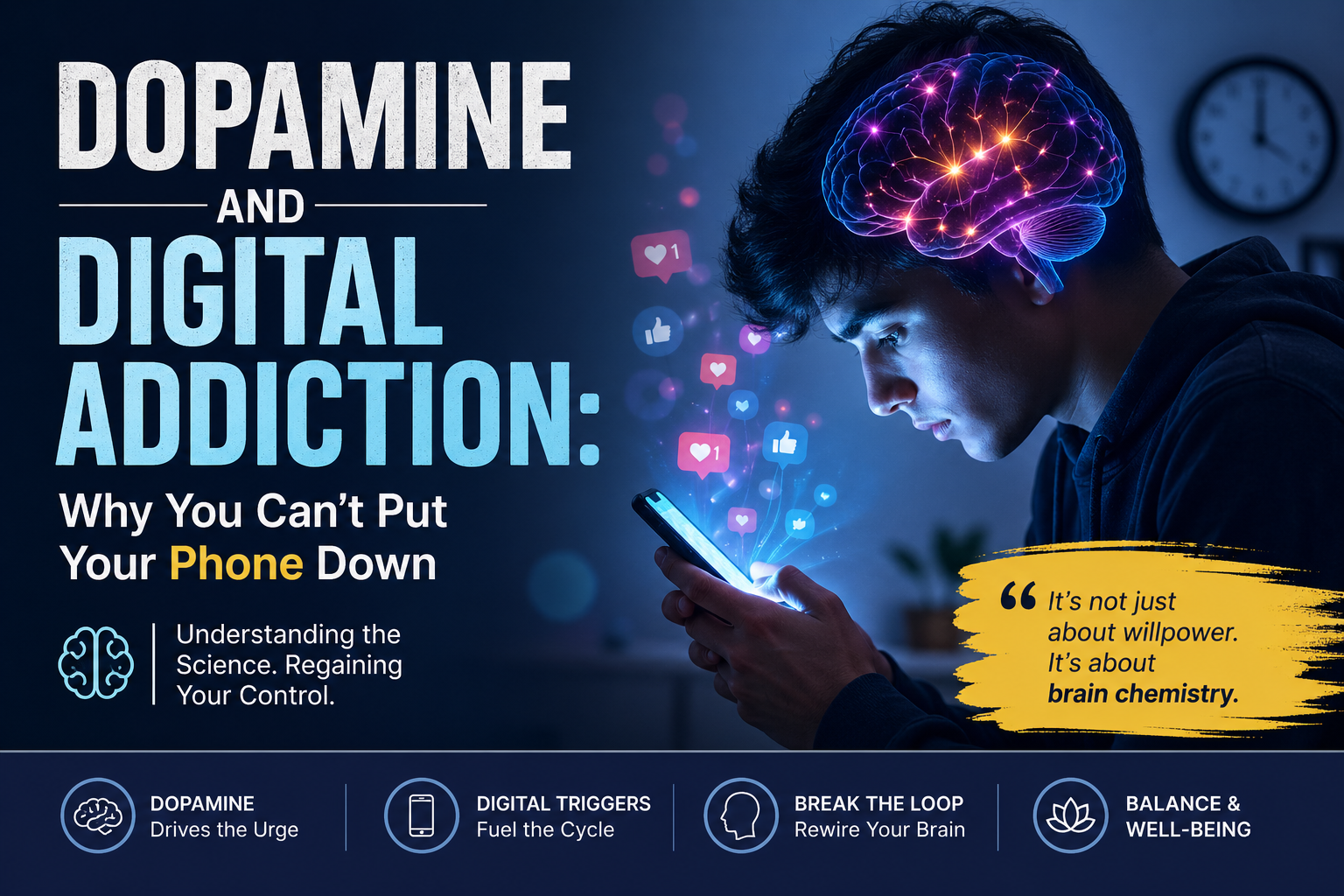
If you’ve ever picked up your phone “just for a minute” and found yourself scrolling 30 minutes later, you’re not alone. Across India and the world, people are increasingly struggling to disconnect from their screens. But this isn’t just a matter of poor discipline—it’s deeply rooted in how your brain works.
At the center of this behavior lies dopamine, a powerful brain chemical that shapes motivation, pleasure, and habit formation. Understanding how dopamine interacts with digital technology can help you regain control—and that’s exactly what this guide will walk you through.
Dopamine is a neurotransmitter—essentially a chemical messenger in your brain—that plays a key role in:
Contrary to popular belief, dopamine isn’t just about feeling good. It’s more about wanting than liking. It drives you to seek out rewards—whether that’s food, social interaction, or… your phone.
Modern apps are not accidental—they are carefully designed to capture and hold your attention. Every notification, like, comment, or new video triggers a small dopamine release.
Here’s how it works:
Social media apps use unpredictable rewards—just like slot machines. Sometimes you get lots of likes, sometimes you don’t. This unpredictability keeps you hooked.
There’s no natural stopping point. Your brain keeps expecting “just one more interesting thing.”
Likes, shares, and comments act as social approval signals, reinforcing repeated behavior.
You keep checking your phone because you’re afraid of missing something important.
If you feel like you “can’t stop,” it’s not weakness—it’s neuroscience.
Your brain forms a loop:
Trigger → Action → Reward → Repeat
Example:
Over time, this loop becomes automatic.
You may be experiencing digital addiction if you notice:
If multiple signs feel familiar, it’s worth paying attention.
Excessive screen use doesn’t just waste time—it can significantly affect your mental well-being.
Constant notifications keep your brain in a hyper-alert state.
Comparison with others on social media can lower self-esteem.
Short-form content rewires your brain to prefer quick stimulation.
Blue light and late-night scrolling disrupt your sleep cycle.
Many people try to quit or reduce phone use using sheer willpower—but fail.
Why?
Because you’re fighting against:
This is why structured strategies and psychological tools work better than just “trying harder.”
Here are practical, science-backed steps you can start today:
Use built-in tools like Screen Time (iPhone) or Digital Wellbeing (Android) to understand:
Awareness reduces unconscious behavior.
Make it slightly harder to access addictive apps:
Small barriers can significantly reduce usage.
Instead of vague goals like “use less,” define:
If you simply remove phone time, your brain will look for another quick dopamine source.
Replace it with healthier alternatives:
Take intentional breaks:
This helps your brain reset its reward sensitivity.
When you feel the urge to check your phone:
👉 Wait 10 minutes
Often, the urge passes. This builds impulse control over time.
Your surroundings influence your habits:
If self-help strategies aren’t enough, professional help can make a huge difference.
Psychologists and psychiatrists use evidence-based approaches like:
Helps identify and change thought patterns driving excessive phone use.
Breaks automatic behavior loops and replaces them with healthier habits.
Addresses underlying issues like stress, loneliness, or boredom.
Improves communication and reduces conflict around screen use.
Consider consulting a mental health professional if:
Early intervention leads to better outcomes.
Let’s be clear—phones are not the enemy.
They are tools for:
The goal isn’t to quit completely—but to use technology consciously instead of compulsively.
Digital addiction is real—but it’s also manageable.
Once you understand how dopamine drives your behavior, you stop blaming yourself and start taking practical steps toward change.
Small changes, consistently applied, can rewire your brain and restore your focus, peace, and productivity.