
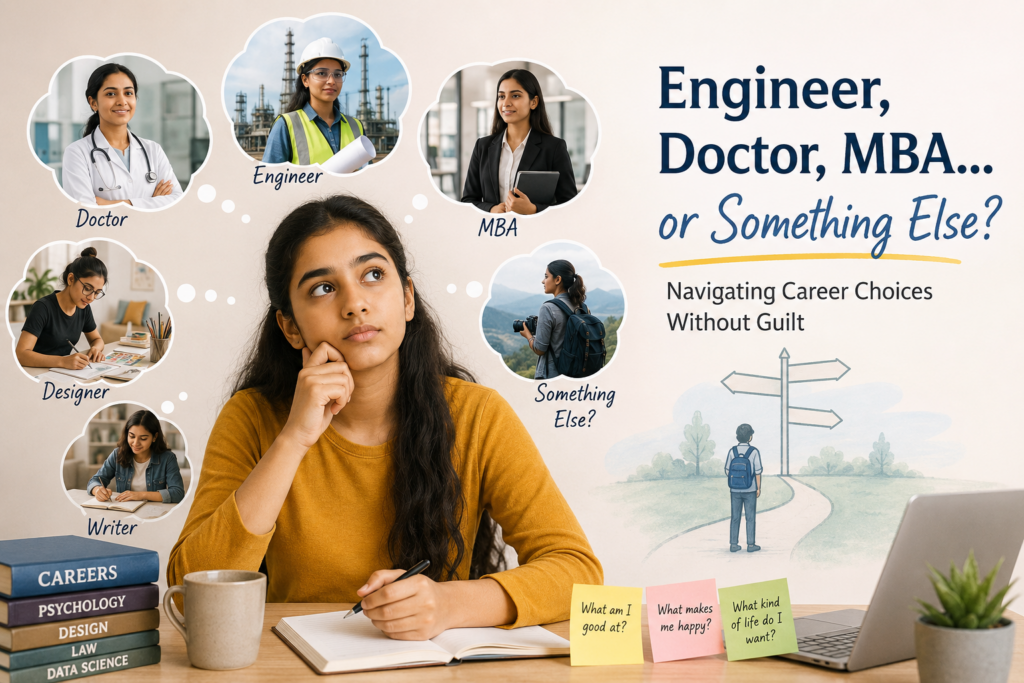
“Beta, engineering kar lo. Scope bahut hai.”
“Medicine is the most respected profession.”
“An MBA will always keep your options open.”
If you’ve grown up in an Indian household, these conversations probably sound familiar.
For many students, choosing a career isn’t just about discovering what they enjoy or where their strengths lie. It’s about balancing expectations, family aspirations, financial security, social approval, and the fear of making the “wrong” decision.
Some students spend months preparing for entrance exams without ever asking themselves a simple question: “Is this really what I want?”
Others carry an invisible burden—the guilt of disappointing their parents if they choose a path that’s different from what the family had imagined.
The truth is, career confusion isn’t a sign of laziness or indecisiveness. It is often a sign that you’re trying to make one of the biggest decisions of your life while carrying the weight of everyone’s expectations.
The good news? You don’t have to make this journey alone.
Unlike many decisions in life, career choices often feel permanent.
Students are expected to decide their future when they’re just 15 to 18 years old—an age when they’re still discovering who they are.
At the same time, they hear questions like:
“Science or Commerce?”
“Have you started preparing for JEE or NEET?”
“Which college are you targeting?”
“What will relatives say if you don’t get in?”
These questions can slowly turn curiosity into anxiety.
Many students begin believing that choosing anything outside engineering, medicine, or management means settling for less.
But today’s world looks very different from the one our parents grew up in.
There are meaningful and successful careers in psychology, design, law, economics, data science, public policy, digital marketing, environmental sciences, entrepreneurship, content creation, healthcare, research, education, sports management, animation, and many more.
Success is no longer limited to just three professions.
Parents usually want the best for their children.
Their advice often comes from love, concern, and the desire to provide financial security.
However, when a career decision is based only on external expectations, students may experience:
Constant self-doubt
Lack of motivation
Emotional exhaustion
Anxiety before work or studies
Low confidence
Feeling “stuck” despite achieving success
It is possible to excel academically and still feel deeply dissatisfied.
Many young adults seek psychological support years later because they realise they have spent years building a career that never truly felt like their own.
One of the biggest misconceptions students have is that there is one perfect career waiting to be discovered.
In reality, careers are built—not found.
The right career usually lies at the intersection of four important questions:
What am I naturally good at?
What genuinely interests me?
What kind of lifestyle do I want?
What opportunities are available for growth?
A career doesn’t need to impress everyone.
It needs to fit you.
Two students may score the same marks but thrive in completely different careers.
One may enjoy solving mathematical problems.
Another may enjoy understanding people.
One may love working independently.
Another may enjoy teamwork and communication.
One may prefer a structured corporate environment.
Another may flourish in creative or entrepreneurial spaces.
Marks tell us how well a student performed in an examination.
They do not tell us:
Personality
Emotional strengths
Work preferences
Creativity
Values
Long-term motivation
That’s why choosing a career based only on percentages often leaves important questions unanswered.
This is perhaps the most common fear among students.
Here’s something worth remembering:
Very few people follow a perfectly straight career path anymore.
Many professionals:
Change industries.
Pursue higher studies later.
Build multiple careers.
Start businesses.
Learn new skills online.
Discover new passions in their twenties or even thirties.
Choosing one stream today doesn’t lock you into one identity forever.
Career decisions are important—but they are not irreversible.
Career disagreements can create tension within families.
Parents may prioritise:
Stability
Financial security
Reputation
Familiar professions
Students may prioritise:
Passion
Creativity
Work-life balance
Flexibility
Personal fulfilment
Neither perspective is completely wrong.
The challenge is learning how to bring both viewpoints together.
Healthy career conversations begin when both sides feel heard—not judged.
Parents don’t need to have all the answers.
Students don’t need to have their entire future planned.
Sometimes, the best decision emerges through honest discussion rather than pressure.
Many people think career counselling simply tells students which profession they should choose.
It doesn’t.
Good career counselling is a process of self-discovery.
A psychologist or career counsellor helps students understand:
Their interests
Personality
Aptitude
Learning style
Emotional strengths
Career values
Motivation
Decision-making patterns
Career counselling combines scientific assessments with meaningful conversations.
The goal isn’t to decide for the student.
The goal is to help the student make an informed, confident decision.
Many high-performing students also benefit from career counselling.
Sometimes a student has excellent marks but too many options.
Should they choose:
MBBS or Biotechnology?
Computer Science or Electronics?
Psychology or Law?
Government exams or Corporate careers?
MBA immediately or gain work experience first?
Career counselling helps organise these questions logically while also considering the student’s emotional well-being.
You may benefit from professional guidance if:
You keep changing your career choice every few weeks.
You feel anxious whenever someone asks about your future.
You are choosing a career mainly to avoid disappointing others.
You have good marks but no clarity.
Your parents and you disagree about career options.
You feel overwhelmed by too many possibilities.
You worry that one wrong decision will ruin your life.
Seeking guidance is not a sign of weakness.
It’s a sign that you’re taking an important decision seriously.
Parents often carry dreams for their children.
That is natural.
But sometimes the greatest gift a parent can give is not choosing the child’s career—it is helping them discover it.
Instead of asking,
“Which career earns the most?”
Try asking,
What kind of work excites you?
What problems do you enjoy solving?
What environment helps you perform your best?
What kind of life do you imagine for yourself?
These conversations build confidence instead of fear.
Children who feel supported are often more motivated, responsible, and resilient.
If you’re feeling confused right now, remember this:
You do not have to figure out your entire future overnight.
You do not need to compare your journey with your friends’.
You do not have to choose a career simply because it sounds prestigious.
And you certainly don’t have to carry guilt for wanting a path that reflects who you are.
Take time to understand yourself.
Ask questions.
Explore different fields.
Speak with professionals.
Seek guidance when needed.
The goal isn’t to find the most popular career.
The goal is to find a career where your abilities, interests, and values can grow together.
Engineering, medicine, and management continue to be excellent professions for many people. But they are not the only paths to a meaningful, successful, and fulfilling life.
Every student deserves the opportunity to discover a career that matches not only their academic abilities but also their personality, aspirations, and emotional well-being.
Career choices made out of fear, guilt, or social pressure often leave people questioning themselves years later.
Career choices made with self-awareness, informed guidance, and honest conversations create stronger foundations for long-term satisfaction.
Your career is more than a job title.
It is a significant part of your identity, your daily life, and your future.
Choose it with curiosity, confidence, and compassion—for yourself.
Because success isn’t about becoming an engineer, doctor, or MBA graduate simply because others expect it.
Success is building a life that feels meaningful to you.