
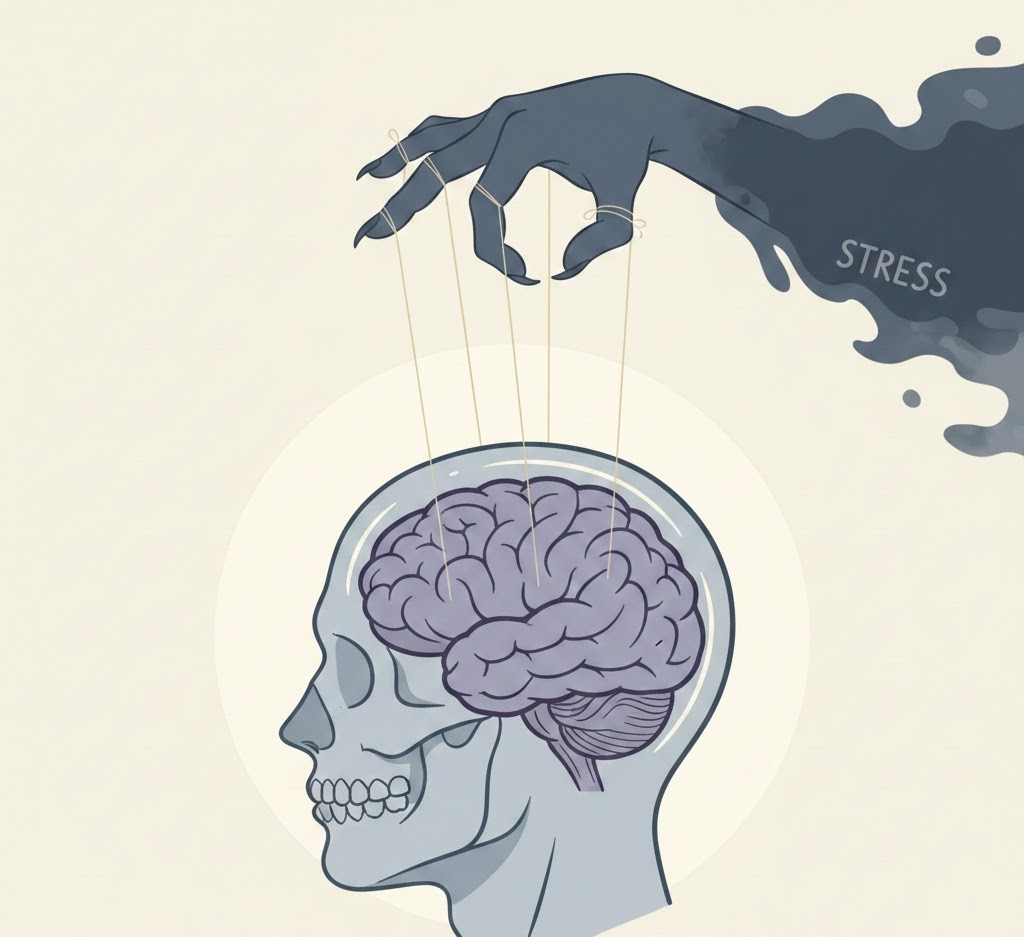
We’ve all had moments when stress seems to take over—when logic, calm, and clarity vanish, replaced by racing thoughts, rapid heartbeats, and impulsive reactions. You might even look back later and think, “What was I thinking?” In those moments, you’ve been mentally hijacked—your brain’s hardwiring has shifted into survival mode, overriding your rational mind.
This phenomenon isn’t just metaphorical. It’s rooted deep in neuroscience and psychology, and understanding it helps you reclaim control over your reactions, habits, and life.
Your brain is a complex network evolving over millions of years to keep you alive. When a threat is perceived—whether it’s an angry boss, a financial crisis, or even a harsh email—your amygdala, the brain’s emotional alarm system, lights up. It signals danger and initiates the fight-or-flight response.
This ancient circuit worked brilliantly when our ancestors faced predators. But in modern life, where “threats” are often psychological, the amygdala still fires as if your life were literally at risk. The result? Your rational prefrontal cortex, responsible for reasoning and decision-making, momentarily shuts down. It’s like someone else has taken the wheel—hence, a “mental hijack.”
Psychologist Daniel Goleman coined this concept as an “amygdala hijack.” During this state, adrenaline and cortisol flood your body, your heart races, and your thoughts narrow to survival. The brain diverts blood flow from the rational to the reactive, priming you to act, not to think.
The tricky part is that our stress system doesn’t differentiate between physical and psychological threats. Whether it’s a tiger charging at you or a text message saying, “We need to talk,” your amygdala reacts in the same way.
Some common “modern predators” that trigger this hijack include:
An overflowing inbox or pending deadlines.
Social rejection, criticism, or comparison on social media.
Relationship conflicts or emotional invalidation.
Financial uncertainty or health anxieties.
Chronic multitasking and decision fatigue.
Your mind interprets these cues as danger signs, activating the same primitive cascade that once determined life or death. Over time, chronic activation of this system remodels your brain, reinforcing anxiety, impulsivity, and emotional reactivity.
When you’re hijacked by stress, subtle but powerful shifts occur across multiple systems:
Cognitive: You lose access to perspective and memory. Complex reasoning feels impossible. Thoughts loop or catastrophize.
Emotional: Mood crashes, irritability spikes, and empathy declines. You may lash out or shut down completely.
Physiological: Your heart rate, blood pressure, and muscle tension rise. Your digestion slows. You may feel heat, dizziness, or nausea.
Behavioral: You may react impulsively, make poor decisions, or rely on short-term coping habits—scrolling, overeating, binge-watching, or withdrawing.
This state can last minutes, hours, or—if unaddressed—become a chronic baseline. Many people live in a near-constant mild hijack, wondering why they’re always tired yet wired.
Behind every hijack is a deeper psychological process. Our brain’s survival bias interprets discomfort as danger. Every thought or situation that feels uncertain, disappointing, or exposes vulnerability can activate the threat system.
For instance:
A perfectionist fear of failure may trigger stress even before a mistake occurs.
A trauma history can sensitize the amygdala, making your stress alarms overactive.
Unmet emotional needs—for safety, control, or connection—can generate chronic hypervigilance.
Stress hijacking isn’t just biological—it’s learned. Each time you react explosively or numbly to stress, your brain strengthens that neural pathway. It’s like carving a groove in a record. Over time, your brain defaults to that pattern faster and more automatically.
The first step to reversing the hijack is awareness. You can’t disarm what you don’t notice. Look out for these subtle signals:
A sudden urge to react or defend before reflecting.
Physical sensations—tight jaw, shallow breathing, chest heaviness.
Feeling detached, numb, or disconnected from yourself.
An inner critic that grows louder and more judgmental.
A shrinking tolerance for uncertainty or mistakes.
Catching these in real-time shifts you from reacting to observing. That split-second pause is where freedom begins.
The good news: your brain is neuroplastic. You can retrain it to recognize stress signals earlier and recover faster. Reversing a hijack doesn’t mean eliminating stress, but developing nervous system resilience—the ability to return to calm and clarity after being thrown off balance.
Here’s a science-backed roadmap:
The moment you sense stress rising, stop what you’re doing—even for a few seconds. Take a slow breath and name what’s happening: “My stress system is activated.” Research shows that labeling emotions (called affect labeling) lowers amygdala activity and restores prefrontal control.
The goal isn’t to suppress emotion but to acknowledge it without being swept away.
Deep, diaphragmatic breathing directly calms the vagus nerve, shifting your body from “fight or flight” to “rest and digest.” Try the 4-6 method: inhale for 4 seconds, exhale for 6. The longer exhale signals safety.
Even one minute of conscious breathing can reverse physiological arousal and help your brain reengage the rational frontal lobe.
Stress thrives on abstract thoughts—What if I fail? What if something goes wrong? To break the loop, anchor yourself in the present through sensory grounding:
Notice three things you can see.
Two things you can touch.
One sound you can hear.
This shifts attention from internal chaos to external reality, calming both the mind and body.
When hijacked, the amygdala assumes the worst. Use your reasoning brain to challenge that story:
What is the real threat here?
Is it permanent, personal, or pervasive?
What evidence contradicts my fear?
Cognitive reframing doesn’t dismiss the stress—it restores proportion. The goal is to transform catastrophe into challenge.
Daily regulation practices “train” your brain’s stress-recovery system, making hijacks less frequent and shorter. Key habits include:
Mindfulness or meditation: Regular practice thickens the prefrontal cortex and weakens the amygdala’s dominance.
Movement: Exercise metabolizes excess stress hormones.
Sleep hygiene: A tired brain cannot regulate emotion efficiently.
Social connection: Safe relationships release oxytocin, which buffers the stress response.
Think of these as the mental fitness that keeps your nervous system agile.
Sometimes, the hijack becomes a way of living—a constant background tension. If you often feel “on edge,” “shut down,” or “overwhelmed,” your system may be stuck in chronic activation. Over time, this state contributes to burnout, anxiety disorders, depression, and even physical health issues like hypertension and diabetes.
The brain can adapt so thoroughly to stress that calm feels foreign—like something’s missing when you’re not rushing or worrying. This is the hallmark of chronic dysregulation. Healing requires deliberate slowing down, body-based relaxation, and—often—professional therapy, especially trauma-informed approaches like EMDR, somatic therapy, or CBT.
Reclaiming control doesn’t mean never feeling stress again. It means mastering your responses—becoming aware, adaptive, and self-directed even in chaos.
Over time, regulated people develop what psychologists call “response flexibility.” Instead of reacting impulsively, they pause, choose, and respond in alignment with their values. They shift from being driven by stress to being guided by awareness.
A few guiding principles help sustain this shift:
Notice the hijack early: Awareness is your early warning system.
Name, not numb: Label what you feel instead of escaping it.
Practice recovery, not perfection: Every time you calm your body, you rewire your brain.
Design your environment: Reduce sensory overload and create moments of rest.
Seek connection: Regulated relationships co-regulate your brain.
Imagine your brain as a complex orchestra. Under stress, one instrument—the amygdala—jumps up and drowns out the rest. But with awareness and practice, you can hand the baton back to the conductor—the prefrontal cortex—and restore harmony.
Stress itself isn’t your enemy; it’s a signal—a call to slow down, recalibrate, and realign. The problem isn’t that your brain sounds the alarm; it’s that you forget to turn it off.
Reversing the hijack is less about control and more about connection—listening to your body with curiosity, not judgment. Every time you breathe through a difficult moment instead of resisting it, you reclaim a small piece of yourself.
You’ll still face deadlines, conflicts, and worries. But the difference is this: you’ll meet them with presence, not panic—with awareness, not autopilot. And from that space, you become the calm within the storm—not the storm itself.