
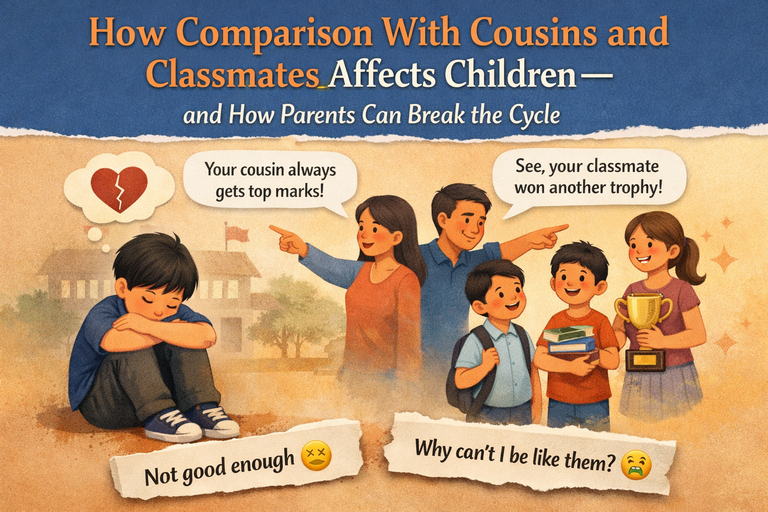
In many families, comparison is not meant to hurt.
It often begins casually—“Your cousin studies for four hours,” or “That classmate is so confident on stage.” Parents usually intend to motivate, not damage.
Yet, from a child psychology perspective, repeated comparison is one of the most powerful—and underestimated—sources of emotional distress in children.
This article explores how comparison affects a child’s self-concept, emotional development, and motivation, and more importantly, how parents can consciously break this cycle without lowering expectations or becoming permissive.
Comparison thrives in environments where:
Achievement is highly valued
Love and approval feel conditional
Children grow up alongside close peer reference groups (siblings, cousins, classmates)
In Indian households especially, comparison often happens because:
Extended families are closely involved
Academic and behavioural milestones are publicly discussed
Parents themselves were raised with comparison as a “normal” motivator
From a psychological lens, comparison becomes harmful not because it exists once or twice, but because it becomes a recurring lens through which a child evaluates their worth.
Adults often believe comparison sends this message:
“If you try harder, you can do better.”
Children usually hear something very different:
“I am not enough the way I am.”
Young minds are not equipped to separate performance from identity.
So repeated comparison shifts from “I didn’t score well” to “I am inferior.”
This is where emotional harm begins.
Children who are frequently compared learn to measure themselves externally.
Instead of asking:
“Am I improving?”
They ask:
“Am I better or worse than others?”
This creates fragile self-esteem, which depends on outperforming someone else rather than internal growth.
When approval feels conditional, children become hyper-alert to mistakes.
Common internal patterns include:
Fear of disappointing parents
Avoidance of challenges
Perfectionism or emotional shutdown
Clinically, we often see anxiety disorders rooted not in pressure alone, but in chronic comparison.
Comparison quietly damages relationships.
Instead of:
Connection
Cooperation
Shared joy
Children develop:
Resentment
Competition
Emotional distance
Over time, family spaces feel unsafe rather than supportive.
Motivation driven by comparison is short-lived.
Children begin to:
Study for praise, not curiosity
Perform for validation, not mastery
Avoid activities they can’t “win” at
This often leads to burnout, disengagement, or rebellion in adolescence.
Every child has a unique temperament, pace, and strength profile.
Comparison sends the message:
“Your natural self is not acceptable.”
Over time, children may:
Suppress interests
Mimic others’ paths
Struggle to understand who they really are
This becomes particularly visible during teenage years.
Children do not yet have:
Emotional filters
Cognitive distance
Adult reasoning abilities
Their sense of self is still forming.
So when a trusted adult repeatedly highlights someone else as better, children internalize it deeply—often silently.
Many parents are surprised to learn that quiet, compliant children are often the most affected, not the rebellious ones.
Parents should watch for:
Sudden drop in confidence
Over-sensitivity to feedback
Statements like “I’m not good enough”
Avoidance of school or social situations
Excessive self-criticism
Loss of joy in previously enjoyed activities
These are not “attitude problems.”
They are emotional responses to perceived inadequacy.
Breaking comparison does not mean lowering standards or avoiding feedback.
It means changing the psychological frame.
Instead of:
“Your cousin got higher marks.”
Try:
“I noticed you stuck with this even when it was hard.”
This reinforces:
Growth
Resilience
Internal motivation
Children begin to value process over ranking.
A psychologically healthy comparison is self-referential.
Examples:
“You read faster than you did last month.”
“You handled that situation more calmly this time.”
This builds:
Self-awareness
Confidence
A realistic sense of progress
Children need to hear:
“Different people are good at different things—and that’s okay.”
Normalize:
Different learning speeds
Different emotional needs
Different strengths
This reduces shame and comparison anxiety.
Children absorb far more than parents realize.
Be mindful of:
Family discussions about marks
Comparing relatives at gatherings
Praising one child by putting another down
Praise should never come at the cost of someone else’s dignity.
Instead of dismissing emotions:
“Don’t feel bad, work harder.”
Try:
“It sounds like that made you feel small. Want to talk about it?”
Emotional validation:
Reduces internal conflict
Builds emotional intelligence
Strengthens parent-child trust
Children learn from how parents speak about themselves.
If parents constantly say:
“I’m not as successful as…”
“Others are doing better than me…”
Children internalize comparison as a life rule.
Model:
Self-compassion
Acceptance
Balanced ambition
Some children need more than parenting changes.
Consider consulting a child psychologist if:
Anxiety or low mood persists
Academic pressure feels overwhelming
Your child avoids challenges entirely
Self-esteem appears deeply shaken
Therapy helps children:
Separate identity from performance
Rebuild self-worth
Learn emotional regulation
Develop healthier internal narratives
Importantly, therapy often involves working with parents as well, not just the child.
Comparison often comes from love, fear, and the desire to prepare children for a competitive world.
But psychology consistently shows:
Children grow strongest not when they are compared, but when they feel understood.
When parents shift from comparison to connection, children don’t become weaker—they become emotionally secure, resilient, and authentically motivated.
And those qualities, in the long run, matter far more than any rank or report card.