
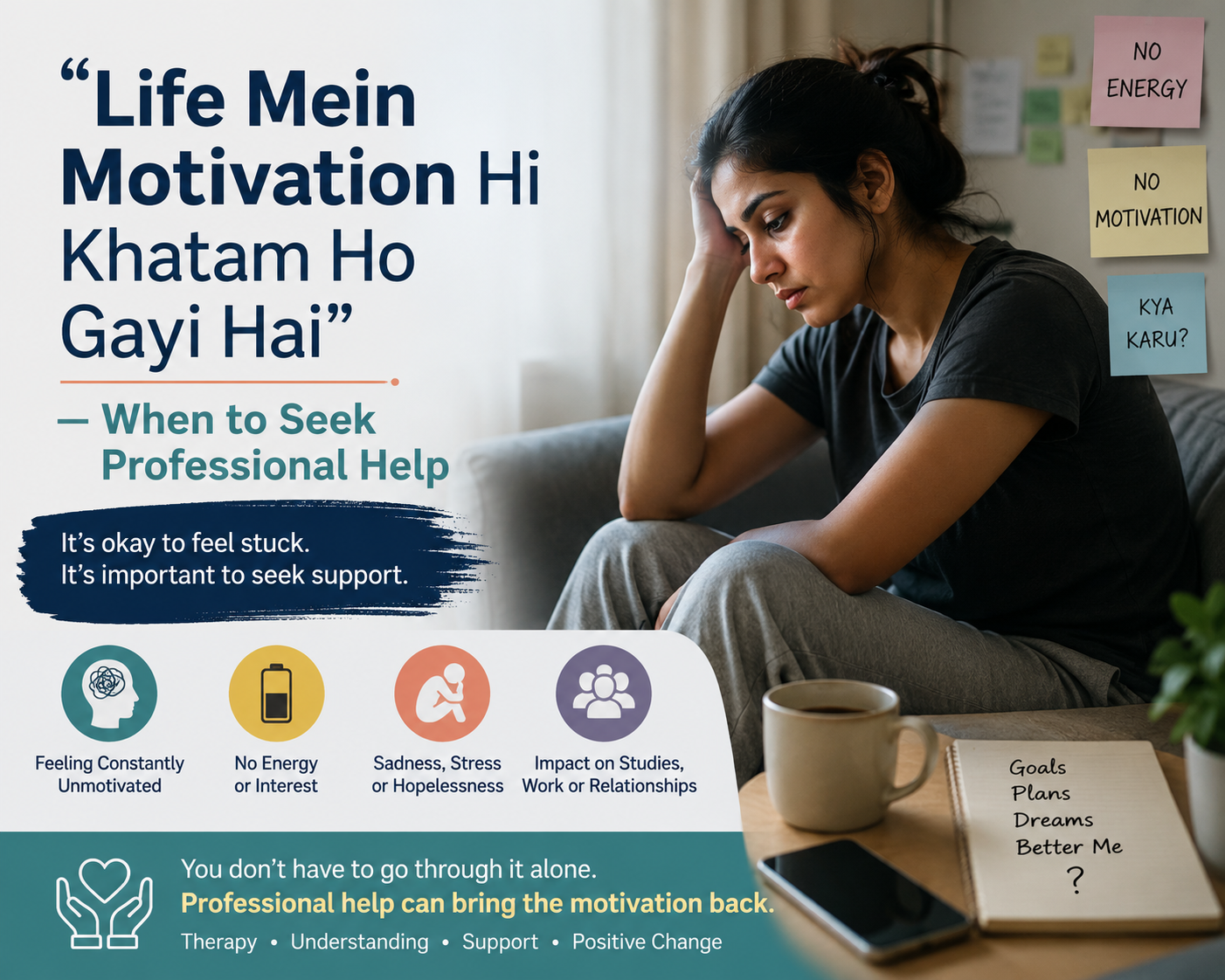
The phrase “Life mein motivation hi khatam ho gayi hai” (I’ve completely lost all motivation in life) has become a staple of modern Indian conversations. You hear it from a college student staring blankly at a textbook, a corporate professional dragging themselves through another endless week of Zoom calls, or even someone who seemingly “has it all” but feels entirely hollow inside.
In our fast-paced, high-achievement-oriented society, casual burnout is often worn like a badge of honor, and venting about a lack of drive is dismissed as mere laziness or a passing phase. We tell ourselves—and each other—to “buckle up,” “change your mindset,” or “take a weekend trip and you’ll be fine.”
But what happens when the weekend trip doesn’t fix it? What happens when days turn into weeks, and weeks into months, and that missing spark evolves into a heavy, suffocating blanket of indifference?
There is a distinct, critical line between a temporary slump and a deeper psychological struggle that requires professional clinical intervention. Understanding this boundary isn’t just helpful; it can be life-saving.
In India, mental health awareness is growing, but our vocabulary for emotional distress remains heavily reliant on colloquialisms. When someone feels deeply distressed, anxious, or clinically depressed, they might not say, “I am experiencing symptoms of anhedonia.” Instead, they say, “Mann nahi lag raha,” “Dimaag kharab hai,” or “Motivation khatam ho gayi hai.”
Because these phrases are used so casually, we tend to normalize them. We live in a culture that deeply values resilience (“adjust kar lo” or “sab theek ho jayega”). While resilience is an incredible trait, it becomes toxic when it forces individuals to suppress genuine psychological suffering.
When you tell someone you’ve lost motivation, the standard responses usually fall into three categories:
The Toxic Positivity Approach: “Just think positive! Look at the bright side of life.”
The Comparison Approach: “Look at those who have less than you. You have a great job/family, why are you sad?”
The ‘Hustle Culture’ Approach: “You just need discipline, not motivation. Wake up at 5:00 AM and hit the gym.”
While well-intentioned, these responses miss the core issue: A profound, prolonged loss of motivation is rarely a issue of willpower. Often, it is a symptom of a deeper mental health condition, such as Major Depressive Disorder (MDD), chronic burnout, dysthymia, or severe anxiety.
Everyone experiences fluctuations in energy and drive. It is entirely natural to feel unmotivated after completing a massive project, during a period of high stress, or simply when you are physically exhausted. This is a temporary slump.
It is situational: You can pinpoint exactly why you are tired (e.g., “I’ve been working 14-hour days all month”).
It responds to rest: After a few days of solid sleep, good food, and stepping away from your stressors, your energy and interest gradually return.
You still experience joy: You might hate your job right now, but you still enjoy eating your favorite meal, watching a movie, or talking to a close friend.
It’s short-lived: It typically lasts a few days to a couple of weeks at most.
When a slump transitions into a clinical concern, it ceases to be about a specific task or situation. It becomes global. It alters how you view yourself, the world, and your future. If your lack of motivation is accompanied by a persistent feeling of emptiness, changes in sleep or appetite, and a total inability to feel pleasure, you are no longer dealing with simple laziness.
If you or someone you know is saying “life mein motivation hi khatam ho gayi hai,” look closely for these five critical warning signs. If these signs persist for more than two consecutive weeks, it is time to consult a qualified mental health professional (a clinical psychologist or a psychiatrist).
Anhedonia is the clinical term for the inability to feel pleasure from activities that you used to love.
The Normal Scenario: You don’t feel like working, so you watch your favorite cricket match or web series instead, and it makes you smile.
The Red Flag: You sit down to watch your favorite show, play a sport you love, or hang out with your favorite people, and you feel absolutely nothing. It feels like watching paint dry. The color has been drained out of your hobbies.
When motivation drops normally, you might procrastinate on writing a report, but you still brush your teeth, take a shower, and eat your meals. When it becomes a deeper mental health issue, your executive functioning breaks down.
The Red Flag: Getting out of bed feels like lifting a 100 kg weight. Taking a shower feels like a monumental chore. Your room is piling up with clutter, you are skipping meals because cooking or ordering feels too overwhelming, and basic personal hygiene feels optional. If your daily functioning is compromised, willpower is no longer the solution.
Mental health isn’t just “in your head”—it is deeply systemic and affects your entire biology. A severe drop in motivation often coincides with significant disruptions in your circadian rhythm and metabolism.
The Red Flag: You are either sleeping 12+ hours a day and still feeling exhausted (hypersomnia), or you are tossing and turning all night, unable to quiet your mind (insomnia). Similarly, your appetite might completely vanish, causing weight loss, or you might find yourself emotionally overeating to cope with the void.
When depression or severe burnout sets in, it physically alters your brain’s ability to process information.
The Red Flag: You experience a persistent brain fog. You find it incredibly difficult to concentrate on a single page of a book, make simple decisions (like what to wear or eat), or remember minor details. This is accompanied by a profound, heavy physical fatigue that is not relieved by sleep. You wake up just as tired as when you went to bed.
This is the most critical differentiator. A lazy or unmotivated person thinks, “I don’t want to do this today, I’ll do it tomorrow.” A person slipping into a severe depressive episode thinks, “What is the point of doing this? What is the point of anything? Nothing I do will ever change my life.”
The Red Flag: You are consumed by feelings of guilt, blaming yourself for your lack of productivity, which triggers a vicious cycle of self-loathing. You view your future as a blank, dark space where things only get worse. If these thoughts progress to a feeling that “it would be better if I wasn’t here,” immediate professional help is required.
To understand why “just trying harder” doesn’t work, we have to look at the psychological cycle of a clinical motivational deficit:
[Low Energy / Neurochemical Imbalance]
                 │
                 ▼
       [Inactivity / Withdrawal]
                 │
                 ▼
[Guilt, Self-Blame & Feeling Worthless]
                 │
                 ▼
    [Increased Hopelessness & Brain Fog]
                 │
                 ▼
[Further Drop in Motivation (Cycle Repeats)]
When you are caught in this loop, pushing yourself harder only increases the guilt when you inevitably crash. A professional steps in to break this cycle using evidence-based tools rather than empty motivational speeches.
If you decide to seek help, it helps to understand the roles of the professionals available to you:
| Professional | What They Do | Best Suited For |
| Clinical Psychologist / Counselor | Use talk therapy (like Cognitive Behavioral Therapy – CBT) to help you understand thought patterns, reframe beliefs, and build behavioral coping mechanisms. | Mild to moderate depression, chronic burnout, life transitions, anxiety, and learning emotional regulation. |
| Psychiatrist | Medical doctors who can diagnose mental health conditions and prescribe medications (like antidepressants) to balance brain chemistry. | Moderate to severe depression, severe sleep disturbances, structural biological imbalances, or when therapy alone isn’t providing relief. |
Note: Very often, a combination of both—therapy to handle the psychological patterns and medication to manage the neurochemical baseline—yields the most effective and sustainable results.
Acknowledging that you need help is the hardest part, especially when your motivation is at absolute zero. Here is a realistic, low-energy roadmap to getting help:
Drop the Shame: Accept that your brain’s neurotransmitters (like dopamine and serotonin) might just be depleted right now. It is a biological issue, not a character flaw. You wouldn’t blame yourself for having a thyroid issue or a fractured bone; don’t blame yourself for this.
Delegate the Search: If looking for a therapist feels too overwhelming, ask a trusted friend, family member, or partner to find two or three verified leads for you. Let them take care of the logistics.
Opt for Telehealth: If getting out of bed and traveling to a clinic feels impossible, schedule an online consultation. Many excellent psychologists and psychiatrists offer video sessions, allowing you to take the first step from the comfort of your room.
Be Honest in Your First Session: You don’t need to have a perfect explanation ready. It is completely okay to sit across from a professional and say your very first sentence: “I don’t know what’s wrong, but life mein motivation hi khatam ho gayi hai, and I can’t fix it on my own anymore.”
The phrase “Life mein motivation hi khatam ho gayi hai” shouldn’t be swept under the rug of casual everyday complaints. It is a valid, profound expression of human distress.
If you are reading this and realizing that your slump has overstayed its welcome, please know that you do not have to white-knuckle your way through the darkness alone. Reaching out to a mental health professional isn’t a sign of weakness or a confession of defeat—it is a courageous, definitive act of taking control of your life. The spark can return, but sometimes, you just need a professional to help you find the matches.