
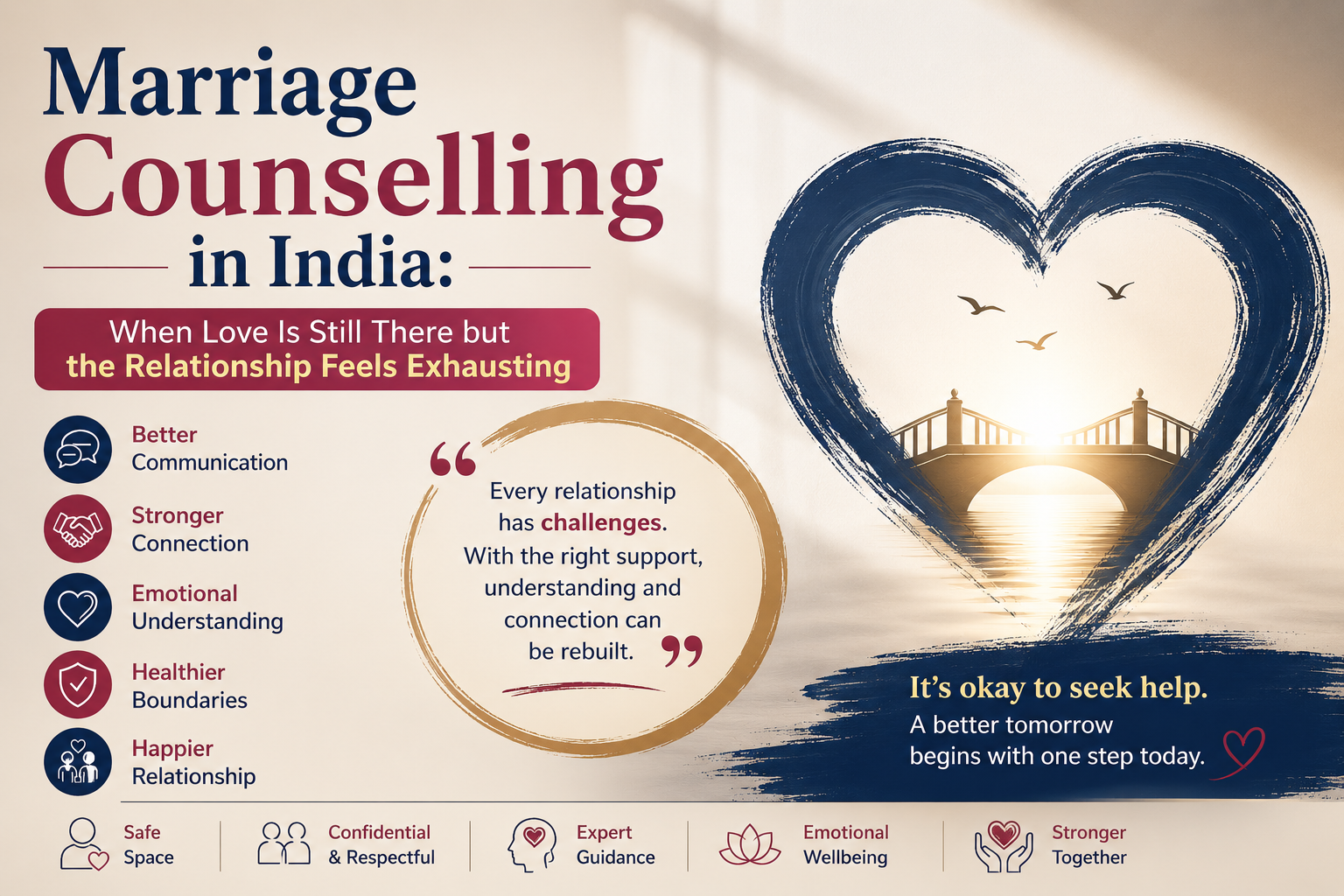
Marriage is often imagined as a partnership built on love, companionship, trust, and shared dreams. Yet, over time, even couples who genuinely love each other can find themselves feeling emotionally drained by the relationship.
The arguments may become repetitive. Conversations may turn into misunderstandings. Small disagreements may trigger major fights. One partner may feel unheard, while the other feels constantly criticised. Sometimes, couples stop fighting altogether and simply stop talking.
This does not necessarily mean that love has disappeared.
In many cases, the relationship has become exhausting because unresolved emotions, communication problems, expectations, family pressures, and changing life circumstances have gradually created emotional distance.
This is where marriage counselling in India can play an important role.
Marriage counselling, also known as couples counselling or couples therapy, provides a structured and non-judgmental space where partners can understand what is happening in their relationship, communicate more effectively, and work towards healthier patterns of interaction.
One of the most confusing experiences in marriage is thinking:
“I still love my partner, but I don’t feel happy in this relationship anymore.”
You may care deeply about your spouse while simultaneously feeling frustrated, lonely, misunderstood, or emotionally exhausted.
You may still enjoy certain moments together, but the relationship may also involve frequent arguments, unresolved resentment, or emotional disconnection.
This contradiction is more common than many couples realise.
Love alone does not automatically solve communication difficulties, emotional wounds, differences in expectations, or recurring conflicts. A healthy relationship also requires emotional safety, mutual respect, communication, boundaries, understanding, and the ability to repair conflicts.
When these areas become strained, even a loving relationship can begin to feel exhausting.
Indian marriages often exist within a larger social and family environment. Couples may not only be navigating their relationship with each other but also expectations from parents, in-laws, relatives, children, careers, and society.
Some common sources of marital stress include:
Many couples communicate regularly but do not actually feel heard.
Conversations can become limited to:
Household responsibilities
Children’s education
Finances
Work
Family obligations
Daily routines
Over time, couples may stop discussing their emotions, fears, needs, and expectations.
Instead of saying, “I feel neglected when we don’t spend time together,” a person may say, “You don’t care about me.”
The underlying emotion may be similar, but the way it is communicated can determine whether the conversation leads to connection or conflict.
Some couples find themselves having the same argument repeatedly.
It may start with something small—household chores, spending money, coming home late, socialising, parenting, or an interaction with a family member.
But the disagreement quickly becomes much larger.
Suddenly, the conversation is no longer about the original issue. Past mistakes are brought up, accusations are exchanged, and both partners become defensive.
When this pattern repeats frequently, couples can begin to feel that every conversation has the potential to become a fight.
Family is an important part of Indian culture. However, maintaining healthy boundaries can sometimes become challenging after marriage.
Differences involving parents or in-laws may create tension between partners.
For example, one partner may feel that their spouse always prioritises their family, while the other may feel that their partner does not respect their parents.
The problem may not necessarily be the family itself. It may be the lack of clear boundaries and communication between the couple.
Money can become a significant source of marital conflict.
Differences in income, spending habits, savings, loans, financial responsibilities towards parents, or disagreements about major purchases can create resentment.
Couples may believe they are arguing about money when they are actually arguing about security, responsibility, trust, or control.
Having children can transform a couple’s relationship.
Responsibilities increase, personal time decreases, and parenting decisions can become another area of disagreement.
One parent may prefer strict discipline, while the other may adopt a more flexible approach.
When these differences are not discussed constructively, partners may begin criticising each other’s parenting rather than working together as a team.
Not all marital problems involve loud arguments.
Sometimes the relationship becomes quiet.
Partners may live together, manage responsibilities together, and appear perfectly fine to everyone around them—but emotionally, they may feel like strangers.
This is sometimes called emotional disconnection.
A person may think:
“I have a partner, but I still feel alone.”
This emotional loneliness can be one of the most painful experiences within a marriage.
Not every disagreement requires professional counselling. Differences are a normal part of relationships.
However, professional help may be useful when problems become persistent or begin affecting emotional wellbeing and daily functioning.
Consider seeking couples counselling if:
You keep having the same arguments without resolving them.
Communication frequently turns into criticism or defensiveness.
You feel emotionally disconnected from your partner.
You have difficulty expressing your needs.
Resentment has been building for months or years.
Trust has been damaged.
You struggle to establish boundaries with family members.
Parenting disagreements are creating significant conflict.
You rarely spend meaningful time together.
You feel lonely despite being married.
You are considering separation but are unsure what you want.
You want to improve the relationship before problems become more serious.
Importantly, you do not have to wait until your marriage reaches a crisis point before seeking counselling.
Couples can seek professional support simply because they want to understand each other better and build a healthier relationship.
Many people hesitate to seek marriage counselling because they assume the psychologist will decide who is right or wrong.
That is not the purpose of couples therapy.
A psychologist or couples counsellor generally works towards helping both partners understand the patterns within their relationship.
Depending on the concerns, counselling may explore:
Communication patterns
Emotional needs
Expectations from marriage
Conflict-resolution skills
Trust and intimacy
Family boundaries
Parenting concerns
Financial disagreements
Resentment and unresolved hurt
Individual emotional factors affecting the relationship
The therapist provides a neutral environment where both partners can express themselves and listen to each other in a more constructive manner.
The goal is not necessarily to make both partners agree on everything.
The goal is to help them understand differences, communicate respectfully, manage conflict, and make healthier relationship decisions.
No.
Seeking counselling does not mean that your marriage has failed.
In fact, asking for help can be an indication that both partners recognise the importance of the relationship and want to understand what is going wrong.
There is still a common misconception in India that relationship problems should remain private or that seeking psychological help means a couple is “weak.”
This belief can prevent couples from getting support until the conflict becomes much more difficult to manage.
Just as people consult professionals for physical health concerns, seeking psychological support for relationship difficulties can also be a healthy decision.
This is also common.
Sometimes one partner recognises the problem earlier than the other. The other person may believe that counselling is unnecessary or may worry about being blamed.
In such situations, an individual can still consult a psychologist to understand their own emotional responses, communication patterns, boundaries, and options.
However, meaningful relationship change often becomes easier when both partners are willing to participate.
The important first step is creating an environment where counselling is seen not as a courtroom, but as a space for understanding.
Counselling cannot guarantee that every marriage will continue or that every relationship problem will disappear.
However, it can help couples understand why they are stuck in repetitive patterns and what they can do differently.
For some couples, counselling helps rebuild emotional intimacy.
For others, it helps them establish healthier communication and boundaries.
In situations where separation is being considered, counselling can also provide a structured environment to understand the relationship and make decisions thoughtfully rather than purely during moments of anger or emotional distress.
The outcome depends on several factors, including the nature of the problem, the willingness of both partners to participate, the duration of the difficulties, and the couple’s commitment to making changes.
A healthy marriage does not mean never arguing.
Every couple will have disagreements.
The difference lies in how those disagreements are handled.
Healthy couples can disagree without constantly attacking each other’s character. They can express hurt without turning it into blame. They can set boundaries without threatening the relationship. Most importantly, they can learn how to repair the emotional damage that occurs after conflict.
If you find yourself thinking, “I love my partner, but I am exhausted by our relationship,” it may be worth looking beyond the question of whether love still exists.
Ask instead:
What is making this relationship feel so difficult?
Sometimes the answer is poor communication.
Sometimes it is unresolved resentment.
Sometimes it is family pressure, financial stress, parenting responsibilities, emotional neglect, or years of unspoken expectations.
And sometimes, both partners simply need a safe space to understand each other again.
If marital conflict is persistent, emotionally overwhelming, or affecting your everyday life, speaking with a qualified psychologist can be a constructive step.
Marriage counselling is not about finding a winner or deciding who is to blame.
It is about understanding the relationship, identifying unhealthy patterns, and exploring healthier ways of connecting.
You can love someone and still struggle in your relationship. And struggling does not mean that you have to struggle alone.
At The Lifestyle Clinic, professional psychological support can help couples explore relationship concerns in a confidential and non-judgmental setting and work towards greater understanding, communication, and emotional wellbeing.
If your relationship still has love but has started to feel exhausting, seeking help may be the beginning of understanding what both of you need to move forward.
1. What is marriage counselling?
Marriage counselling is a form of psychological support that helps couples understand relationship difficulties, improve communication, manage conflicts, and work towards healthier patterns within their relationship.
2. When should a couple consider marriage counselling?
Couples can consider counselling when conflicts become repetitive, communication breaks down, emotional distance develops, trust is affected, or relationship problems begin impacting everyday life.
3. Is marriage counselling only for couples who are planning to separate?
No. Couples may seek counselling at any stage of their relationship, including when they simply want to improve communication, emotional intimacy, or their ability to manage disagreements.
4. Can marriage counselling help with family or in-law conflicts?
Yes. Counselling can help couples understand family-related stress, establish healthier boundaries, communicate their needs, and work together when extended-family issues affect the marriage.
5. What if my partner does not want to attend counselling?
An individual can still consult a psychologist to understand their own concerns and explore healthier ways of responding to relationship difficulties. Joint counselling can be considered if both partners later become comfortable with it.
6. How long does marriage counselling take?
There is no fixed duration. The number and frequency of sessions depend on the concerns, relationship dynamics, goals, and progress of the couple.
Disclaimer: This article is intended for general educational purposes and should not be considered a substitute for individual psychological assessment or professional advice.