
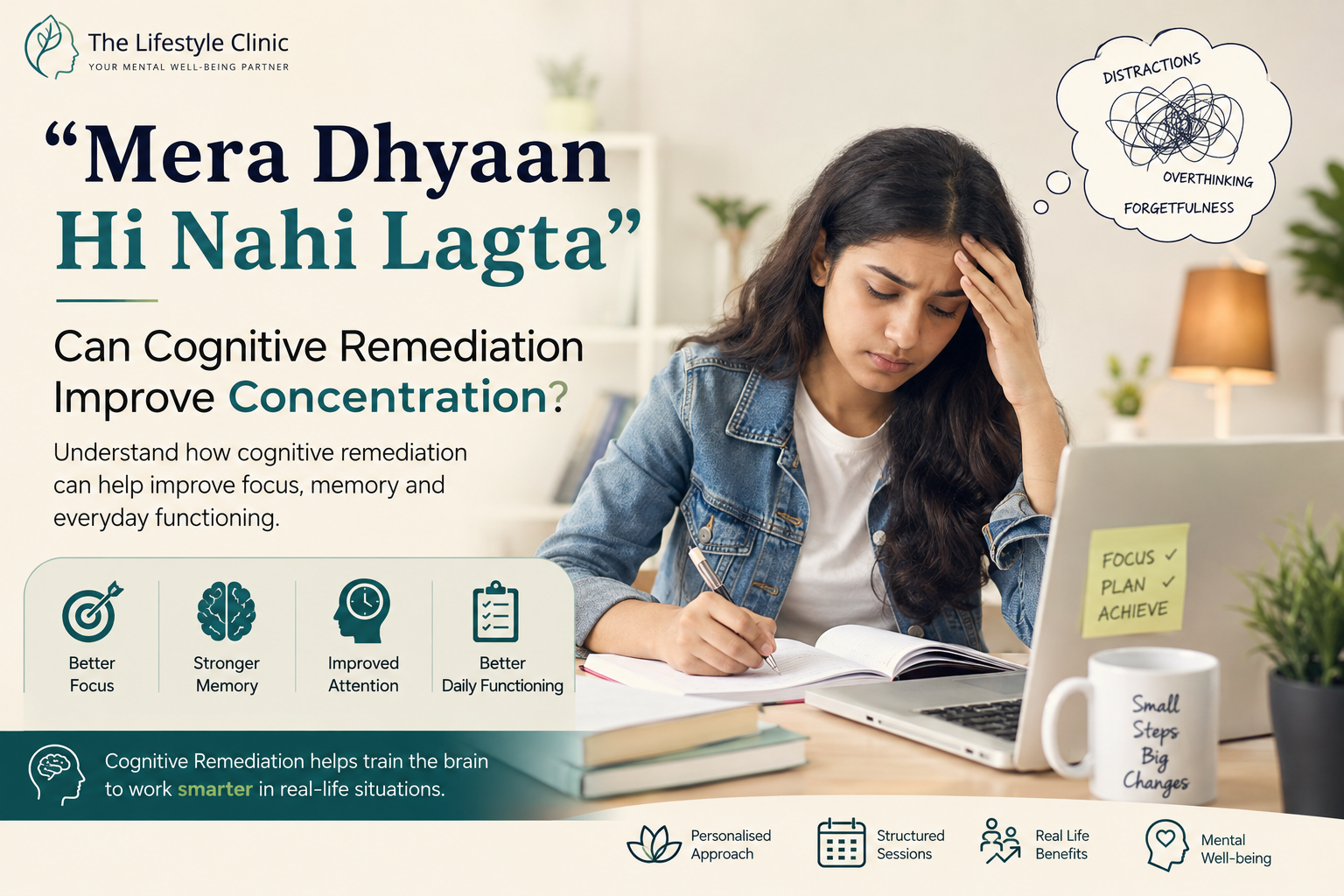
Have you ever sat down to study, complete office work, or even watch a movie, only to realise that your mind has wandered somewhere else?
You read the same paragraph several times but still cannot remember what it said. You start one task, check your phone, open another tab, and suddenly 30 minutes have passed. Sometimes, even simple instructions feel difficult to follow.
If you often find yourself saying “Mera dhyaan hi nahi lagta”, you are not alone.
Difficulty concentrating is common among children, teenagers, college students, working professionals, and older adults. While occasional distraction is normal, persistent problems with attention, memory, processing speed, and concentration can interfere with studies, work, relationships, and everyday life.
One approach that may help in appropriate cases is cognitive remediation.
But what exactly is cognitive remediation? Can it really improve concentration? And who can benefit from it?
Let’s understand.
Cognitive remediation is a structured psychological intervention designed to help people improve or compensate for difficulties in cognitive skills such as:
Rather than simply telling someone to “focus more,” cognitive remediation involves structured exercises and strategies designed around the person’s specific cognitive difficulties.
The goal is not just to perform better on an exercise. Ideally, the skills and strategies learned during sessions should gradually become useful in real-life situations—such as studying, working, following conversations, managing tasks, or remembering important information.
Before discussing treatment, it is important to understand that poor concentration can have many causes.
For example, difficulty focusing may occur because of:
Sometimes, people assume that they are simply “lazy” or “not trying hard enough.”
That is not necessarily true.
Concentration is a cognitive skill, and several factors can affect how effectively the brain uses that skill.
This is why identifying the underlying reason for poor concentration is an important first step.
Cognitive remediation may help strengthen attention and related cognitive abilities through repeated, structured practice combined with practical strategies.
For example, a person who struggles to maintain attention may work on activities requiring them to identify relevant information while ignoring distractions.
Someone with working-memory difficulties may practise holding and using information for short periods.
The intervention can also teach strategies for managing everyday situations.
Some people can concentrate for a few minutes but find it difficult to remain focused on a task.
Cognitive remediation may include exercises that gradually challenge the person to maintain attention for longer periods.
For a student, this could potentially translate into being able to remain engaged with a chapter for longer instead of repeatedly reaching for their phone.
Notifications, social media, conversations, background noise, and multiple open tabs can make concentration difficult.
Cognitive remediation may help individuals identify distractions and practise strategies for maintaining focus on the task that matters.
The aim isn’t to eliminate every distraction. Instead, it is to become better at directing attention intentionally.
Have you ever walked into a room and immediately forgotten why you went there?
Or someone gives you three instructions and you remember only the first one?
Working memory allows us to temporarily hold and use information.
Cognitive remediation may include exercises that challenge working memory and teach strategies such as:
These strategies can be particularly useful for students and working professionals.
Sometimes the problem isn’t that a person doesn’t understand information. They may simply need more time to process it.
For example, a student might understand a question but take longer to interpret it. A professional may need additional time to process multiple instructions during a busy workday.
Depending on the individual’s needs, cognitive remediation may target processing speed and encourage more efficient ways of handling information.
Concentration doesn’t work in isolation.
Planning, organisation, prioritisation, and decision-making are also important for completing tasks successfully.
Someone may technically be able to focus but still struggle to finish assignments because they don’t know where to start.
Cognitive remediation may therefore include practical strategies such as:
Break → Prioritise → Focus → Complete → Review
This can make overwhelming tasks feel more manageable.
Cognitive remediation isn’t only for one age group.
Depending on the individual’s assessment and needs, it may be considered for:
A child may have difficulty:
However, concentration problems in children should not automatically be assumed to require cognitive remediation. A proper assessment is important to understand whether the difficulties are related to attention, learning, emotional factors, sleep, developmental concerns, or something else.
Indian students often face intense academic competition and long study hours. Preparing for examinations can require sustained attention, working memory, planning, and efficient information processing.
A student who repeatedly says “Main padh toh raha hoon, lekin yaad nahi ho raha” may benefit from understanding which cognitive skills are creating difficulty.
Cognitive remediation, when clinically appropriate, can be combined with effective study strategies and psychological support.
Concentration problems can become particularly frustrating at work.
You may find yourself:
Instead of simply blaming yourself for being “unproductive,” it can be useful to understand what is affecting your cognitive performance.
Changes in memory and attention can also become a concern with ageing.
However, not every memory lapse is a sign of dementia, and significant or progressive cognitive changes should be evaluated by an appropriate healthcare professional.
You may have seen advertisements for apps claiming that a few minutes of brain games can dramatically improve memory or intelligence.
Cognitive remediation is more comprehensive.
It typically involves:
Assessment → Identifying Difficulties → Structured Training → Strategy Development → Real-Life Application → Monitoring Progress
The exercises are selected according to the individual’s needs rather than simply providing random puzzles.
The important question is not:
“Can I get better at this particular game?”
The more meaningful question is:
“Can I use these skills and strategies in my everyday life?”
The exact process varies from person to person.
A psychologist may first understand the individual’s concerns and may recommend a cognitive assessment when appropriate.
This can help identify areas such as:
Based on the findings, an intervention plan can be developed.
Sessions may involve structured cognitive activities, strategy training, and practical exercises related to everyday functioning.
For example, instead of simply practising memory tasks, a person may learn how to remember important appointments using calendar systems, reminders, repetition, and organisation strategies.
This is an important question.
There is no single intervention that guarantees complete elimination of concentration difficulties.
The effectiveness of cognitive remediation depends on several factors, including the underlying cause of the cognitive difficulty, the individual’s needs, consistency with practice, and whether other problems—such as anxiety, depression, sleep difficulties, or medical conditions—are also being addressed.
For some people, improving sleep and managing stress may make a significant difference.
For others, psychological treatment, medication where clinically indicated, educational support, or treatment of an underlying condition may be necessary.
Cognitive remediation can sometimes be one part of a broader treatment plan rather than a standalone solution.
Occasional distraction is normal.
But consider speaking with a psychologist or other qualified healthcare professional if concentration difficulties are:
For children, parents and teachers may notice signs before the child does.
Instead of repeatedly saying “Dhyaan se padho” or “Tum concentrate kyun nahi karte?”, it may be more helpful to understand why the child is struggling.
Professional intervention may be appropriate in some cases, but everyday habits also matter.
Multitasking can make it harder to maintain focus.
Choose one important task and work on it before moving to another.
If possible, keep your phone out of immediate reach while studying or working.
Even frequent checking of notifications can interrupt your attention.
Instead of expecting yourself to concentrate continuously for several hours, divide your work into manageable periods with planned breaks.
Poor sleep can affect attention, memory, mood, and mental performance.
A consistent sleep routine can therefore be an important part of improving concentration.
Don’t force your brain to remember everything.
Use:
These tools can reduce cognitive load and improve organisation.
Trying to remember 10 things simultaneously can make everything feel difficult.
Break large tasks into smaller steps.
For example:
“Study biology”
can become:
Small, clearly defined steps are easier to approach.
If you frequently say “Mera dhyaan hi nahi lagta,” don’t immediately label yourself as lazy, careless, or incapable.
Difficulty concentrating can have many possible causes, and understanding the underlying problem is the first step toward finding the right solution.
Cognitive remediation is a structured approach that can target cognitive skills such as attention, working memory, processing speed, planning, and problem-solving. For individuals with appropriate cognitive difficulties, it may become a useful part of a personalised psychological or rehabilitation plan.
Most importantly, the goal isn’t simply to become better at completing exercises.
The goal is to help you function better in real life—whether that means studying with greater efficiency, following conversations, managing work responsibilities, remembering important information, or completing everyday tasks with greater confidence.
If concentration problems are affecting your daily life, consider speaking with a qualified psychologist for an appropriate assessment rather than trying to diagnose yourself.
Because sometimes, “mera dhyaan nahi lagta” isn’t a question of effort—it may be a sign that your brain needs the right support and strategies.