
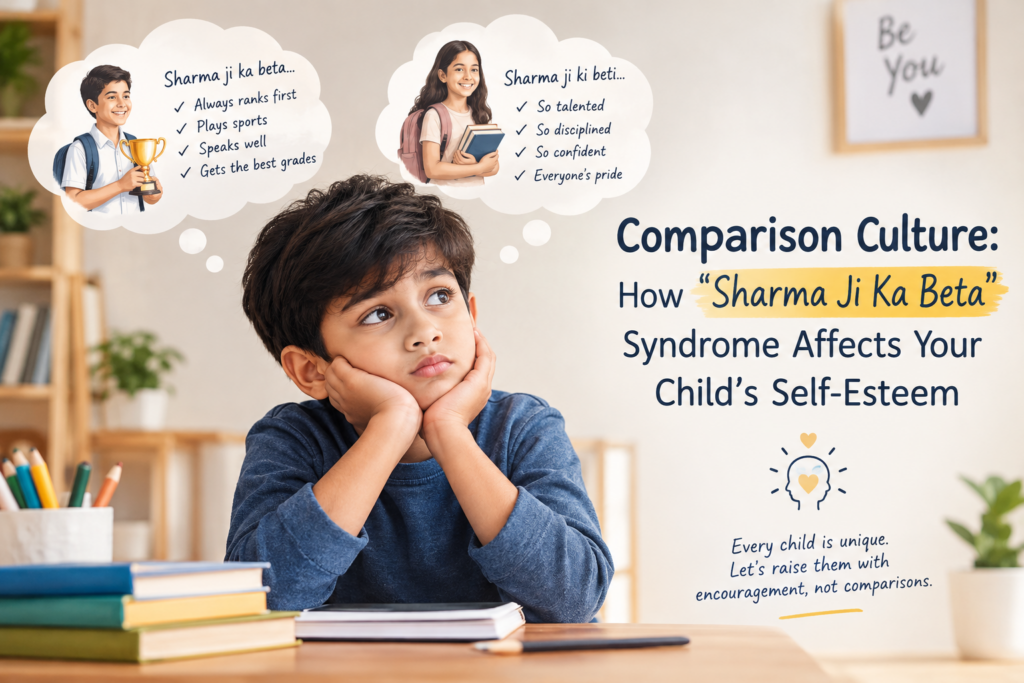
If you grew up in an Indian household, you’ve heard it. Perhaps at the dinner table, perhaps during a report card discussion, perhaps in front of relatives during a festival gathering: “Dekho, Sharma ji ka beta kitne acche marks laya hai.” It’s said so often, in so many households, that it has become a cultural shorthand of its own — an entire syndrome named after a fictional neighbor’s impossibly accomplished son.
For the parent, the comment might feel like harmless motivation — a nudge to help their child try harder. But for the child on the receiving end, it often lands very differently: as proof that they are not enough, that their worth is measured against someone else’s achievements, and that love and approval at home come with conditions attached.
As a society, we’ve normalized comparison to the point where we barely notice we’re doing it. But the psychological research on this is clear — and it’s worth taking seriously.
Comparison culture in Indian families doesn’t come out of malice. It’s usually rooted in a few deeply ingrained beliefs:
1. The belief that comparison motivates. Many parents genuinely believe that pointing out someone else’s success will light a fire under their child. “If I tell him how well the neighbor’s son is doing, he’ll want to work harder too.”
2. Collectivist family culture. Indian families are often deeply relational — a child’s achievements reflect not just on the child, but on the whole family’s reputation. This creates enormous pressure for children to perform well “for the family,” and parents unconsciously use comparison to enforce this.
3. Generational patterns. Many of today’s parents were themselves compared to cousins, classmates, and neighbors growing up. Without realizing it, they repeat the same patterns with their own children — because it’s the parenting script they know.
4. Anxiety about the future. In a country as competitive as India — with limited seats in top colleges, fierce competition for government jobs, and a rapidly changing economy — many parents compare out of genuine fear that their child won’t be equipped to succeed.
Understanding where this comes from doesn’t excuse the harm it can cause, but it does help explain why comparison feels so automatic, even to loving, well-intentioned parents.
1. It teaches conditional self-worth.
When children are repeatedly compared to others, they learn — often without anyone saying it outright — that their value is tied to performance, not to who they inherently are. Over time, this creates a fragile sense of self-worth that depends entirely on external validation: marks, medals, or rankings. When that validation isn’t there, the child’s sense of self can collapse.
2. It damages intrinsic motivation.
Ironically, comparison often backfires as a motivational tool. Psychological research on motivation consistently shows that when children are driven by fear of falling short (extrinsic, comparison-based motivation) rather than genuine interest or a sense of mastery (intrinsic motivation), their engagement and performance often decline over time — not improve. Comparison can turn learning into a threat to be avoided rather than a challenge to be embraced.
3. It fuels chronic anxiety.
Children who are constantly compared often develop a persistent, low-grade anxiety — a sense that they are always being watched, judged, and measured. This can manifest as perfectionism, procrastination (avoiding tasks where failure feels too risky), or even psychosomatic symptoms like stomachaches and headaches before exams or performance situations.
4. It damages sibling and peer relationships.
When comparisons happen between siblings (“Why can’t you be more like your didi?”), it doesn’t just hurt the child being compared unfavorably — it can create resentment toward the sibling being held up as the standard, straining a relationship that could otherwise be a source of support.
5. It can lead to a fear of authenticity.
Children who grow up in comparison-heavy households often learn to hide their real interests, struggles, and personalities in favor of performing whatever earns approval. This can follow them into adulthood as difficulty knowing what they actually want, separate from what will make them look good to others.
Parents often ask: isn’t some healthy competition good for kids? Doesn’t the real world involve comparison — exams, job interviews, promotions?
The key distinction psychologists draw is between comparison to others and comparison to one’s own past self. The former (“Why can’t you score like Sharma ji ka beta?”) tends to damage self-esteem because it’s based on a moving target the child cannot control — someone else’s abilities, resources, and circumstances. The latter (“You scored 65% last time and 75% this time — look how much you’ve improved!”) builds genuine motivation because it’s rooted in the child’s own growth, which they can see themselves influencing.
The real world does involve comparison, yes — but children who enter adulthood with a strong, stable sense of self-worth are far better equipped to handle competitive environments without their mental health unraveling. Resilience comes from a secure foundation, not from early exposure to comparison.
1. Catch yourself mid-sentence.
The first step is simply noticing when you’re about to make a comparison. If you find yourself starting a sentence with “Dekho kaise…” or “Why can’t you be like…,” pause. You can redirect: “I know you’re working hard on this. Let’s figure out together what’s making it difficult.”
2. Praise effort and process, not just outcomes.
Instead of “You got the highest marks in class, well done,” try “I noticed how much you practiced for this — that really paid off.” This shifts the focus to something within the child’s control, which builds resilience rather than fragile pride.
3. Separate your anxiety from your child’s identity.
It helps to ask yourself: Am I making this comparison because it will genuinely help my child, or because I’m anxious about how their performance reflects on me? Often, comparison is more about a parent’s own fears than the child’s actual needs.
4. Celebrate different kinds of strengths.
Not every child will be a topper. Some children are creative, some are kind, some are great with their hands, some are emotionally intuitive. Actively naming and valuing these strengths at home teaches children that worth isn’t confined to academic or competitive metrics.
5. Address relatives directly, if you can.
This is often the hardest part, since comparison frequently comes from grandparents, aunts, and uncles rather than parents themselves. A simple, respectful boundary can go a long way: “We’re trying not to compare the kids to each other — it helps them feel more confident.” You don’t need to make it a confrontation; a calm, repeated redirection often works over time.
6. Model self-compassion.
Children absorb how their parents talk about themselves. If a parent frequently self-criticizes or compares themselves unfavorably to others, children learn that this is simply how self-evaluation works. Practicing (and voicing) self-compassion — “I made a mistake today, but I’m learning” — gives children a healthier internal script to imitate.
7. Ask about the inner experience, not just outcomes.
Instead of only asking “How many marks did you get?”, ask “Did you enjoy learning about this?” or “What was the most interesting part of your day?” This helps children build an identity around curiosity and experience, not just achievement.
Breaking comparison culture isn’t about lowering expectations or avoiding all forms of accountability. Children still need structure, encouragement to work hard, and guidance to develop good habits. The shift is in how we motivate — replacing comparison with genuine engagement, replacing “Sharma ji ka beta” with “look how far you’ve come.”
This shift can feel unfamiliar, even uncomfortable, for parents who were raised on comparison themselves. But every generation has the opportunity to consciously choose what to carry forward and what to leave behind. Raising a child with a secure, internally rooted sense of self-worth may be one of the most valuable gifts a parent can give — one that will serve them long after school, exams, and Sharma ji’s son have faded into the background.