
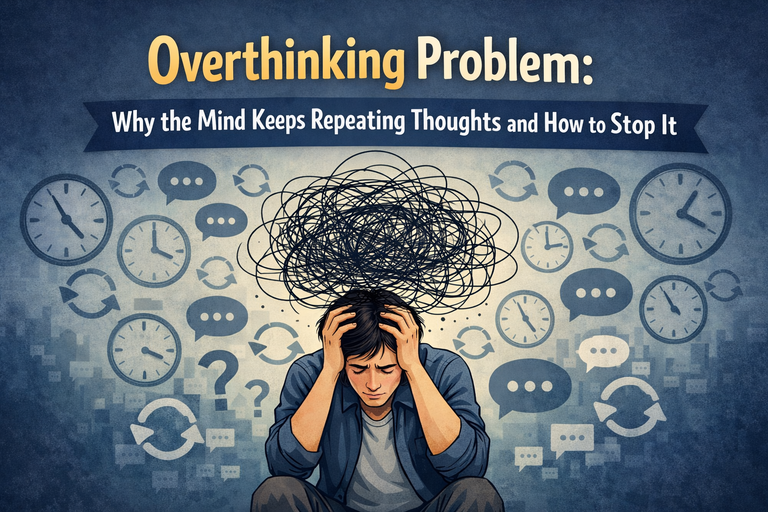
In the quiet hours before sleeping or while sitting alone, many people notice their mind replaying the same scene repeatedly — a conversation that went wrong, a decision they regret, or a fear about the future. This endless mental loop is called overthinking, and it often feels like being stuck in a maze made of one’s own thoughts.
But why does the mind do this? And more importantly, how can we stop it? Understanding the psychology of overthinking and using practical techniques to manage it can break the cycle for good.
Overthinking simply means thinking too much — replaying situations, analyzing possible outcomes, and worrying about things beyond control. Psychologists often call this rumination when the focus is on past mistakes, or worrying when the focus is on future uncertainties.
It’s not about being reflective or analytical; those are healthy strategies that help us learn from experience. Instead, overthinking is unproductive mental repetition that leaves us feeling drained rather than empowered.
Common examples of overthinking include:
Replaying a conversation to see what you “should have said.”
Obsessing over a decision, even after making it.
Imagining worst-case scenarios that rarely happen.
Constantly checking if someone misunderstood or disapproved of you.
Overthinking doesn’t solve problems — it multiplies them by adding mental noise, guilt, and fear.
The mind doesn’t overthink to torture us; it does so because it’s trying to protect us. To understand this, we need to explore how overthinking works on a cognitive and emotional level.
From an evolutionary standpoint, the human brain evolved to detect potential danger. Constant scanning for threats — physical or social — helped our ancestors survive. In the modern world, where physical threats are rare, the brain keeps using this same system but applies it to abstract fears: “What if I embarrass myself?” or “What if I fail?”
Thus, the brain repeats thoughts to ensure we “don’t miss something,” even if there’s nothing important to catch. In short, overthinking is a modern side effect of a biological survival mechanism.
Overthinking gives a false sense of control. We believe that the more we think about something, the closer we get to preventing mistakes or disasters. In reality, over-analysis just paralyzes decision-making. Psychologists call this analysis paralysis — a mental freeze caused by too many options and too little confidence.
Anxiety and overthinking feed each other. Worrying releases stress hormones like cortisol, which heighten alertness and make the mind more reactive. In turn, the brain keeps finding new things to worry about, reinforcing the anxious loop.
This explains why overthinkers often feel physically tense or tired. The brain’s constant activation triggers real bodily stress responses — shallow breathing, tight muscles, and rapid heartbeats — even when there’s no real threat.
Perfectionists are particularly prone to overthinking. When every decision or outcome “must” be perfect, the mind refuses to rest until it’s sure no mistake has been made. Unfortunately, since perfection doesn’t exist, the thought loop never ends.
This perfection-driven overthinking can extend to relationships, work, or even simple daily choices, creating chronic dissatisfaction and burnout.
Overthinking can creep in subtly. You may not even realize how much energy it consumes until you begin noticing patterns such as:
Feeling mentally exhausted without doing much.
Difficulty falling asleep due to racing thoughts.
Revisiting old mistakes that no longer matter.
Asking for multiple opinions before making simple decisions.
Frequently imagining negative outcomes.
Difficulty enjoying the present moment.
Awareness is the first step toward change. Once you identify overthinking as a habit, you can start retraining your brain to break the loop.
Modern neuroscience shows that overthinking is linked to the default mode network (DMN) — a group of brain regions active when the mind is “at rest” and not focused on external tasks. The DMN is responsible for self-referential thoughts, imagination, and recalling the past.
When the DMN is overactive, we fall into repetitive thought patterns, often involving self-criticism or regret. Meditation and mindfulness practices have been shown to quiet this network, allowing for greater mental clarity.
Functional MRI studies reveal that the more time a person spends overthinking, the stronger the neural connections responsible for rumination become. This means that overthinking can literally train your brain to keep doing it. The good news: new habits can rewire those same neural circuits in healthier ways.
Repeated thinking might look harmless, but emotionally it can be draining and sometimes destructive. Chronic overthinkers often report:
Fatigue and burnout: Mental loops use as much energy as physical labor.
Decision-making paralysis: Fear of regret prevents timely action.
Reduced creativity: The analytical mind overshadows imaginative thinking.
Emotional detachment: Constant mental engagement leaves less space for genuine emotions.
In the long term, overthinking is associated with anxiety disorders, depression, and insomnia. It narrows perspective and fosters a sense of helplessness — as if one’s mind has turned against itself.
Breaking the cycle of repetitive thoughts doesn’t mean suppressing thinking. The goal is to redirect and regulate it. Here’s how you can do it, step by step:
Overthinking thrives when the mind lives in the past or future. Mindfulness — being present here and now — stops that drift.
Technique: Focus on your breath, surroundings, or sensory experiences when thoughts spiral. For example, notice the texture of an object or the rhythm of your breathing.
Why it works: It activates brain areas associated with attention and quiets the DMN, bringing you back to reality.
Even simple activities like washing dishes or walking can be mindfulness exercises if done with full attention.
Strange as it sounds, allocating specific time to worry actually reduces overthinking. Allow yourself 10–15 minutes a day to think about problems — and once that window ends, consciously move on.
This method, supported by cognitive-behavioral therapy (CBT), trains the brain to contain worry instead of letting it spill throughout the day.
Not every thought is fact. When you catch yourself overthinking, pause and ask:
Is this thought based on evidence or assumption?
Will this matter a week, a month, or a year from now?
What advice would I give a friend in this situation?
These questions shift your perspective from emotional reactivity to rational evaluation, reducing emotional intensity.
Action breaks inertia. When thoughts become repetitive, take a small step related to your concern — send the email, make the call, write down the plan.
Even if the action feels imperfect, it stops mental stagnation. Overthinking often dissolves when replaced with movement.
Instead of seeing mistakes or uncertainties as threats, reframe them as opportunities to learn. Cognitive restructuring — a CBT technique — helps replace “What if I fail?” with “Even if I fail, I will grow.”
This doesn’t mean ignoring risks; it means facing them with resilience instead of fear.
The digital age fuels overthinking through constant exposure to news, opinions, and comparisons on social media. Setting boundaries — such as limiting screen time or curating your content feed — protects mental space.
Remember, clarity comes from focus, not excess input.
Since overthinking disconnects the mind from the body, grounding techniques work powerfully. Try:
Noticing five things you can see, four you can touch, three you can hear, two you can smell, one you can taste.
Doing short stretches or taking deep, slow breaths.
Grounding brings attention back to the body, cutting short the mental loop.
Writing thoughts down externalizes them. Once written, they lose their emotional charge. You may notice patterns or triggers that lead to repetitive thinking.
Journaling also lets you see progress over time, turning abstract worries into concrete reflections.
Often, overthinking comes from self-criticism — the belief that we should have done better or been smarter. Psychologist Kristin Neff’s research shows that self-compassion (treating ourselves with the same kindness we’d offer a friend) reduces unhelpful rumination and anxiety.
Remind yourself: “I did the best I could with what I knew then.” Acceptance transforms guilt into wisdom.
If overthinking severely impacts daily life, therapy can help. CBT, Acceptance and Commitment Therapy (ACT), and mindfulness-based therapies are particularly effective. A mental health professional can guide you in challenging core beliefs that fuel the cycle.
Stopping overthinking isn’t about eliminating thoughts; it’s about building mental flexibility — the ability to observe, redirect, and balance them. Here’s how to cultivate that mindset daily:
Focus on progress, not perfection. Every effort, even small, counts.
Set realistic goals instead of trying to solve everything at once.
Engage in flow activities — tasks that immerse your attention, such as art, gardening, music, or exercise.
Practice gratitude journaling to train your mind toward positivity.
Accept uncertainty as a natural part of life — not a problem to fix.
When you live with curiosity rather than control, the mind quiets naturally.
Overthinking is not a flaw; it’s a mind trying too hard to protect you. Awareness, compassion, and gentle retraining can transform it into clarity. Instead of getting trapped in “what ifs,” learn to return to “what is.”
When you catch yourself drifting into mental loops, take a deep breath and remind yourself: It’s just a thought, not a life sentence. The goal isn’t to stop thinking but to think wisely — with calm, focus, and presence.