
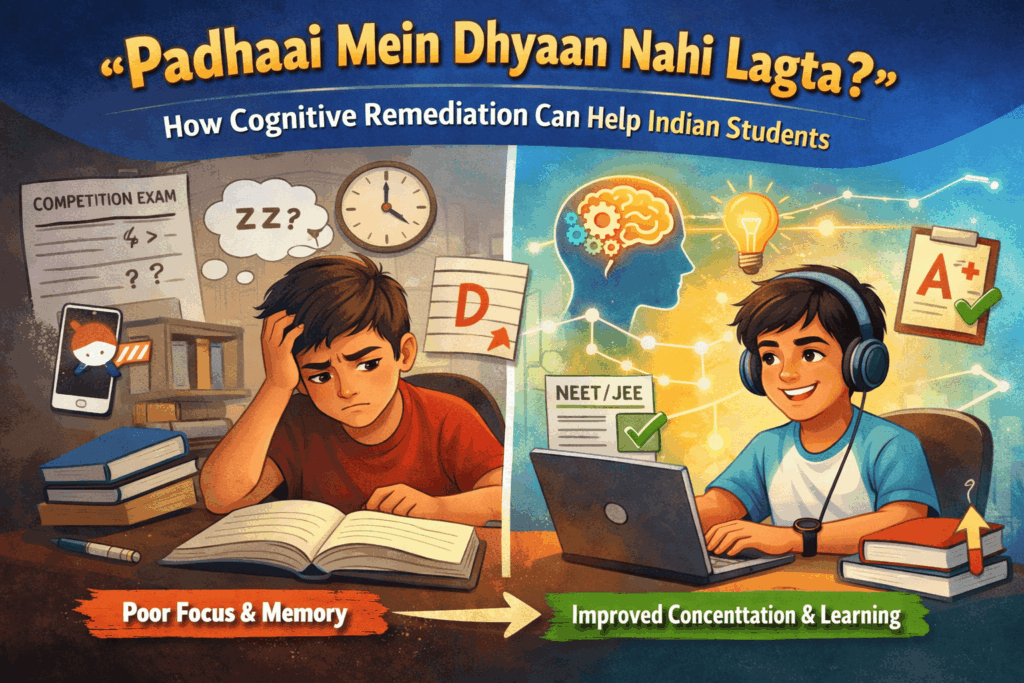
In India, one of the most common concerns parents share with psychologists is:
“Doctor, padhaai mein dhyaan nahi lagta… mobile side mein rakhta hai, phir bhi focus nahi karta.”
If you’re a parent, teacher, or student reading this, you may relate.
Your child may be:
Intelligent but underperforming
Forgetting what they just studied
Taking too long to complete homework
Getting distracted easily
Struggling with competitive exam preparation
Called “lazy” despite genuine effort
The truth is — sometimes the problem is not motivation, but cognition.
This is where Cognitive Remediation Therapy (CRT) can make a real difference.
Cognitive Remediation Therapy (CRT) is a structured, scientifically designed therapy that helps improve core thinking skills such as:
Attention
Memory
Processing speed
Planning and organization
Problem-solving
Executive functioning
Unlike talk therapy, CRT focuses on training the brain directly through targeted exercises and strategies.
Think of it as physiotherapy for the brain.
In the Indian education system, students face:
Heavy academic pressure
Long school hours + coaching classes
Competitive exams like NEET, JEE, CUET
Constant comparison with peers
High screen time and digital distraction
But when a child repeatedly says:
“Mujhe samajh aata hai, par yaad nahi rehta.”
“Main try karta hoon, par concentration toot jaata hai.”
It may indicate underlying cognitive difficulties.
Here are common signs seen in Indian students:
Cannot sit for more than 15–20 minutes without distraction.
Forgets instructions quickly. Needs repeated reminders.
Understands concepts but takes extra time in exams.
Books misplaced, timetable not followed, incomplete assignments.
Cries before exams, avoids studying, gives up quickly.
High potential but average results.
These issues are often mistaken for laziness or lack of discipline — but they may be cognitive skill gaps.
Many parents ask:
“Is it ADHD or just mobile addiction?”
Attention difficulties can be linked to:
ADHD
Anxiety
Depression
Learning disabilities
Post-COVID brain fog
Academic burnout
A psychological assessment helps identify the root cause.
Cognitive Remediation can support students whether they have a formal diagnosis or simply need structured cognitive strengthening.
Through structured attention exercises, students learn:
Sustained focus
Selective attention (ignoring distractions)
Divided attention
Over time, they can sit longer and study more efficiently.
CRT works on:
Working memory (holding information in mind)
Long-term retention
Recall strategies
Students start remembering formulas, concepts, and instructions better.
Some students know the answer but write slowly.
Cognitive training improves:
Speed of thinking
Quick decision-making
Timed performance
This is especially helpful for board exams and competitive tests.
Executive functions include:
Planning
Time management
Organization
Task initiation
CRT teaches practical strategies to manage study schedules effectively.
When students see improvement in cognitive skills:
Confidence increases
Anxiety decreases
Motivation improves naturally
Success builds self-belief.
Rohan, a Class 9 student in Gurgaon:
Bright child
Good verbal skills
Low exam scores
Easily distracted
Parents frustrated
After cognitive assessment, weaknesses in working memory and processing speed were identified.
With 3 months of Cognitive Remediation:
Homework completion improved
Teacher complaints reduced
Exam scores increased
Parent-child conflict decreased
The child was not lazy — he needed brain skill training.
Cognitive Remediation is helpful for:
Students with ADHD
Children with learning difficulties
Teens preparing for competitive exams
Students recovering from depression
Children with slow processing speed
Post-pandemic attention issues
Smart but underperforming students
It is suitable for both school-going children and college students.
At a professional psychology clinic, the process usually includes:
Cognitive testing identifies strengths and weaknesses.
Targets like improving focus duration or memory recall are set.
Activities may include:
Attention drills
Memory tasks
Problem-solving exercises
Strategy training
Computer-based cognitive tasks
Students are taught how to apply skills in school and exams.
Sessions are structured, engaging, and age-appropriate.
Every child is different.
Typically:
Mild concerns: 6–8 weeks
Moderate issues: 2–3 months
Complex cases: Longer duration
Consistency is key.
Punishment doesn’t improve cognitive skills.
Digital distraction is not always the root cause.
Today’s academic pressure is very different.
Intelligence ≠ cognitive efficiency.
When attention and memory issues are ignored:
Self-esteem drops
Academic confidence reduces
Anxiety increases
Parent-child conflicts rise
Early cognitive intervention prevents long-term academic and emotional struggles.
Preparing for NEET, JEE, CLAT, UPSC, or CUET requires:
Sustained focus
Strong memory
Fast processing
Mental stamina
Cognitive Remediation can support exam aspirants by improving mental endurance and performance consistency.
Along with therapy, you can:
Create structured study routines
Reduce multitasking
Encourage breaks using Pomodoro technique
Appreciate effort, not just marks
Avoid constant comparison
Support > Pressure.
Seek professional help if:
Teachers repeatedly complain about focus
Child studies but marks don’t improve
Frequent emotional meltdowns before exams
Significant forgetfulness
Academic performance below potential
A professional evaluation provides clarity.
With rising academic stress in urban India, many families are now seeking structured psychological interventions.
At The Lifestyle Clinic (Gurgaon), Cognitive Remediation programs are tailored to:
School students
Teens
College students
Young professionals
Each plan is customized after assessment.
If your child keeps saying:
“Mujhe samajh aata hai, par dhyaan nahi lagta.”
It is not always laziness.
It may be a skill gap.
Cognitive skills can be trained.
Focus can improve.
Memory can strengthen.
Confidence can rebuild.
The right support can change not just marks — but a child’s future.