
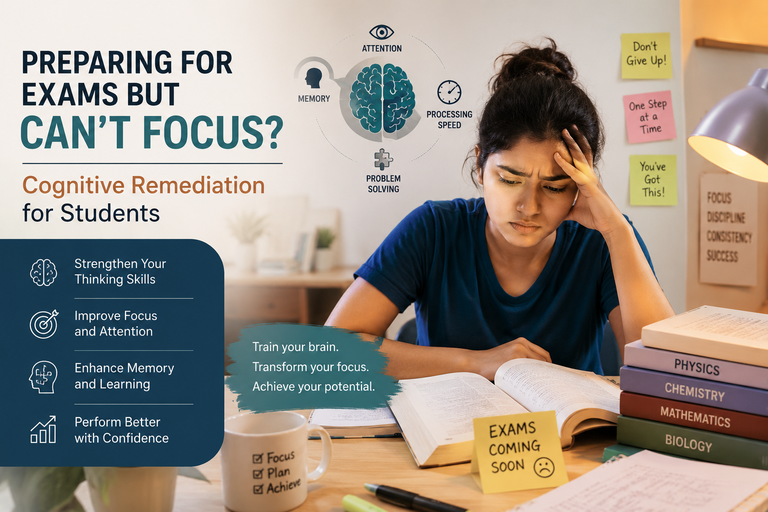
You sit down to study with the best intentions—your books are open, your notes are ready, and your exams are approaching fast. Yet, despite your efforts, your mind keeps wandering. You read the same paragraph repeatedly but struggle to remember what you just studied. If this sounds familiar, you are not alone.
Many students in India preparing for board exams, competitive entrance tests like NEET, JEE, UPSC, CAT, or even university assessments experience difficulty concentrating, mental fatigue, brain fog, and poor memory retention. While stress and anxiety are often blamed, there is another important factor many students and parents are unaware of—cognitive functioning.
This is where Cognitive Remediation can make a meaningful difference.
Cognitive Remediation (CR) is a structured psychological intervention designed to improve essential thinking skills such as:
Think of it as brain training guided by psychological science. Unlike general study tips or motivational strategies, cognitive remediation targets the underlying mental processes that affect how efficiently you learn and retain information.
It helps students strengthen the brain skills needed for academic success.
Students today face enormous mental demands. Between academic pressure, digital distractions, social expectations, and competitive exams, staying mentally sharp can feel overwhelming.
Common reasons students struggle with focus include:
Indian students often face intense pressure to perform well. Chronic stress can affect the brain’s ability to process and store information efficiently.
Long study hours without effective breaks can lead to cognitive exhaustion, making concentration increasingly difficult.
Constant notifications, social media scrolling, and multitasking reduce attention span over time.
Worrying about exams can consume mental energy, leaving less capacity for studying.
Some students may naturally struggle with working memory, attention regulation, or executive functioning—even when they are highly motivated.
It is easy to assume poor focus means laziness or lack of discipline. In reality, cognitive difficulties are often invisible but very real.
You may benefit from cognitive remediation if you:
These challenges can deeply affect self-esteem, motivation, and academic performance.
Cognitive Remediation Therapy (CRT) uses scientifically designed exercises and therapist-guided strategies to strengthen weak cognitive skills.
Sessions may include:
Activities designed to improve sustained focus and reduce distractibility.
Example:
Strategies to improve short-term and long-term retention.
Example:
Helping students plan, prioritize, and organize their studies more effectively.
Example:
Helping the brain process information faster and more efficiently.
Students learn how to apply these improved cognitive skills directly to studying, note-taking, and exam performance.
Instead of fighting constant distractions, students gradually build stronger attention control.
Students often report remembering concepts more clearly and recalling information faster.
Improved cognitive efficiency means less energy is wasted.
When students see progress in their thinking abilities, motivation improves.
Better focus often reduces anxiety and frustration related to studying.
No.
While cognitive remediation is commonly used for individuals with ADHD, learning difficulties, or mental health conditions, it can also benefit students experiencing:
Many high-performing students use cognitive training to optimize performance—not just to overcome deficits.
Traditional study advice focuses on what to do:
Cognitive remediation focuses on how your brain functions while studying.
For example:
If your attention span is weak, even the best timetable may not help.
If your working memory is overloaded, revision alone may feel ineffective.
Cognitive remediation strengthens the mental systems behind successful studying.
A psychologist usually begins with a cognitive assessment to identify areas of difficulty.
This may include evaluating:
Based on the results, a personalized therapy plan is created.
Sessions may involve:
Therapy is collaborative, supportive, and adapted to the student’s age and academic goals.
Absolutely.
Parents play a key role in supporting students dealing with concentration problems.
Helpful steps include:
Instead of saying “You are lazy,” try asking, “What feels difficult when you study?”
Does focus worsen at certain times of day? Are distractions specific?
Persistent focus problems deserve attention—not criticism.
Sleep, nutrition, movement, and emotional support are essential for cognitive performance.
It may be time to consult a psychologist if:
Early intervention can prevent academic struggles from becoming emotional struggles.
If you are preparing for exams but feel unable to focus, it does not mean you are not trying hard enough.
Sometimes, the issue is not motivation—it is how efficiently your brain is processing information.
Cognitive Remediation offers a structured, evidence-based way to strengthen attention, memory, and mental clarity—helping students study smarter, not just harder.
Whether you are preparing for board exams, competitive entrance tests, or university assessments, improving your cognitive skills can make learning less frustrating and more rewarding.
Your brain can be trained.
Your focus can improve.
And with the right support, academic success can feel achievable again.