
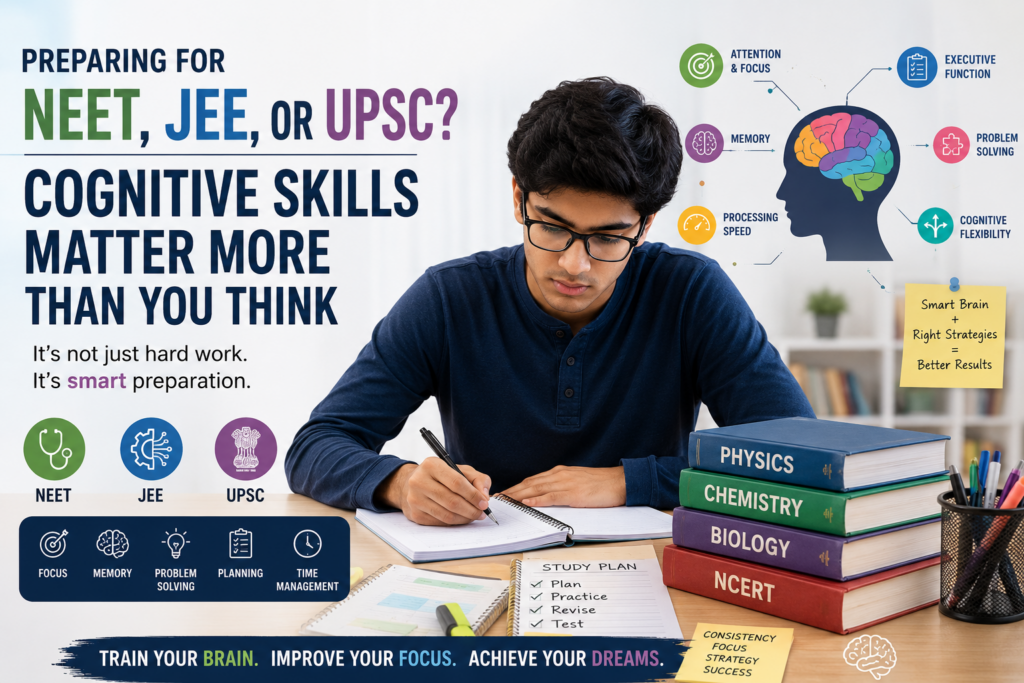
Every year, millions of students across India dedicate countless hours to preparing for competitive examinations like NEET, JEE, and UPSC. Coaching classes, mock tests, study schedules, and endless revision become a part of daily life. Yet, despite working hard and investing significant time, many students find themselves asking a frustrating question:
“Why am I not getting the results I deserve?”
The answer may not always lie in how much you study. Sometimes, it lies in how your brain processes, retains, and uses information. These mental abilities, known as cognitive skills, play a crucial role in academic success and competitive exam performance.
If you’ve ever struggled with concentration, memory, time management, problem-solving, or mental fatigue despite sincere efforts, understanding cognitive skills could transform the way you prepare for exams.
Cognitive skills are the brain’s core mental abilities that help us learn, remember, think, focus, and make decisions. They influence how effectively we absorb information and apply it when needed.
Some of the most important cognitive skills for competitive exam preparation include:
The ability to focus on a task without being distracted.
The ability to hold and manipulate information in your mind while solving problems.
How quickly your brain can understand and respond to information.
Skills involved in planning, organizing, prioritizing, and managing time effectively.
The ability to switch between different concepts and adapt to changing questions or situations.
The ability to analyze information and arrive at logical conclusions.
When these skills function efficiently, studying becomes more productive and less exhausting.
NEET, JEE, and UPSC are not merely tests of knowledge. They evaluate how effectively you can use your knowledge under pressure.
Consider the demands of these exams:
Students must quickly recall vast amounts of information while maintaining accuracy under time constraints.
Success requires advanced reasoning, analytical thinking, and the ability to solve complex problems rapidly.
Candidates must process large volumes of information, connect concepts across subjects, and think critically while writing detailed answers.
In each case, cognitive skills often determine whether a student can translate preparation into performance.
Many students believe that if they are not performing well, they simply need to increase their study hours.
However, more study time does not always mean better results.
Imagine two students studying for six hours daily:
Although both spend the same amount of time studying, Student A is likely to achieve better outcomes because their cognitive skills support efficient learning.
The issue is not always effort—it is often the effectiveness of the brain processes behind learning.
Many students experience challenges that are actually linked to cognitive functioning.
You may benefit from evaluating your cognitive skills if you frequently:
These difficulties are often mistaken for laziness, lack of discipline, or insufficient effort. In reality, they may indicate areas where cognitive skills need strengthening.
Indian students preparing for competitive examinations face immense pressure.
Expectations from family, peers, coaching institutes, and society can create chronic stress. While a moderate level of stress may improve motivation, excessive stress negatively affects cognitive functioning.
Stress can:
This is why many students perform exceptionally well during practice sessions but struggle during actual examinations.
The brain’s cognitive systems become less efficient when overwhelmed by stress and anxiety.
Many students assume that high intelligence guarantees academic success.
However, intelligence is only one piece of the puzzle.
A highly intelligent student with poor attention, weak planning skills, or ineffective memory strategies may underperform compared to a student with average intelligence but strong cognitive functioning.
Success in competitive exams depends on:
All of these involve cognitive processes.
Strong cognitive skills help students:
Effective working memory and attention improve:
Strong executive functioning supports:
Cognitive skills enable students to:
One of the most encouraging findings from neuroscience is that the brain is adaptable.
This ability, known as neuroplasticity, means that cognitive skills can often be strengthened through targeted interventions and practice.
Just as physical exercise strengthens muscles, cognitive exercises can strengthen mental abilities.
Improvement is possible in areas such as:
The key is structured and evidence-based training.
Cognitive Remediation Therapy (CRT) is a scientifically supported intervention designed to improve cognitive functioning.
It involves structured exercises and strategies that help individuals strengthen specific mental skills.
Unlike ordinary studying, CRT focuses on improving the underlying brain functions that support learning and performance.
A cognitive remediation program may target:
The goal is not simply to improve test scores but to enhance the cognitive abilities that contribute to academic success.
Students often report fewer distractions and greater ability to stay focused during long study sessions.
Enhanced memory skills help with retaining formulas, concepts, facts, and important information.
Improved processing speed allows students to understand and absorb information more efficiently.
Students become better equipped to analyze complex questions and identify solutions.
Stronger executive functioning supports planning, scheduling, and prioritization.
As cognitive performance improves, students often experience greater confidence and reduced academic stress.
In addition to professional interventions, students can adopt habits that support cognitive health.
Sleep plays a critical role in memory consolidation and learning.
Most students preparing for competitive exams should aim for 7–9 hours of quality sleep.
Physical activity improves blood flow to the brain and supports cognitive functioning.
Even 30 minutes of daily exercise can make a difference.
Mindfulness and meditation can improve attention and emotional regulation.
Continuous studying without breaks reduces efficiency.
Techniques such as the Pomodoro Method can help maintain focus.
Frequent phone notifications and social media interruptions weaken concentration.
Nutrient-rich foods support brain health and sustained mental performance.
Occasional concentration problems are normal.
However, if cognitive difficulties persist despite sincere effort, professional evaluation may be beneficial.
Consider seeking help if:
A psychologist trained in cognitive assessment can identify strengths and weaknesses and recommend appropriate interventions.
In India’s highly competitive educational environment, students are often judged solely by marks and ranks.
Yet, academic performance is influenced by much more than intelligence or hard work.
Many students who struggle academically are not lacking motivation. Instead, they may be facing challenges related to attention, memory, processing speed, or executive functioning.
Recognizing and addressing these cognitive factors can make a significant difference.
Parents should understand that statements like:
may not solve the underlying issue.
Supportive guidance and appropriate interventions are often far more effective.
Preparing for NEET, JEE, or UPSC requires more than determination and long study hours. Success depends on a combination of knowledge, strategy, emotional resilience, and strong cognitive skills.
If you find yourself studying hard but struggling to remember information, maintain focus, manage time, or perform consistently in exams, it may be time to look beyond traditional study methods.
Strengthening cognitive skills can help unlock your true potential and make your preparation more effective, efficient, and rewarding.
Remember, success in competitive exams is not just about how much you study—it is also about how effectively your brain learns, processes, and applies information.
Investing in cognitive health today may be one of the smartest steps you can take toward achieving your academic goals.