
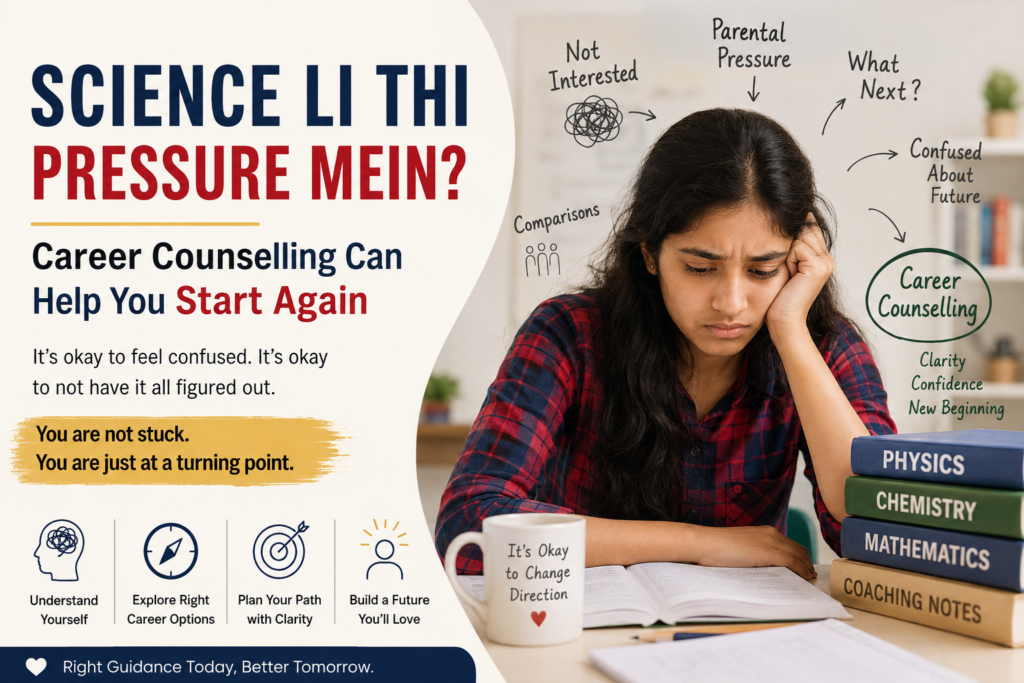
In many Indian homes, choosing the Science stream after Class 10 is often seen as the “safe” or “smart” decision. Sometimes it comes from genuine ambition. But many times, students choose Science because of pressure — pressure from parents, relatives, teachers, society, or even comparison with friends.
“Beta science le lo, options open rahenge.”
“Good students always take science.”
“Arts aur commerce mein scope nahi hai.”
These are sentences thousands of students hear every year.
At first, it may feel manageable. But slowly, many students begin experiencing constant stress, self-doubt, exhaustion, poor academic performance, anxiety, and emotional burnout. Some continue forcing themselves through coaching classes and entrance preparation while silently feeling disconnected from the subjects they study every day.
If you are someone who took Science under pressure and now feels stuck, confused, or unhappy, this article is for you.
The good news is this:
One wrong stream choice does not destroy your future. Career counselling can help you understand yourself better and rebuild your direction with clarity and confidence.
In India, career decisions are rarely emotional decisions alone. They are deeply connected with family expectations, financial security, social image, and fear of uncertainty.
Many students choose Science because:
Unfortunately, students often realise much later that they were never genuinely interested in Physics, Chemistry, or competitive exam preparation.
This realisation can feel frightening because Indian students are taught that changing direction means “failure.” But in reality, recognising a mismatch early is actually a sign of self-awareness.
Sometimes students do not immediately realise they are struggling because of a wrong stream choice. They simply think they are “lazy” or “not good enough.”
But emotional and behavioural signs often tell a different story.
Some students even develop physical symptoms like headaches, sleep problems, stomach discomfort, or panic during exams.
These struggles are not always about intelligence. Many times, they are about misalignment between the student’s interests, personality, aptitude, and chosen academic path.
This is one of the most common fears students express during career counselling sessions.
They believe:
But career journeys are not linear anymore.
Today, students successfully shift from:
The world has changed. Career options have changed. The definition of success has changed.
What matters now is not forcing yourself into a socially approved career, but building a sustainable and emotionally healthy future.
Career counselling is not about forcing another career option on a student.
A psychologist or career counsellor helps students understand:
This process creates clarity instead of confusion.
Many Indian students believe marks alone decide career suitability.
But scoring well in Science does not automatically mean a student will enjoy engineering or medicine.
Career counselling uses scientifically designed aptitude and psychometric assessments to evaluate:
This helps students discover careers aligned with both ability and personality.
Students carrying pressure often experience guilt and fear.
A counsellor provides a non-judgmental space where students can openly discuss:
Sometimes students simply need permission to admit:
“I am unhappy.”
That emotional validation itself can reduce significant stress.
One major reason students feel trapped is lack of awareness.
India now offers strong career opportunities in:
Career counselling helps students explore realistic, structured pathways instead of random internet advice.
In Indian culture, parents usually pressure children out of concern, not cruelty.
Most parents want:
However, excessive pressure can unintentionally create:
Students often begin hiding emotions because they fear being labelled irresponsible or weak.
This is why modern career counselling also involves family conversations. Sometimes parents need guidance too.
A healthy career decision happens when:
Another silent fear many students carry is:
“What if I am not exceptional at anything?”
Social media and competitive culture create unrealistic expectations. Students believe they must become toppers, IITians, doctors, or influencers to be successful.
But real career success is usually built through:
Not everyone needs to become an engineer to live a meaningful and financially stable life.
Career counselling helps students shift focus from comparison to compatibility.
Absolutely.
Science students actually develop transferable skills like:
These skills can be applied across multiple fields.
Many universities and courses now allow interdisciplinary movement.
For example:
The important thing is making an informed decision instead of staying stuck in fear.
Parents play a huge role in a student’s emotional confidence.
Helpful approaches include:
Sometimes one supportive conversation at home can reduce months of stress.
Many families still think counselling is only needed when something is “seriously wrong.”
In reality, career counselling is preventive guidance.
It helps students:
Seeking guidance is a sign of maturity, not failure.
Some students continue in unwanted careers simply because they fear restarting.
But imagine spending:
Changing direction may feel uncomfortable temporarily, but staying unhappy for years creates much deeper emotional damage.
You are allowed to pause, rethink, and rebuild.
Taking Science under pressure does not mean your future is ruined.
It simply means you made an early decision in a system where students are often expected to decide their entire future at 15 or 16 years old.
That pressure is real.
But your career journey does not end with one stream choice.
With proper career counselling, emotional support, aptitude assessment, and honest self-reflection, students can rediscover confidence and move toward careers that fit both their abilities and mental well-being.
Success is not about blindly following the most socially respected path.
Real success is building a life where you feel capable, emotionally healthy, and connected to what you do.
And sometimes, starting again is the bravest decision a student can make.