
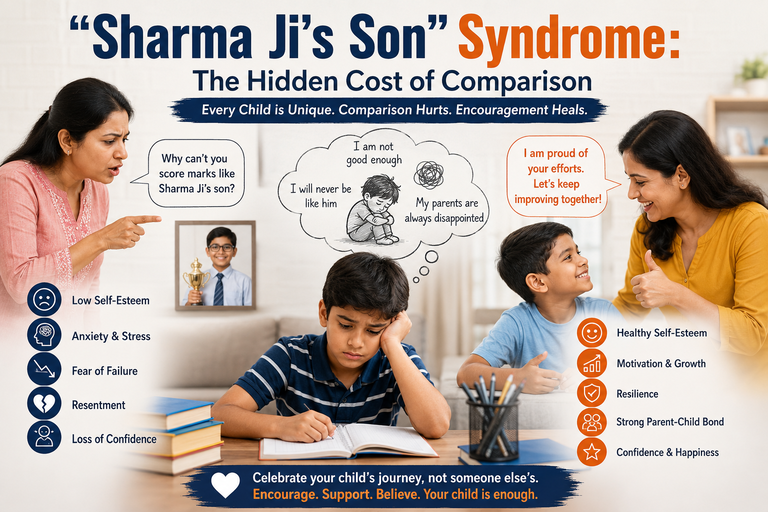
“Why can’t you score marks like Sharma Ji’s son?”
Many Indian adults can recall hearing a version of this statement during their childhood. Whether it was about academic performance, sports achievements, behavior, or career choices, comparisons have long been a part of parenting in Indian households.
While most parents compare with good intentions—hoping to motivate their children—the psychological impact of constant comparison can be far more damaging than many realize. What begins as an attempt to encourage better performance can gradually affect a child’s confidence, emotional well-being, self-worth, and relationship with their parents.
In psychology, frequent comparison can create feelings of inadequacy, anxiety, resentment, and fear of failure. Over time, children may begin to believe that they are valued only for their achievements rather than for who they are as individuals.
This phenomenon, often humorously referred to as “Sharma Ji’s Son” Syndrome, is not merely a cultural joke. It reflects a serious parenting pattern that can have lasting emotional consequences.
Most parents do not compare their children to hurt them. In fact, many believe comparison is a powerful motivator.
Some common reasons include:
Parents may think statements like:
will inspire their child to improve.
However, children often interpret these messages differently.
Instead of hearing encouragement, they hear:
This difference in perception can significantly affect emotional development.
Human beings naturally compare themselves with others. Psychologists refer to this as social comparison.
While occasional comparison is normal, repeated external comparisons during childhood can influence how children view themselves.
Children develop self-esteem based largely on feedback from significant adults, especially parents.
When parents consistently compare them with others, children may begin to measure their worth through external achievements rather than internal qualities such as:
As a result, they become dependent on external validation and struggle to develop a healthy sense of self-worth.
One of the most common consequences is reduced self-confidence.
Children start believing they are inherently less capable than others.
Even when they achieve success, they may feel it is never enough because someone else is always performing better.
Over time, this creates a persistent sense of inadequacy.
Children who are frequently compared often become anxious about meeting expectations.
They may worry excessively about:
This pressure can lead to chronic stress and fear of failure.
When children feel that success is the only way to earn approval, they become afraid of failure.
They may avoid:
This fear can limit personal growth and learning opportunities.
Comparison can create emotional distance between parents and children.
A child who repeatedly hears comparisons may begin to feel:
Instead of motivating improvement, comparison may lead to frustration and resentment.
Children who are constantly compared often begin comparing themselves with others.
This can result in:
Healthy competition turns into unhealthy self-judgment.
Many parents compare children to improve academic performance.
Ironically, excessive comparison often produces the opposite result.
Research in child psychology suggests that children perform better when they feel supported rather than criticized.
When comparison becomes frequent:
Instead of studying to learn, children begin studying to avoid criticism.
This shift from intrinsic motivation to fear-based motivation can negatively affect long-term academic success.
The teenage years are particularly sensitive because adolescents are already trying to understand their identity.
During this stage, comparison can intensify feelings of:
Teenagers may begin questioning:
These thoughts can affect mental health and contribute to anxiety or depressive symptoms.
Today’s children face a double burden.
Not only are they compared by parents, but they are also constantly exposed to social media comparisons.
Through Instagram, YouTube, and other platforms, children see:
When parental comparison combines with social media pressure, children may experience overwhelming feelings of inadequacy.
They begin chasing unrealistic standards and may feel they are always falling behind.
Parents should watch for warning signs such as:
If these patterns persist, professional guidance from a child psychologist may be beneficial.
Children thrive when they feel accepted, valued, and supported.
Instead of comparing them to others, parents can focus on individual growth.
Praise statements such as:
help build resilience and self-confidence.
Children learn that their worth is not dependent solely on outcomes.
A healthier approach is comparing a child with their own past performance.
For example:
Instead of saying:
“Your friend scored 95%, why didn’t you?”
Try saying:
“You improved from 70% to 80%. Let’s see how we can keep improving.”
This encourages growth without creating shame.
Every child has unique talents.
Some excel academically.
Others may shine in:
Parents who recognize these strengths help children develop a balanced and positive self-image.
Teach children that abilities can improve with effort and learning.
When children believe improvement is possible, they become more willing to face challenges and recover from setbacks.
Replace comparison-based statements with supportive alternatives.
| Instead of Saying | Try Saying |
|---|---|
| “Look at Sharma Ji’s son.” | “Let’s focus on your goals.” |
| “Why can’t you be like your cousin?” | “Everyone learns differently.” |
| “Others are doing better.” | “How can I help you improve?” |
| “You’re not trying hard enough.” | “Let’s figure out what’s making this difficult.” |
| “You always fall behind.” | “Progress takes time.” |
Small changes in language can significantly improve a child’s emotional well-being.
Children need to know that parental love is not conditional on performance.
A strong parent-child relationship is built on:
When children feel emotionally safe, they are more likely to:
The goal of parenting is not to create the “perfect child” but to help each child become the best version of themselves.
If comparison has led to significant emotional distress, parents should consider consulting a child psychologist.
Professional support may be helpful when a child experiences:
Early intervention can prevent these challenges from affecting long-term mental health.
The phrase “Sharma Ji’s Son” may sound harmless or even humorous, but the emotional impact of constant comparison is very real.
Children do not need to be reminded that someone else is better. They need to know that they are valued, supported, and loved for who they are.
Every child develops at their own pace and possesses unique strengths. When parents shift their focus from comparison to encouragement, they create an environment where children can thrive emotionally, socially, and academically.
Instead of asking, “Why can’t you be like Sharma Ji’s son?” perhaps the more powerful question is:
“How can I help my child become the best version of themselves?”
That simple shift can make all the difference in a child’s confidence, happiness, and future well-being.