
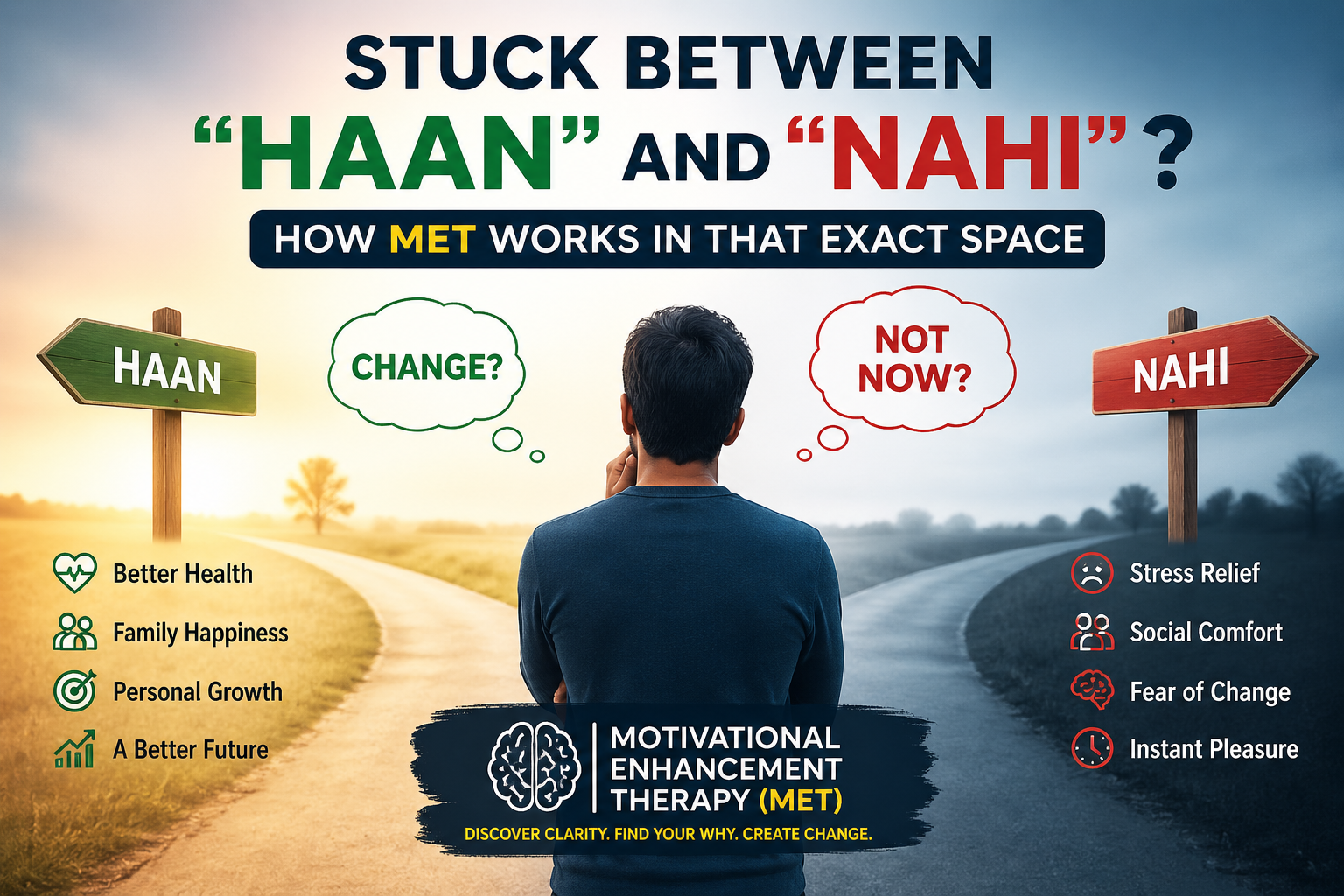
You’ve probably said this to yourself more times than you’d like to admit:
“Mujhe change karna hai… par pata nahi kyun ho nahi raha.”
You’re not alone. Many people in India—and across the world—find themselves caught in a frustrating mental loop: part of you wants to change, and another part resists it just as strongly. This internal tug-of-war is not laziness, lack of discipline, or weakness. It’s something far more nuanced.
In psychology, this space is called ambivalence—and it’s exactly where Motivational Enhancement Therapy (MET) does its most powerful work.
Imagine this:
This isn’t confusion—it’s conflicting motivations co-existing at the same time.
One part of your mind says:
✔ “This is important. I need to change.”
Another part whispers:
✖ “But what will I lose if I do?”
Most traditional advice tries to silence the second voice. But here’s the problem:
👉 The more you suppress resistance, the stronger it becomes.
You’ve likely heard things like:
While well-intentioned, this advice misses a key psychological truth:
👉 Change doesn’t fail because you don’t want it enough. It fails because part of you doesn’t want it at all.
This is where Motivational Enhancement Therapy (MET) takes a completely different approach.
Instead of forcing motivation, MET explores why you feel both “haan” and “nahi” at the same time.
Motivational Enhancement Therapy is a structured, evidence-based approach used by psychologists and psychiatrists to help individuals resolve ambivalence and move toward meaningful change.
It is especially effective in:
Unlike traditional therapy models that focus on what you should do, MET focuses on:
👉 Why you feel stuck about doing it
MET is built on a powerful insight:
People are not unmotivated. They are multiply motivated in different directions.
For example:
| Desire to Change (Haan) | Desire to Stay the Same (Nahi) |
|---|---|
| Better health | Comfort of current habits |
| Family expectations | Fear of failure |
| Financial savings | Immediate pleasure |
MET doesn’t try to “win” this argument for you.
Instead, it helps you understand both sides deeply—so you can make a clear, internally aligned decision.
In MET, a therapist doesn’t tell you what’s right or wrong.
They create a safe space where you can openly say:
This reduces defensiveness and allows honest reflection.
One of the most powerful techniques in MET is recognizing “change talk”—statements that reflect your desire, ability, or reasons to change.
For example:
The therapist gently amplifies these statements, helping your “haan” voice grow stronger naturally—not forcefully.
At the same time, MET respects your resistance:
Instead of arguing against these thoughts, MET explores them.
👉 Because resistance is not the enemy—it’s information.
This is where real shifts begin.
MET helps you see the gap between:
For example:
This internal mismatch creates natural motivation—far more powerful than external pressure.
Many people stay stuck not because they don’t want change—but because they don’t believe they can change.
MET works on building:
So the shift becomes:
👉 “Maybe I can do this.”
In India, decision-making is rarely individual. It’s influenced by:
This creates layered ambivalence:
MET is uniquely effective here because it:
✔ Doesn’t impose decisions
✔ Respects personal and cultural values
✔ Helps individuals find their own reasons for change
Case: A 32-year-old working professional struggling with alcohol use
Haan side:
Nahi side:
Traditional advice: “Stop drinking”
Result: Resistance, guilt, relapse
MET approach:
Outcome:
| Willpower Approach | MET Approach |
|---|---|
| “Force yourself” | “Understand yourself” |
| Short-term push | Long-term clarity |
| High relapse risk | Sustainable change |
| Ignores resistance | Works with resistance |
You might benefit from Motivational Enhancement Therapy if:
👉 In short: If you’re living in “haan bhi, nahi bhi” — MET is designed for you.
Most importantly:
👉 It doesn’t push change—it evokes it from within you.
We often think change begins when we’re fully ready.
But that’s not true.
Change begins right in the middle of confusion—
In that uncomfortable space where:
That space is not a problem.
👉 It’s the starting point.
And Motivational Enhancement Therapy is designed exactly for that space.
If you’re feeling stuck between “haan” and “nahi,”
you don’t need to force a decision today.
You just need to understand the conflict clearly.
Because once your mind stops fighting itself,
change doesn’t feel forced anymore—it feels natural.
If you or someone you know is struggling with motivation, addiction, or behavioral change, consulting a trained psychologist or psychiatrist in Motivational Enhancement Therapy can make a significant difference.
Early support can help turn confusion into clarity—and intention into action.