
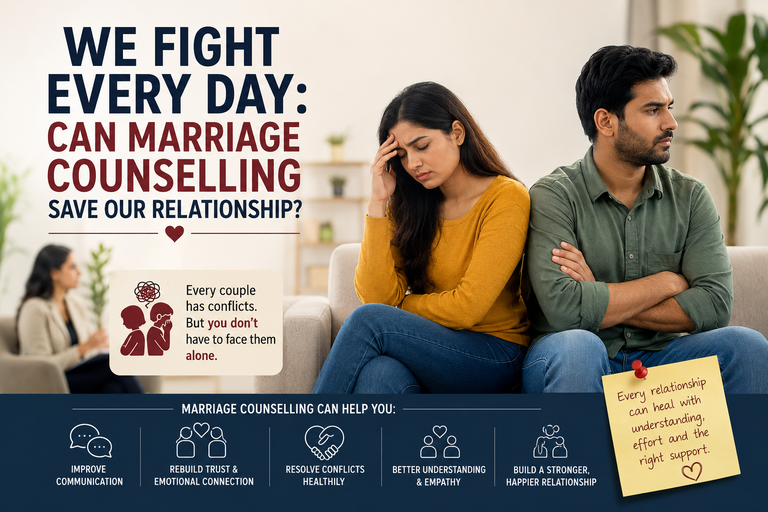
If you and your partner find yourselves arguing every day, you may have started wondering, “Is our relationship beyond repair?” Many couples in India silently struggle with constant conflicts, emotional distance, and misunderstandings. While occasional disagreements are a normal part of every relationship, frequent arguments can slowly weaken trust, affection, and emotional connection.
The good news is that fighting every day does not always mean your relationship is over. In many cases, the underlying issue is not a lack of love but unhealthy communication patterns, unresolved emotions, stress, or unmet expectations. This is where marriage counselling can make a significant difference.
In this blog, we’ll explore why couples fight, when conflicts become unhealthy, how marriage counselling works, and whether it can help save your relationship.
Every couple has disagreements. Differences in opinions, habits, finances, parenting styles, or family expectations are common. However, when arguments become a daily routine, they can create emotional exhaustion and distance.
Daily fights often lead to:
Increased stress and anxiety
Poor communication
Loss of emotional intimacy
Constant blame and criticism
Reduced trust
Feelings of loneliness despite living together
Thoughts of separation or divorce
Instead of solving problems, couples often begin fighting over small issues because deeper concerns remain unresolved.
Understanding the root cause is the first step toward healing.
Many couples communicate only to solve problems rather than to understand each other. Interrupting, shouting, assuming, or avoiding conversations often leads to repeated misunderstandings.
Everyone wants to feel valued, respected, appreciated, and heard. When these emotional needs go unmet, frustration builds over time.
Money is one of the leading causes of marital conflict. Differences in spending habits, savings, debt, or financial responsibilities can create ongoing tension.
In India, relationships with parents and in-laws can significantly influence a marriage. Lack of healthy boundaries may result in frequent disagreements.
Couples may disagree about discipline, education, screen time, or parenting responsibilities, creating ongoing conflict.
Long working hours, career pressures, and lack of quality time can make partners feel neglected.
Broken promises, dishonesty, emotional affairs, or infidelity often damage trust and lead to recurring arguments.
Stress, anxiety, depression, or unresolved trauma may affect emotional regulation, making conflicts more frequent and intense.
Every disagreement is not harmful. However, professional help may be needed if you notice these warning signs:
The same argument happens repeatedly.
One or both partners avoid talking altogether.
Small disagreements quickly become major fights.
There is constant criticism or blaming.
You feel emotionally disconnected.
Silent treatment lasts for days.
You no longer enjoy spending time together.
Thoughts of separation occur frequently.
Children are witnessing frequent conflicts.
Respect has been replaced by anger or contempt.
Ignoring these signs often allows resentment to grow.
In many cases, yes.
Marriage counselling is not about deciding who is right or wrong. Instead, it helps couples understand each other’s emotions, improve communication, resolve conflicts, and rebuild trust.
A trained psychologist provides a safe and non-judgmental space where both partners can openly discuss their concerns.
Research has shown that couples who seek counselling early often experience improved relationship satisfaction, healthier communication, and better emotional connection.
However, counselling works best when both partners are willing to participate honestly and consistently.
One of the biggest goals of counselling is teaching couples how to communicate without attacking each other.
Instead of saying:
“You never care about me.”
You learn to express:
“I feel hurt when I don’t feel heard.”
This simple shift reduces defensiveness and encourages understanding.
Often, arguments about dishes, money, or household chores are actually about feeling unappreciated, ignored, or unsupported.
A psychologist helps uncover these deeper emotional concerns.
Many couples unknowingly repeat unhealthy cycles:
One partner criticizes.
The other becomes defensive.
Someone withdraws.
The argument ends without resolution.
Counselling helps replace these patterns with healthier responses.
If trust has been damaged, counselling provides structured steps toward rebuilding honesty, transparency, and emotional safety.
Partners learn to express appreciation, empathy, affection, and emotional support again.
Many couples hesitate because they don’t know what to expect.
Typically, counselling sessions involve:
Understanding the relationship history
Identifying major concerns
Exploring communication styles
Learning conflict-resolution techniques
Setting realistic relationship goals
Practicing healthy conversations
Building emotional intimacy
The psychologist remains neutral and supports both individuals equally.
Reality: Many happy couples attend counselling to strengthen their relationship before problems become severe.
A professional psychologist does not choose sides. The focus is on understanding both perspectives and improving the relationship.
Seeking help is a sign of commitment, not failure. Just as people seek medical treatment for physical illnesses, relationships sometimes need professional care.
Healing takes time. Most couples benefit from multiple sessions where they gradually develop healthier habits.
While professional guidance is valuable, small daily changes can also improve your relationship.
Allow your partner to finish speaking before responding.
Avoid bringing up old arguments during every disagreement.
Words spoken in anger can leave lasting emotional wounds.
Simple expressions of gratitude help strengthen emotional bonds.
Even 20–30 minutes of uninterrupted conversation each day can improve connection.
If emotions become overwhelming, take a short break before continuing the discussion.
It is best to seek help early rather than waiting until resentment becomes overwhelming.
Consider marriage counselling if:
You argue almost every day.
Communication has completely broken down.
Trust has been damaged.
Emotional intimacy is fading.
Family conflicts are affecting your relationship.
Financial disagreements are constant.
Parenting conflicts never get resolved.
One or both partners feel lonely in the marriage.
You are considering separation but still want to save the relationship.
Early intervention often leads to better outcomes.
Yes.
If your spouse is unwilling to attend initially, individual counselling can still help.
A psychologist can help you:
Improve communication skills.
Understand relationship dynamics.
Manage stress and emotions.
Develop healthier responses during conflicts.
Decide the next steps for your relationship.
Sometimes, positive changes in one partner encourage the other to participate later.
No marriage is perfect. Every relationship experiences difficult phases.
Healthy marriages are not built because couples never fight—they are built because couples learn how to repair after disagreements.
With patience, commitment, empathy, and professional guidance when needed, many couples successfully rebuild stronger and healthier relationships.
Remember, asking for help is not a sign of weakness. It is a step toward protecting a relationship that matters.
If you and your partner are saying, “We fight every day,” don’t assume your relationship is beyond hope. Daily conflicts often point to deeper emotional needs, communication gaps, or unresolved stress rather than a lack of love.
Marriage counselling provides practical tools to understand each other better, communicate effectively, and work together instead of against each other. Seeking support early can prevent small issues from becoming lifelong regrets.
Every healthy relationship requires effort, understanding, and growth. If both partners are willing to learn and heal, marriage counselling can become the turning point toward a stronger, happier, and more fulfilling marriage.
Q1. Can marriage counselling really save a relationship?
Yes. Marriage counselling can help couples improve communication, resolve conflicts, rebuild trust, and strengthen emotional intimacy. Success depends on both partners’ willingness to participate.
Q2. How many marriage counselling sessions are usually needed?
The number of sessions varies depending on the concerns. Some couples notice improvement within a few sessions, while others may benefit from longer-term counselling.
Q3. Should we wait until things become serious?
No. Seeking help early often prevents problems from becoming more difficult to resolve.
Q4. Can counselling help after infidelity?
Yes. Many couples work through betrayal with the support of a trained psychologist, although rebuilding trust takes time and commitment.
Q5. Is marriage counselling confidential?
Yes. Sessions are confidential, allowing both partners to discuss their concerns in a safe and supportive environment.