
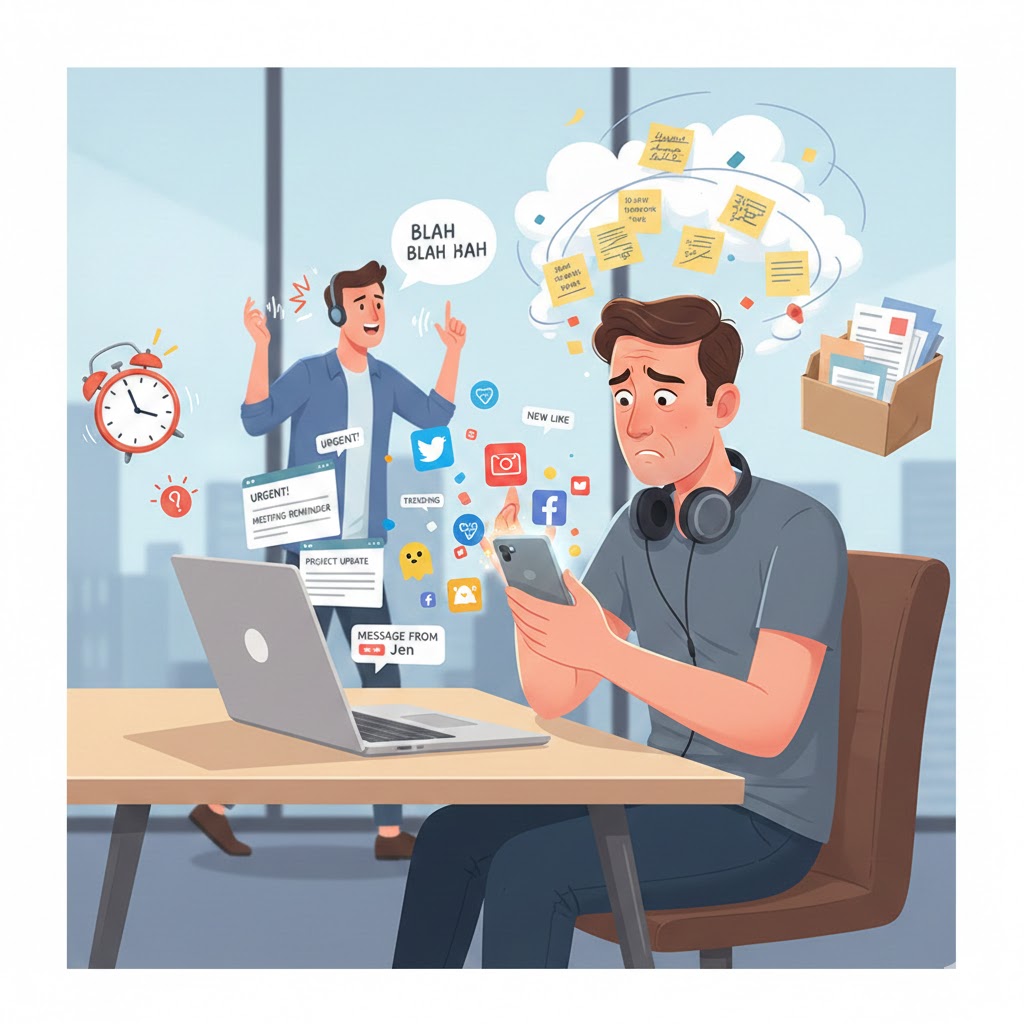
In an age where our attention is the most valuable currency, distraction has become the biggest thief. We live in a world of constant notifications, buzzing devices, and never-ending stimuli competing for mental real estate. Yet, distraction isn’t entirely a modern phenomenon—it’s deeply rooted in how the human brain evolved.
Understanding why your brain loves distractions is the first step to regaining control. Once we decode that, we can use evidence-based strategies drawn from neuroscience and psychology to sharpen focus and reclaim productivity.
Thousands of years ago, distraction kept our ancestors alive. Early humans evolved in unpredictable environments filled with dangers—rustling in the bushes could signal a predator or an incoming storm. The brain learned to prioritize novelty because paying attention to new, sudden changes often meant survival.
The part of the brain responsible for detecting novelty is the mesolimbic dopamine system—the same network activated by pleasure and reward. Each time something new grabs your attention, this circuit releases a small dopamine surge, giving you a hit of curiosity and motivation. This ancient mechanism once helped us explore our surroundings; today, it’s hijacked by endless social media feeds, clickbait headlines, and app notifications.
We are wired to respond to distraction because, biologically, novelty signals importance—even if it’s just a meme or a message ping.
When you check your phone or scroll through feeds, dopamine serves as the messenger of “potential reward.” The crucial part is “potential.” You don’t need a guarantee of something exciting—just the possibility keeps the brain returning for more. This is the same mechanism that makes slot machines addictive.
Psychologists call this the variable reward system. Unlike predictable rewards, variable ones (e.g., Will there be a new message? Will this post be funny?) generate stronger dopamine responses. Each scroll promises a thrill, even if it’s minor, and this fuels a reinforcement loop that’s hard to break.
In essence, your attention span isn’t shrinking—it’s being constantly trained to expect fast, rewarding feedback. The brain learns that the next distraction might be more pleasurable than the task at hand.
While our ancient wiring explains why distractions feel good, modern neuroscience reveals how they harm cognitive performance.
Each time you switch between tasks—say, writing an email and checking WhatsApp—your brain undergoes a phenomenon called attention residue. A part of your focus remains stuck on the previous task, preventing you from diving fully into the next one. Studies from the University of California, Irvine, found that it can take over 20 minutes to regain full focus after an interruption.
Frequent task-switching also activates the anterior cingulate cortex, which manages error detection and conflict between competing goals. Over time, this cognitive juggling drains mental energy, increases stress hormones, and reduces creative problem-solving.
You end up feeling busy but unproductive—a hallmark of modern burnout.
Many professionals pride themselves on multitasking. However, neuroscientific research consistently shows that multitasking is less about doing several things at once and more about rapidly switching between them. Chronic multitaskers experience decreased gray matter density in the anterior cingulate cortex, the area responsible for emotional regulation and cognitive control.
In practical terms, this means your brain becomes less efficient at ignoring distractions the more you indulge them.
Multitasking gives the illusion of efficiency but often doubles the time required to complete complex tasks and decreases the quality of work produced. True productivity lies in monotasking—deep engagement with one thing at a time.
The modern attention economy exploits our brains through intentional design. Platforms measure and maximize time on screen, using algorithms optimized to keep you scrolling. Each notification is an invitation to experience a dopamine spike.
Moreover, digital multitasking (listening to music, replying to messages, browsing social media—all simultaneously) fragments your working memory—the temporary mental workspace responsible for reasoning and decision-making. Over time, this leads to what psychologists call cognitive fatigue, making it harder to concentrate even when you want to.
Hence, distraction today isn’t just a bad habit—it’s an environmental challenge reinforced by technology, social norms, and workplace culture.
Focus isn’t about “forcing” your brain to concentrate. It’s about creating conditions that minimize interference and align mental energy with intrinsic motivation.
Two regions orchestrate focus:
Prefrontal cortex (PFC) – The command center for complex thought, planning, and impulse control. This area helps you resist distractions and sustain attention.
Parietal cortex – Directs sensory input, deciding what stimuli deserve attention.
When both function harmoniously, focus flows smoothly. However, stress, fatigue, and dopamine overload disrupt this balance, causing the PFC to weaken and impulsivity to dominate. That’s why you find yourself opening Instagram “just for a minute” even during important work sessions.
Sustained attention is less about “discipline” and more about neural optimization—reducing noise, managing dopamine, and designing an environment where focus feels natural.
The solution isn’t to eliminate distractions entirely (that’s impossible) but to train your brain to manage them intelligently. Here are research-backed strategies that work.
Behavioral scientist Shawn Achor describes the 20-second rule: make distractions 20 seconds harder to access. The extra friction discourages impulse use.
Keep your phone in another room during work.
Log out of social media or remove easy-access apps from the home screen.
Use website blockers (e.g., Freedom, Cold Turkey) during deep work hours.
Small environmental barriers can drastically lower distraction frequency by leveraging the brain’s preference for convenience.
This popular method works because it syncs with the brain’s natural attention rhythms. Human minds can sustain high-quality focus for 25–45 minutes before needing a brief reset.
Break work into 25-minute deep sessions followed by a 5-minute pause. After four cycles, take a longer 15–30 minute break.
This structured alternation harnesses focus in manageable bursts and prevents cognitive fatigue.
No, it’s not about cutting off all pleasure—it’s about resetting your brain’s reward threshold. Constant digital stimulation desensitizes dopamine receptors, making regular tasks feel dull. By temporarily avoiding overstimulating activities (social media, binge watching, gaming), you allow dopamine sensitivity to normalize.
Start by designating tech-free hours each day—perhaps the first hour after waking and the last before bed. During those periods, engage in low-dopamine activities like journaling, walking, or reading. Over time, you’ll find focus on complex tasks more enjoyable again.
Psychologists call this “temptation bundling”—pairing a guilty pleasure with an essential task. For example: only checking social media during coffee breaks, or allowing Netflix only after finishing reports.
When the brain knows it will get a reward later, resisting immediate distraction becomes easier. This technique transforms delayed gratification into an actionable habit.
Mindfulness meditation effectively trains the brain to notice distractions without succumbing to them. Functional MRI studies show regular meditators have stronger connectivity between the prefrontal cortex and default mode network (the brain’s wandering system).
Spend 10 minutes daily focusing on the breath or observing thoughts non-judgmentally. Over time, mindfulness enhances meta-awareness—the ability to recognize when your focus drifts and calmly realign it.
Rituals prime the brain for specific mental states. Before work, create a repeatable sequence—perhaps making tea, setting a timer, wearing noise-cancelling headphones, and opening only essential tabs.
When done consistently, the brain associates this ritual with deep concentration, automating the transition into work mode. This reduces the decision fatigue of “getting started,” which is often the hardest part.
Environmental design influences attention more than willpower.
Make your workspace distraction-resistant:
Keep a clear, minimal desk.
Use ambient focus music or white noise.
Sit near natural light to support circadian rhythm and alertness.
Communicate your “focus hours” to colleagues to reduce interruptions.
Essentially, external silence supports internal stillness.
Poor sleep shortens attention span by impairing the prefrontal cortex, while fluctuating blood sugar levels cause mood dips that trigger distraction-seeking.
For optimal focus:
Get 7–8 hours of sleep regularly.
Avoid caffeine late in the day.
Eat balanced meals with steady glucose sources (whole grains, protein, fruit).
Think of sleep and nutrition as software updates for your cognitive system.
Much distraction stems from avoidance, not laziness. The brain drifts when it associates a task with stress, ambiguity, or boredom. Reframe work as meaningful—connect it to your long-term values and goals.
When intrinsic motivation kicks in, focus naturally follows. The brain’s reward system lights up not only for pleasure but for purpose.
People often assume focus is a personality trait—you either have it or you don’t. But neuroscience paints a different story. Attention functions like a muscle, strengthened through repeated use and intentional recovery.
Every time you resist a notification or complete a deep work block, you reinforce neural circuits for self-regulation. Over weeks and months, your baseline focus grows stronger. This gradual rewiring—called neuroplasticity—is nature’s way of adapting to practice.
Distraction may be wired into your evolutionary core, but so is adaptability. The same brain that invented smartphones can also master them through awareness and restraint.
Your brain loves distractions because it evolved to find meaning in novelty, uncertainty, and rewards. But modern life amplifies those impulses beyond what evolution prepared us for.
True focus isn’t about cutting off the world—it’s about understanding how your brain works and designing life around its strengths. Think of it as aligning technology with biology rather than fighting against it.
With mindful habits, environmental tweaks, and a little patience, you can retrain your attention to work for you—not against you. The result is not just higher productivity, but deeper satisfaction, creativity, and peace of mind.